29 January 2026
|
Story Onthatile Tikoe
|
Photo Supplied
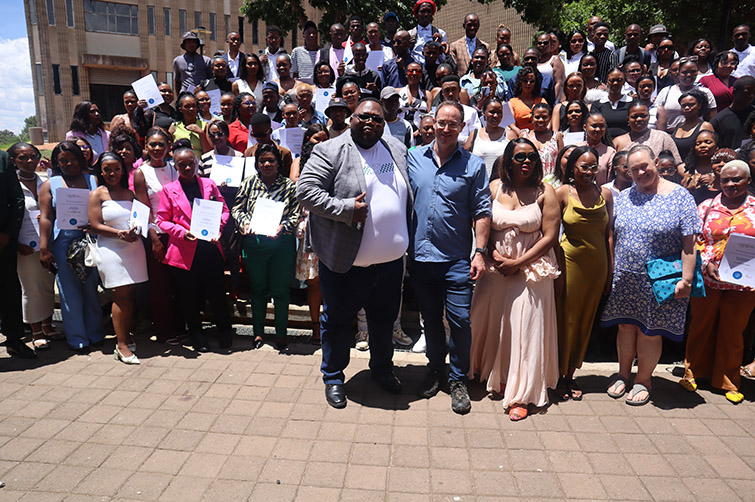 Participants and student facilitators of the UFS Information Technology Service-Learning Programme, which equipped 450 community members with essential digital skills; this marks a significant milestone in community-driven digital empowerment.
The University of the Free State’s (UFS) Information Technology Service-Learning (ITSL) Programme has reached a significant milestone, doubling its impact in 2025 by equipping 450 community members with essential digital skills. This achievement reflects the programme’s steady growth and its commitment to meaningful, sustainable community engagement.
According to Dr Rouxan Fouché, Lecturer in Computer Science and Informatics and programme owner, the milestone is particularly significant for a programme that has been running since 2012. “Training 450 community members – double what we achieved last year – shows that our community-driven model is working and that we’ve built the partnerships and capacity to scale responsibly,” he says. More importantly, the programme has expanded access to computer literacy for individuals in marginalised communities, improving their ability to seek employment.
Addressing barriers to employment through digital skills
The ITSL Programme was established to address a critical barrier to employment – limited access to digital skills. Many job seekers are unable to apply for work because they lack basic computer knowledge, such as creating a CV, using email, or navigating online platforms.
Through free training in MS Word, MS Excel, and foundational digital skills, the programme equips unemployed community members with practical competencies needed in today’s job market. The 10-week programme runs every Friday and includes all training materials and UFS-issued certificates at no cost to participants.
Partnerships and innovation driving expanded reach
To overcome logistical and safety challenges in rural areas, the programme introduced recorded video lessons for the Botshabelo cohort. Delivered at the loveLife Youth Development Centre and facilitated on site, this model has enabled broader reach while maintaining quality training.
Transformative learning for students and communities
The programme has also had a transformative impact on students. As part of the service-learning component, students prepare and present lessons, assist during practical sessions, and engage directly with community members. “They learn to communicate complex concepts to people with no prior computer experience,” says Dr Fouché, noting that the experience fosters empathy, leadership, and social awareness.
Beyond individual outcomes, the programme has sparked a ripple effect within communities. Graduates are using their skills to support others with CV writing, online job applications, and basic digital assistance. Research shows that many participants continue using their skills long after completing the programme, with improved employment outcomes.
Building a sustainable, community-driven future
Looking ahead, plans include expanding the curriculum to introduce basic Python programming and strengthening partnerships to ensure long-term sustainability. Reflecting on the programme’s broader value, Dr Fouché emphasises that “service-learning is not charity, it’s partnership”.