14 July 2026
|
Story Palesa Rantamo
|
Photo Kaleidoscope Studios
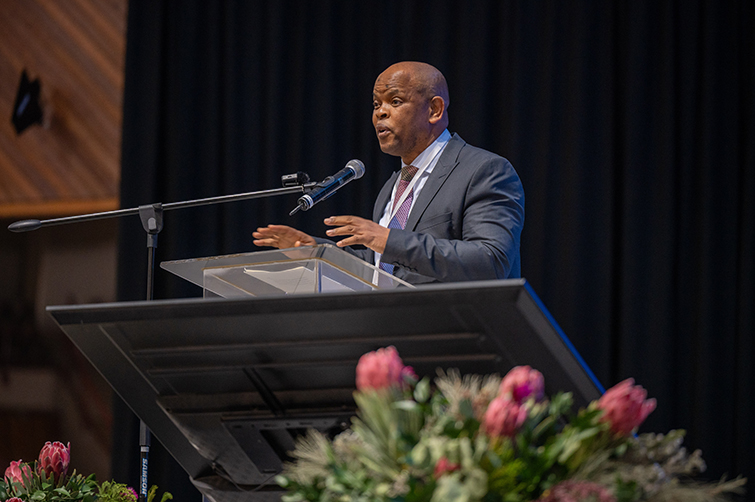 Max Boqwana, Chief Executive Officer of the Thabo Mbeki Foundation, encourages students to pursue education in service of their communities and the African continent.
Higher education leaders, government representatives, student affairs practitioners and student leaders used the second day of the
Global Student Well-being Summit at the University of the Free State (UFS) to call for a decisive shift from policy to practice, emphasising that academic success cannot be separated from students' well-being, safety and dignity.
Hosted by the UFS Division of Student Affairs, Sport and Arts and Culture under the theme, Leaving No Student Behind: Towards Inclusive Pathways for Student Well-being, the summit continued to serve as a platform for meaningful dialogue on creating inclusive learning environments where every student has the opportunity to succeed and thrive.
Students are leaders of today
Opening the day's proceedings, UFS Institutional Student Representative Council (ISRC) President-General,
Esona Radebe, challenged students to recognise their role as active agents of change within higher education and society.
"A lot of people may look at this gathering and see universities coming together for a conversation. I see African giants, formerly known as students, who are here to shape the future."
Encouraging delegates to engage meaningfully throughout the summit, Radebe reminded student leaders that leadership begins in the present.
"We are not future leaders; we are leaders of today, right here and right now."
Student well-being is central to institutional success
"What began as an institutional initiative has grown into an important national and even international conversation," he said, congratulating the UFS and its Division of Student Affairs, Sport and Arts and Culture for establishing a platform that continues to influence the student affairs sector.
September noted that although enrolment figures, graduation rates and research outputs remain important indicators, they are no longer sufficient measures of institutional success.
"Student well-being is no longer a peripheral concern, but central to the future of higher education."
He added that universities must prepare graduates who are resilient, adaptable and socially conscious.
"Student success cannot simply mean obtaining a qualification. It must also mean developing graduates who are resilient, adaptable, socially conscious, and capable of navigating uncertainty with confidence and purpose."
Universities must foster dignity, belonging and service
During the morning's breakaway session,
Mooketsi 'Pop' Motsisi, Chairperson of the Investment Committe of the Sishen Iron Ore Community Development Trust and Director on the Board of Airlink, reflected on the ethical responsibility universities have towards students. He argued that institutions should be places where every student experiences dignity, belonging and safety.
He highlighted the growing challenges confronting students, including financial hardship, discrimination, violence, cyberbullying and inadequate accommodation, and called for institutional responses that prioritise prevention, inclusion and care.
Max Boqwana, Chief Executive Officer of the
Thabo Mbeki Foundation, challenged students to view higher education as a means of serving society rather than pursuing personal success alone.
He encouraged delegates to use education to rebuild communities and address Africa's development challenges.
"Your task now is to acquire knowledge and develop the capacity to generate independent knowledge. None of this must be done for selfish ends."
Drawing on the story of Tanzanian Olympic marathon runner John Stephen Akhwari, Boqwana encouraged students to persevere despite adversity.
"They sent me here not to start the race, but to finish it."
From inclusion to institutional action
Introducing the keynote address,
Pholla Samkezi Mbalane, Deputy Director: Institutional Student Governance Office, reflected on the transformative role universities play in society.
"The university is never simply a collection of lecture halls, libraries and laboratories. It is every society's great institution. It is in this place where knowledge becomes service, ideas become action, and young people are prepared not only to learn, but to shape the future of their society."
Delivering the keynote address, Dr Nomusa Dube-Ncube, Deputy Minister of Higher Education, challenged universities to confront the inequalities that continue to prevent many students from reaching their full potential.
"Leaving no student behind also means being honest about who gets left behind. Most often, students carrying the weight of race, gender, disability, socio-economic hardship or the rural-urban divide all at once."
Dr Dube-Ncube called on institutions to make student well-being a guiding principle for policies, budgets and programmes, emphasising that safe accommodation, accessible mental health support and inclusive learning environments are fundamental to student success.
"A student left behind anywhere in the system is a wound on all of us."
Dr Dube-Ncube also highlighted government's efforts to strengthen student accommodation, expand mental health interventions through Higher Health and improve access to higher education, while calling on universities, government and partners to work collectively to remove barriers to student success.
Addressing students directly, Dr Dube-Ncube concluded:
"Do not wait for permission to excel. Be the first in your family. Be the best in your generation."
Turning dialogue into lasting change
Throughout the day's discussions, delegates explored practical strategies for strengthening student support services, promoting mental health and well-being, encouraging responsible financial behaviour, advancing inclusive institutional cultures and preparing graduates for an increasingly complex world.
A recurring theme throughout the summit was that student well-being is not solely the responsibility of student affairs divisions. Instead, it requires a coordinated institutional commitment involving university leadership, academic and professional support staff, government, student leaders and civil society.
As the summit progressed, delegates reaffirmed the importance of moving beyond dialogue to sustained action, ensuring that higher education institutions create environments in which every student is empowered to learn, develop and succeed, leaving no student behind.