29 June 2026
|
Story Leonie Bolleurs
|
Photo Supplied
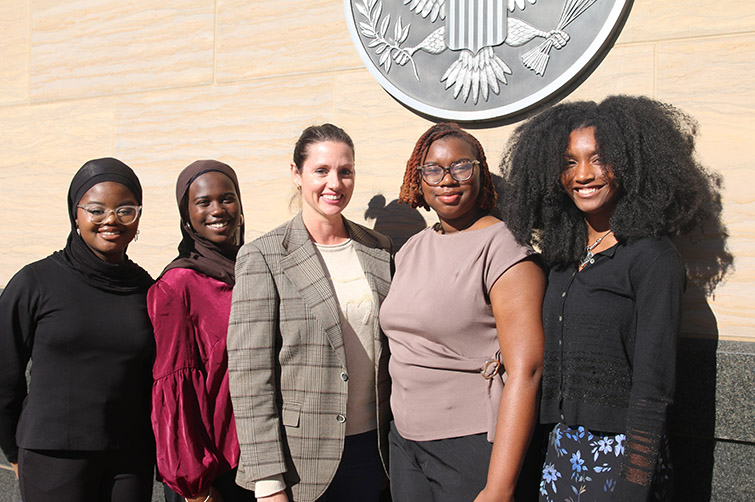 University of Virginia students participated in workshops on community-based participatory research and health communication on the UFS Qwaqwa Campus, exploring how local knowledge can contribute to healthcare solutions. Here they are pictured with Dr Anke van der Merwe (centre).
A healthcare professional may spend years mastering diagnosis, treatment, and clinical procedures. Yet some of the most important moments in healthcare begin with a conversation. A patient’s understanding of a diagnosis, a family’s ability to make informed decisions, or a community’s willingness to engage with healthcare services often depends on communication. Well designed campaigns extend these conversations into the public sphere by raising awareness, building trust, and empowering people to take ownership of their health.
Recognising the importance of these skills, the University of the Free State (UFS) recently welcomed four students from the University of Virginia (UVA) in the United States as part of the InterSciComm Internship Programme – an initiative that combines healthcare communication, research, intercultural learning, and community engagement.
Rather than focusing only on technical skills, the programme places equal emphasis on preparing graduates who understand their broader role in society. Dr Van der Merwe explained: "The InterSciComm programme reflects the UFS’ commitment to developing graduates who are not only competent professionals, but also socially conscious citizens. By engaging with healthcare challenges across different contexts and communities, students learn to communicate with empathy, appreciate diverse perspectives, and recognise their responsibility in advancing social justice and health equity."
Bonolo Makhalemele from the Directorate for International Partnerships and Relations agrees with Dr Van der Merwe. She commented that the programme was intentionally designed to provide a holistic experience that extended beyond the classroom.
The programme was designed on the basis that communication is central to effective healthcare. In multilingual and socio-economically diverse environments, the ability to communicate complex health information in ways that are accessible, culturally relevant, and meaningful can influence health outcomes and patient experiences.
Throughout their visit, the UVA students participated in a range of academic and experiential learning activities. They attended workshops, engaged with researchers, contributed to qualitative research processes, and explored how communication could support healthcare delivery across different contexts.
Their academic programme included engagements with the Department of Optometry, where they attended a public health lecture alongside UFS students, the Department of Dietetics, where they learned about food security initiatives, and the Next Generation Sequencing Unit, where they were taken on a tour of the facility, gaining insight into the innovative health-related research being conducted at the UFS.
On the Qwaqwa Campus, students participated in workshops presented by
Prof Diana Breshears and
Prof Grey Magaiza, both of whom challenged participants to think differently about health communication and community engagement.
Prof Breshears focused on health and development communication. "The focus of the workshop was to engage the students on ways to use effective science communication to create culture-centred health campaigns," she said.
Prof Magaiza introduced students to community-based participatory research from a Global South perspective, encouraging them to view communities as partners in knowledge creation rather than passive recipients of interventions. "The workshop demonstrated that communities possess valuable indigenous and experiential knowledge critical to understanding health challenges and designing contextually relevant responses," he explained.
Prof Jared McDonald, Assistant Dean in the Faculty of The Humanities on the UFS Qwaqwa Campus, shares his colleagues’ views that interdisciplinary initiatives such as the InterSciComm programme play an important role in student development. "Interdisciplinary work such as this has a powerful impact on students’ growth, because it encourages them to think beyond the boundaries of their own disciplines, engage with different perspectives, and develop a deeper understanding of real-world challenges," he said.
The workshops left a lasting impression on the students. Rasheedat Gidado, who is studying Global Health with a minor in Entrepreneurship at the UVA, said, "In Qwaqwa, I learned to respect indigenous knowledge. Communities are experts too, not just outsiders. This journey taught me that respecting knowledge systems and valuing communication are important to building equitable healthcare everywhere.”
Listening and learning from communities has become central to how Global Public Health student Connie Okonkwo views her work. She said, "At the UFS, I saw how healthcare communication directly affects patient outcomes and how bridging scientific language with native languages is crucial. I saw that humility and curiosity are important when engaging communities and not to project assumptions, but to listen and value local knowledge."
Ayah Ibrahim, who studies Global Public Health and Cognitive Science, found that the programme challenged many of her views about healthcare and expertise. "Profs Magaiza and Breshears showed me that indigenous knowledge is clinical knowledge too. Communities are experts, and healthcare must be culturally centred."
“Communication is important, because that’s one way that patients are able to explain all their fears to their providers and know that they will be supported in their treatment plan,” said Asyatou Bah, a first year student on the pre med track. She added, “In Qwaqwa, I was able to understand how to view community in a different way; how to come in and respect different people and respect the community foundations. Experiencing South Africa’s education system for the first time also showed me how community and kindness shape learning.”
Curiosity and commitment to advancing public health
Through the Umoja Buddy Programme, the visiting students engaged with local students and experienced life on campus and within surrounding communities. Historical and cultural visits in and around Phuthaditjhaba, including parts of Lesotho, provided additional opportunities to learn about the region's history, culture, and social context.
According to Makhalemele, the programme reflects the university's commitment to meaningful international engagement. "What stood out most to me during the programme was the cohort's remarkable sense of curiosity and their genuine commitment to advancing public health outcomes for marginalised communities."
She added that initiatives such as these contribute to the university's vision of ensuring that it is globally recognised for its focus on Responsible Societal Futures, using its knowledge, partnerships, and resources to help build a more just, sustainable, and humane society.
“I could not be more grateful to Dr Van der Merwe and colleagues in the Directorate for International Partnerships and Relations at the UFS, and the Associate Director of the Centre for Global Health Equity,
Amber Steen, for creating such a deeply engaging opportunity for both of our university communities. We are committed to growing the partnership,” reflected
Dr Scott Heysell, Director of the Centre for Global Health Equity and Professor of Medicine.
The lessons the four students learned, including the value of listening, the importance of cultural understanding, and the role communities play in creating solutions to complex health challenges, will remain relevant long after the programme has ended. Working in hospitals, clinics, research institutions, or communities, these future healthcare professionals will carry forward a deeper understanding that effective healthcare begins with understanding people.