11 June 2026
|
Story Nthabeleng Seleteng
|
Photo Supplied
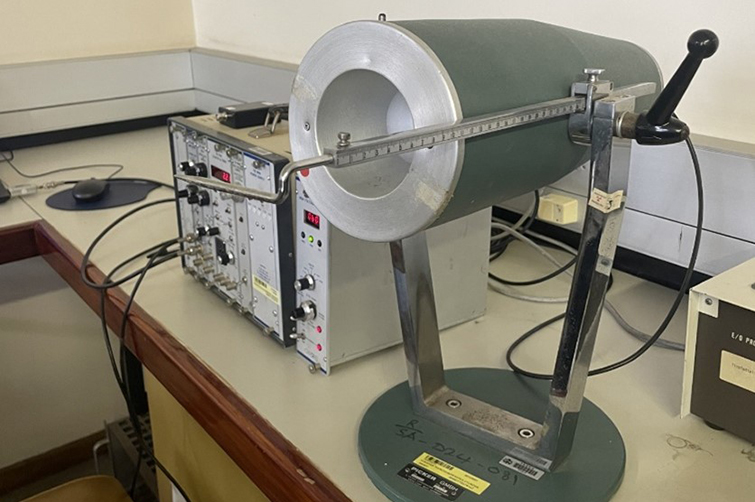 A closer view of the thyroid dosimetry system used for safe and accurate thyroid function measurement.
The Faculty of Health Sciences at the University of the Free State (UFS) has acquired a new treatment system for thyroid disorders that will help ensure that every patient receives a dose tailored to their thyroid, improving outcome predictability while reducing unnecessary radiation exposure.
The thyroid is a small gland in the neck that produces hormones that help regulate the body's metabolism, energy levels, heart rate, and other essential functions. When thyroid disorders occur, the patient’s energy levels, heart health, and overall well-being can be negatively impacted. Some patients can be treated with radioactive iodine, a therapy that targets thyroid tissue while limiting effects on the rest of the body.
To improve the accuracy of treatment for these patients, the Faculty of Health Sciences recently acquired a new thyroid dosimetry system. Thyroid dosimetry is the process of measuring how much radioactive iodine a patient’s thyroid absorbs and calculating the radiation dose delivered to the gland. The new system strengthens thyroid dosimetry capacity, teaching, training and research in medical physics and nuclear medicine at the UFS.
“The newly acquired thyroid dosimetry system allows clinicians to determine the amount of radioactive iodine each patient needs, ensuring treatment that is effective, personalised, and aligned with modern best practice,” Dr Van Staden explained.
Boost for accurate individual treatment
The new system does not replace traditional treatment methods. Instead, it allows the treatment activity to be calculated accurately for individual patients.
“Without dosimetry, two patients with the same diagnosis could receive the same amount of radioactive iodine but end up with different radiation doses because of their thyroid size,” Pretorius explained. “That can lead to undertreatment – in which symptoms persist – or overtreatment, which can lead to long-term thyroid underactivity.”
With dosimetry, thyroid uptake, thyroid size, and the required absorbed dose can be considered, allowing for a more personalised treatment approach. “A helpful way to picture this technology is to imagine it as a combined fuel gauge and navigation system,” Dr Van Staden said. “The gauge measures how much ‘fuel’, or radioactive iodine, the thyroid takes up, while the navigation system helps clinicians determine the safest and most effective treatment route.”
From a patient’s perspective, Dr Van Staden and Pretorius explained, the process is simple. The patient receives a very small amount of radioactive iodine, after which a specialised detector measures how much iodine the thyroid absorbs. The thyroid size is also determined, and these parameters are then used to calculate the optimal treatment activity. The procedure is quick and non-invasive and supports a more personalised radioactive iodine treatment by allowing the administered activity to be based on patient-specific measurements rather than a general estimate.
Need for further investment
By supporting accurate dose calculations, the new system can help reduce unnecessary radiation exposure. For the community, this means improved thyroid treatments, more predictable treatment outcomes, fewer repeat treatments, and improved confidence in nuclear medicine services. It can also help address misconceptions that radiation-based procedures can be harmful.
The Faculty of Health Sciences recognised the need to invest in this system to improve treatment accuracy, align clinical practice with international best practice, support innovation in medical physics and nuclear medicine, and strengthen student training and research capacity.
The system aligns with the UFS’ strategic direction, particularly its focus on being an innovative, research-led, student-centred and regionally engaged university. It also supports the University’s emphasis on academic excellence, innovation, impact, and societal benefit.
“For medical staff, the system supports accurate thyroid treatment planning, quality assurance, and enhanced training in nuclear medicine dosimetry. It is also valuable for students, interns, and postgraduate research, as it provides hands-on exposure to patient-specific thyroid treatment planning and clinical measurement principles,” Pretorius said.
Dr Van Staden added that the technology also plays a key role in training medical physics interns, supporting postgraduate research programmes, and developing the skills required for modern nuclear medicine practice. “This helps ensure that graduates are work-ready and internationally competitive. In the long term, it also contributes to improved healthcare by helping to grow a highly skilled local workforce.”