17 March 2026
|
Story André Damons
|
Photo Kaleidoscope Studios
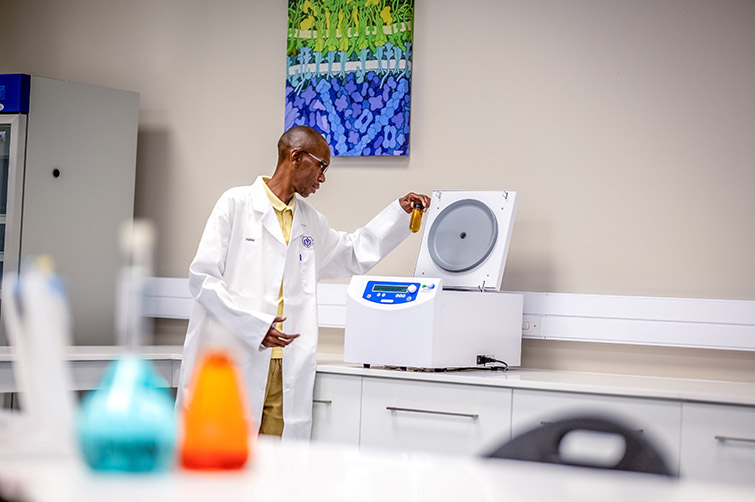 The Faculty of Health Sciences at the University of the Free State (UFS) established a Biobank which is set to strengthen biomedical research in the province while helping train the next generation of clinician-scientists.
For many years, the people of the Free State have been underrepresented in biobanks and biomedical research. One of the goals of the newly established biobank at the University of the Free State (UFS) is to help change this by ensuring that research better reflects the communities it serves.
The Faculty of Health Sciences Biobank is set to strengthen biomedical research in the province while helping train the next generation of clinician-scientists. The initiative, a structured and ethically governed facility that collects, processes, stores, and manages human biological samples, including blood and DNA, is expected to improve the understanding of disease patterns in the Free State and contribute to the development of diagnostics and treatments tailored to local health needs.
According to Dr Claire Barrett, Head of Research and Development in the UFS School of Clinical Medicine, the biobank focuses particularly on longitudinal data and biological samples that are preserved under strict quality and ethical standards to support both current and future research. It is built on strong governance, ethical oversight, and transparency, recognising that participants entrust researchers with something deeply personal.
“By investing in world class research infrastructure such as the UFS Biobank, we are strengthening biomedical innovation while developing the next generation of clinician scientists and researchers,” says Prof Vasu Reddy, UFS Deputy Vice-Chancellor: Research, Innovation and Postgraduate Studies.
Supporting research projects
“At the heart of the biobank are the people of the Free State who choose to contribute their samples for research. Their generosity makes discovery possible and creates opportunities to improve health for future generations. In many ways, the biobank reflects the spirit of Ubuntu – the understanding that progress is achieved together.
“Research should never be done about communities without their involvement and partnership. The knowledge generated from the biobank is therefore not only for science, but for the people of the Free State, whose participation makes it possible. The biobank creates a bridge between the public and scientists,” says Dr Barrett.
For Prof Reddy the biobank creates an important bridge between science and society – linking biological samples with clinical data to produce research that is locally relevant and globally significant.
Dr Barrett explains that biological material donated voluntarily is preserved safely and used to advance scientific knowledge, improve diagnosis, and support the development of better treatments. The facility supports research projects within the Faculty of Health Sciences as well as collaborations with national and international partners. Current research interests include nutrition and health, as well as chronic lifestyle-related diseases such as obesity, type 2 diabetes, hypertension, cardiovascular and cerebrovascular disease, dyslipidaemia, and chronic respiratory conditions. The state-of-the-art biobank will also contribute to studies of complex non-communicable diseases that involve interactions between genetics, immunity, and environmental factors.
In addition, the platform will support oncology research, particularly molecular and epidemiological studies. Other areas include genetic and molecular research on disease, population health and biomarker discovery, population data science, genomic and precision medicine, and modelling of disease pathways and risk. “By linking biological samples with clinical information, researchers can investigate disease mechanisms, identify biomarkers, and explore new approaches to diagnosis and treatment.”
Improving representation in research
Dr Barrett explains that biobanks are increasingly recognised as essential infrastructure for modern biomedical research. Collecting biological samples can be costly and difficult, but systematic and responsible storage ensures that valuable materials can be used to answer multiple research questions over time.
The research platform aligns with the university’s broader strategic goals of academic excellence and impact. By providing specialised research infrastructure, the biobank enables innovative, high-quality studies across disciplines and contributes to meaningful scientific outputs. Biobanks also play a key role in international collaboration. Established in 2025, the biobank will allow researchers to participate in global research networks while ensuring that African populations are better represented in scientific discovery.
Historically, biological samples collected for research were often stored in individual laboratories with varying standards of documentation, storage, and governance. A centralised biobank introduces standardised collection and storage procedures, ethical governance structures, long-term preservation of samples, and controlled access for ethically approved research.
“This improves research quality and ensures that samples donated by participants are used responsibly and to their full scientific potential. The biobank’s goals include ensuring that the people of the Free State are represented in biomedical research, providing high-quality infrastructure for biomedical studies, and promoting the ethical use of human biological samples. It will also strengthen interdisciplinary collaboration and research capacity within the faculty and beyond,” she says.
A vision for the future
Looking ahead, Dr Barrett says the long-term vision is to establish the UFS Biobank as a recognised research platform supporting both local and international collaboration. This would enable large-scale studies on diseases affecting South Africans, while also contributing to postgraduate training and research capacity development. Ultimately, the initiative aims to contribute to improved diagnostics, prevention strategies, and treatments.
“When African institutions lead collaborative, high quality research platforms, we advance not only scientific excellence, but also equity in global knowledge production,” observes Prof Reddy.
Acknowledgements
Although the biobank project was led by Dr Barrett, its development reflects a broader Faculty of Health Sciences initiative. The project received strong institutional support from the Head of the School of Clinical Medicine, Prof Nicholas Pearce, and the Head of the
School of Pathology, Prof Jaco Joubert. Key collaboration from Dr Anneke van Marle and Dr Jean Kloppers from the School of Pathology was also instrumental in establishing the biobank. Dr Barrett notes that while she led the project, its success depended on the collective support of the university and faculty leadership, colleagues, and Prof Deliwe Phetlhu, Dean of the Faculty of Health Sciences.