02 March 2026
|
Story Tshepo Tsotetsi
|
Photo Tshepo Tsotetsi
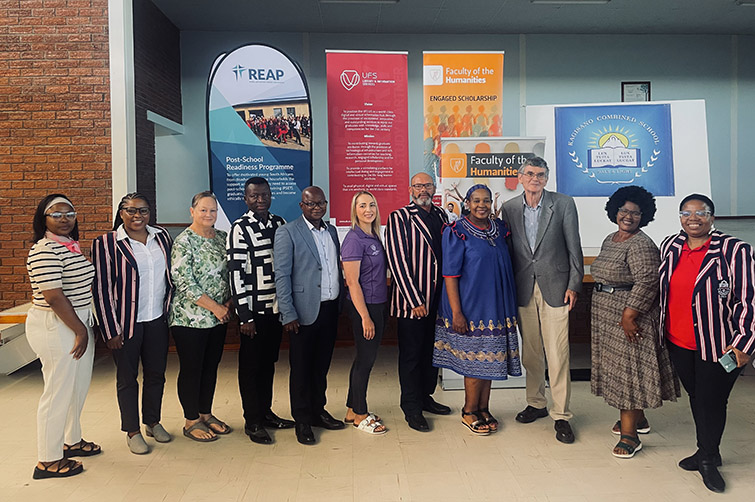 The University of the Free State, SALI Trust, and local teachers came together to strengthen reading literacy among Grade 4 pupils in Soutpan.
When the Faculty of the Humanities at the University of the Free State started its community engagement partnership with the community of Ikgomotseng in Soutpan, a town approximately 45 km north-west of Bloemfontein, the intention was clear: contribute meaningfully to local development through evidence-based work.
One of the first projects born from this partnership was the study titled ‘Promoting Reading Literacy Amongst Grade 4 Learners in Soutpan, Lejweleputswa District Municipality in the Free State: A Community Library Case’, which set out to understand the literacy challenges pupils face and identify ways to strengthen reading development in the community.
According to the latest findings of the Progress in International Reading Literacy Study, 81% of South African Grade 4 children cannot read for meaning. This is a statistic that signals more than academic difficulty. At this stage of schooling, comprehension becomes the foundation for every subject that follows. Without it, progression through the education system becomes increasingly fragile.
At Kagisano Combined School in Ikgomotseng, those national concerns are reflected in daily classroom realities. Last week, the UFS presented findings from a study launched in 2023 to determine the reading literacy levels of the school’s Grade 4 pupils and to identify the factors shaping their development. The research was a collaboration between the Faculty of the Humanities and the university’s Library and Information Services, ensuring a coordinated approach to both research and community engagement.
Inside the challenges and realities of reading literacy in Soutpan
Dr Rosaline Sebolao, Project Leader and Teaching and Learning Manager in the Faculty of the Humanities, explained that the research was a deliberate first step before introducing any empowerment initiatives.
“We realised that, for us to initiate some empowerment programmes, we need to conduct research to base our decisions on,” she said. “This was also informed by the national research that indicates the challenge of reading literacy among Grade 4 pupils.”
The study sought to establish pupils’ literacy levels, explore how the community library could strengthen a reading culture, introduce innovative pedagogical approaches, and equip parents and other stakeholders with skills to better support reading development. Promoting the use and development of African languages also formed part of the broader objectives.
The findings confirmed a significant challenge. “Pupils are really struggling to read for comprehension,” Dr Sebolao said. “Only a few of the pupils could read with understanding and were able to relate the story they read.”
For Acting Deputy Principal Babalwa Mlonyeni, the research articulated what teachers confront daily. “A lot of our pupils cannot read to understand, and that affects performance across subjects,” she said. “We also see limited parental involvement when it comes to reading support at home.”
The research further identified limited family engagement and underutilisation of available literacy resources – including the community library – as key contributing factors. While support structures are present within the community, they are not consistently embedded in pupils’ routines or reinforced at home.
Keselepile Speelman, parent of a school pupil, acknowledged the shared responsibility between school and family. “Parents play a very important role in bettering education and making sure children receive proper support at school and at home,” she said. “Support from universities, schools, and departments can help change the future of our children.”
Sustained access to reading materials remains central to that effort. John van Niekerk, administrator and trustee of the South African Library and Information Trust (SALI Trust), which funded the research, emphasised the long-term implications of early literacy investment. “It is crucial for children to have access to school and community libraries, so they are exposed to reading from an early age,” he said. “Investing in education at a young age gives them a stronger foundation for life.”
With the findings now presented to the school and broader community, the project moves into an implementation phase. Plans include establishing a literacy committee comprising school representatives, community stakeholders, and partners such as the Letsatsi Trust and the Rural Education Access Programme. Reading clubs for pupils and parents will be introduced, spelling bee competitions strengthened, and the school library, established in partnership with the university in 2024, more actively utilised.
Dr Sebolao underscored that the work does not conclude with the presentation of results. “As the University of the Free State, we see this as living the vision of being innovative and research-led in contributing to the development of our communities,” she said.
In Soutpan, the reading crisis is no longer described only through national statistics. It is now documented through local research, shaped by community voices, and positioned for collective action.