13 May 2026
|
Story Christelle du Toit
|
Photo Kaleidoscope Studios
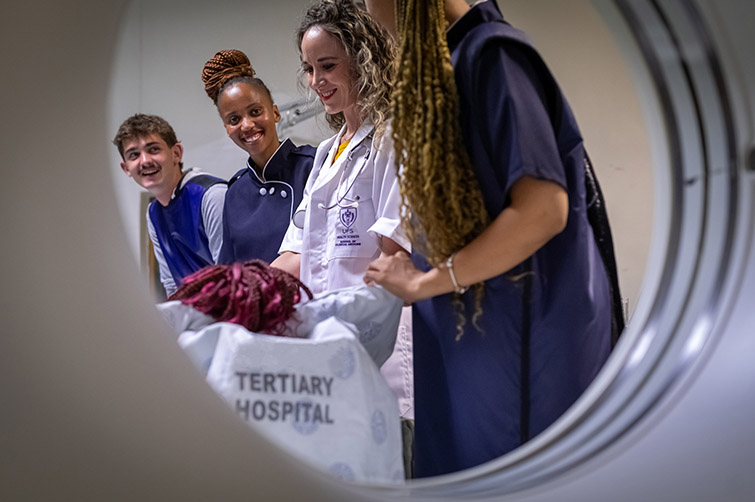 South Africa’s nursing crisis is not only about numbers. It is also about leadership, according to the University of the Free State (UFS) Vice-Chancellor and Principal, Prof Hester C. Klopper.
South Africa’s nursing crisis is not only about numbers. It is also about leadership, according to the University of the Free State (UFS) Vice-Chancellor and Principal, Prof Hester C. Klopper.
Speaking during the Nursing Education Association’s (NEA) webinar on Continuous Professional Development on Monday 11 May, held ahead of International Nurses Day, Prof Klopper challenged nursing educators to rethink how future nurses are prepared for increasingly complex health-care environments.
“We do not only have a shortage of nurses,” she said. “We have a shortage of nursing leaders.”
Drawing on her own journey from clinical nursing to academic leadership, Prof Klopper described nursing educators as ‘architects of the future’ whose influence extends far beyond lecture halls and simulation labs.
“The nursing educator is not just a teacher,” she said. “The nursing educator is an architect of the future. What we build – or fail to build – ripples out to wards, clinics, and operating theatres for decades to come.”
Her address focused on the growing need for nurses who can lead teams, navigate ethical complexity, advocate for patients, and strengthen health-care systems under pressure.
Prof Klopper noted that global health systems are facing mounting strain, with the World Health Organisation projecting a worldwide shortfall of 11 million health workers by 2030. South Africa, she said, continues to experience severe shortages across nursing categories.
Against this backdrop, she argued that leadership development can no longer be treated as optional in nursing education.
Leadership beyond the hospital ward
“At the University of the Free State, we believe that leadership development belongs in the curriculum from year one,” she said.
The address also highlighted the role of the UFS Faculty of Health Sciences in preparing graduates who are clinically skilled, socially accountable, and equipped to work in diverse communities.
Prof Klopper pointed to the university’s investment in high-fidelity simulation environments and standardised patient training spaces as part of a broader commitment to future-focused health sciences education.
“The safest place for a student to develop leadership judgement is before real patients are involved,” she said.
Much of the discussion centred on the human dimensions of health-care leadership. Prof Klopper encouraged educators to create environments where students feel confident enough to ask difficult questions, reflect critically, and learn from mistakes without fear of humiliation.
“The student who asks an inconvenient question in your classroom may one day ask an inconvenient question that saves a life,” she said.
She also called for stronger mentorship cultures within nursing education, arguing that educators play a formative role not only in developing technical competence, but also in shaping confidence, resilience, and professional identity.
“Your story is one of the most powerful teaching tools you have,” she told attendees. “Use it.”
Throughout the address, Prof Klopper linked nursing leadership to the UFS vision of contributing meaningfully to responsible societal futures. She argued that health-care education must remain grounded in ethics, care, and human dignity, even as technologies such as artificial intelligence continue to reshape the sector.
“Our task as educators is not to protect students from that reality, but to prepare them to lead within it,” she said.
In closing, she reflected on the long-term influence of educators whose impact is often only seen years later in the lives and careers of their students.
“You are not just teaching nursing,” she told nursing educators attending the webinar. “You are building the leadership infrastructure of the South African health system.