09 December 2025
|
Story Lunga Luthuli
|
Photo Supplied
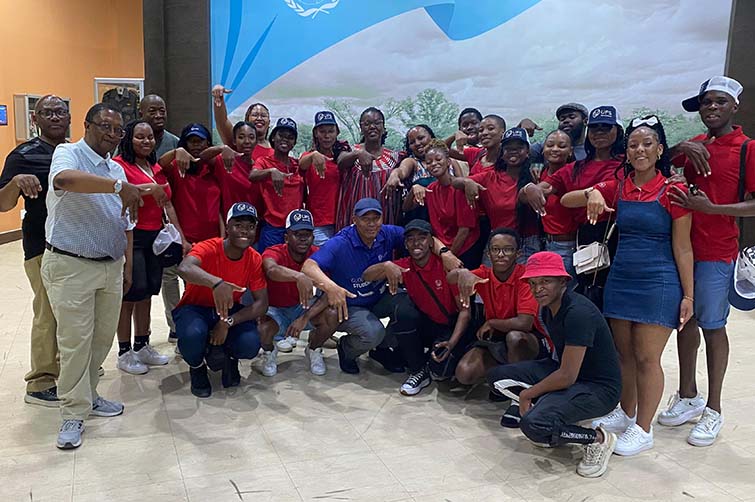 UFS student leaders and university executives during the Global Citizenship Programme trip, strengthening partnerships and demonstrating the university’s commitment to African-centred global engagement.
The University of the Free State’s
Division of Student Affairs, Sport, Arts and Culture (DSA-SAC) continues to advance an African-centred global agenda. From 28 November, the division led a cohort of student leaders on a regional engagement trip to Namibia and Botswana as part of the Global Citizenship Programme – an initiative that blends academic enrichment, cultural immersion, and strategic continental partnerships.
Launched in 2024, in collaboration with the University of Zambia, the programme is expanding through partnerships with universities across Africa. Its aim is to cultivate global citizenship among UFS students by equipping them with skills and perspectives needed to excel in international contexts, foster meaningful impact, and engage with best practices in student support and student welfare.
Dr Temba Hlasho, Executive Director of the Division of Student Affairs, Sports, Arts and Culture, emphasised the programme’s strategic value: “The Global Citizenship Programme strengthens our commitment to developing well-rounded, globally aware students. Through the Namibia and Botswana engagements, we advance UFS Vision 130 by exposing students to international best practices that shape them into responsible global citizens.”
Deepening academic and cultural engagement in Namibia
The programme began in Windhoek, where the delegation received an official welcome from the Vice-Chancellor of the University of Namibia (UNAM),
Prof Kenneth Matengu, and senior leadership. This engagement set the tone for a series of academic, cultural, and institutional exchanges.
Students visited UNAM’s
Neudamm Campus, where they interacted with experts in Agriculture, Veterinary Science, and Food Science. These engagements offered first-hand insight into Namibia’s academic innovations and key areas of scholarly focus.
The itinerary also highlighted Namibia’s cultural and historical richness. A visit to the National Museum of Namibia deepened students’ understanding of the country’s heritage and national narratives, while the Hage Geingob Centre provided valuable perspectives on national leadership, democracy, and political development.
A central component of the trip was the student affairs exchange between UFS and UNAM. Presentations by the UNAM Counselling Centre, Disability and Clinic Services, Career Services, and Sports Facilities provided UFS students with an understanding of the support systems that underpin student success at a partner institution.
The group also explored the UNAM Entrepreneurship Hub, faculty spaces, and library facilities. These experiences broadened students’ appreciation of diverse academic ecosystems and strengthened their understanding of what it means to be an active global citizen.
Continental alignment through higher education networks
The Namibia visit coincided with the broader UFS engagements on the continent. While UFS students were immersed in regional collaboration activities, UFS Vice-Chancellor and Principal, Prof Hester C. Klopper, addressed higher education leaders at the 21st
RUFORUM Annual General Meeting in Botswana.
Speaking at the REFORUM AGM, Prof Klopper highlighted the importance of closing the gap between research and societal impact, promoting innovation-driven programmes, and strengthening Africa’s higher education networks - principles closely aligned with the vision of the Global Citizenship Programme.
The alignment between institutional leadership and student-focused initiatives reflects the university’s commitment to preparing graduates who are academically capable, socially responsible, collaborative, and attuned to the developmental priorities of the African continent.