11 December 2025
|
Story Martinette Brits
|
Photo Kaleidoscope Studios
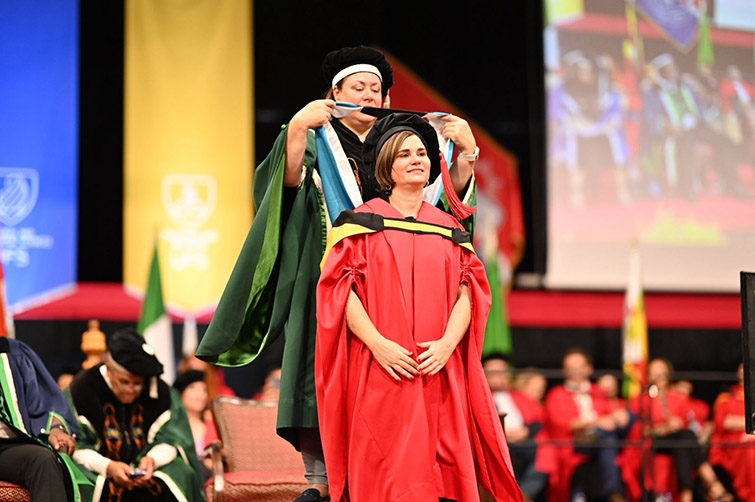 Dr Mariëtte van Straaten – graduating with her PhD after a journey marked by illness, courage, and deep dedication to the social work profession.
When
Dr Mariëtte van Straaten thinks back to her childhood, one moment quietly rises to the surface: sitting with a book in Grade 1, struggling to read a story that her three-year-old sister could already recite from memory. It was then that she began to understand that learning would never come easy to her. She was dyslexic, and words would always require more effort, more patience, more persistence.
“Already in Grade 1 (Sub A), when my mom had to help me read the prescribed book Koeloe kan nie vlieg nie, want hy weet nie hoe nie, my three-year-old sister was citing the book, while I still could not read it sufficiently.”
Her early years were shaped by quiet, steady support. “My mother assisted me with my reading and learning in primary school. In high school, I was fortunate to have my grandfather, Mr Underhay – a maths and science teacher – to assist me.”
Her father gave her a phrase that would follow her throughout her life. “My dad always said, ‘Your best is not good enough’, leading to encouragement, so that I tried harder to do better.”
No one could have predicted that the child who struggled through her first reader would one day write a doctoral thesis during a global pandemic, holding onto her research through illness, exhaustion, and uncertainty, to walk the graduation stage on Thursday 11 December to obtain her PhD in
Disaster Management from the University of the Free State – a title she once never imagined possible.
A doctorate written through exhaustion
By 2020, Dr Van Straaten was working as a school social worker, taking learners for COVID-19 testing while living with co-morbidities herself. She contracted the virus twice. Her recovery was slow and difficult.
“The most challenging was the post-COVID fatigue and exhaustion. You know you need to focus on your studies, but your body and brain are not cooperating.”
Her doctoral journey stretched across hospitalisations, frontline work, and long nights of emotional labour. “Many times, I wanted to give up. Being a social worker, I do assessments with children who have been sexually abused. I felt that I could have said no, as I did not have time to complete assessments and focus on my research. My promoters, Prof Alice Ncube and Prof Christo Heunis, kept me going. Setting deadlines and motivating conference attendance.”
Her home became a landscape that reflected both chaos and determination. “My workspace during the ‘lockdown’ consisted of towering piles of books, academic articles, and countless red-inked documents returning from my promotors.”
She worked between two study spaces – one at her parents’ home and one in her living room – always accompanied by a quiet companion. “It was a space shared with my cat, Jenny, who sat with me for hours during the journey.”
The hardest days were unforgettable. “Papers and documents with little cat paws on them filled my whole living room. Empty coffee mugs, and my dad asking, ‘Are you done yet?’”
Still, she kept going.
Seeing the gaps, shaping a framework
Before the pandemic, she hoped to study the role of social workers in disasters. COVID-19 turned that hope into necessity.
“The COVID-19 disaster actually sharpened my focus. I wanted to conduct research on the role of social workers during disasters, but I was unsure how to frame it. Then, when COVID-19 was declared a disaster and the list of essential service providers was released, social workers were not included. However, psychosocial issues, such as GBVF, child abuse, food insecurities, housing, etc., have increased.”
Her interviews exposed the emotional burden carried by those working on the ground. “I believe the whole journey was emotional, especially the interviews. The participants did their best to render good services. I recall one person mentioning how difficult it was in the hospital. The patient was dying and could not even have visitors. The participant spent time with the patients to render support.”
She learned that social workers often have a far greater impact than the public realises. “Social workers provide services that adhere to various legislation and guidelines; however, they may not always be familiar with the specific names of these laws or guidelines. Furthermore, social workers can make a bigger impact. Usually, we work ‘undercover’ on a small scale. However, social workers can be part of multidisciplinary teams to have a whole-system approach.”
From this, her doctoral contribution – the Integrated Disaster Risk Reduction Social Work (IDRRSW) Framework – took shape. It offers practical guidance for strengthening mental health and psychosocial support (MHPSS) during disasters. She takes quiet pride in how she built it. “One, I am proud that I have been able to master Excel to make the dropdown lists. I did not have the finances to outsource the data analysis and development of the framework.”
The framework also found a place in her teaching. “I utilised the framework in my DIMP class to help my postgraduate students understand ecological systems theory, and it seems that they grasped it more easily than in the past.”
Anchors, mentors, and faith
Throughout her journey, she was surrounded by a circle of support she refers to as her anchors. “My parents, Chris and Carine van Straaten, and my sister, Tania van Straaten, whom I dedicated my thesis to as ‘My Anchors’.”
She explains what this meant in practice. “My father always encouraged me by saying, ‘Your best is not good enough,’ pushing me to try harder. My mother and sister – bringing coffee and motivating me to work.”
Her cat was more than just a pet; she was a presence. “I must also acknowledge my cat, Jenny, who sat with me for hours during my PhD journey.”
Her academic community carried her too. “My supervisors, Prof Alice Ncube, Prof Christo Heunis, and Prof Joerg Szarzynski, were instrumental in their guidance, advice, patience, and faith in me.”
And she was not alone among colleagues. “My colleague, Dr Merlene Esau in the Department of Social Work. She shared her PhD journey with me and pushed me to finish.”
At the heart of her perseverance was her faith. “I can do anything through Christ, who gives me the strength.”
A message from someone who has lived it
Today, Dr Van Straaten’s work spans teaching, clinical practice, training, and leadership. She threads her roles together with purpose. “I am a social worker. You cannot separate the knowledge and values that you are taught into categories of work and leisure. I weave these roles together to ensure that the knowledge I produce directly improves lives.”
To young people who struggle as she once did, her message is simple and profound. “I want them to know that their challenges do not determine their limits. From struggling to read in Grade 1, spelling ‘bobbejaan’ as ‘doddehaan’, to obtaining a PhD, my journey proves that with perseverance, support, and purpose, we can all rise. Every challenge can be transformed into purpose.”
And to South Africans, she offers a warning and hope. “The neglect of mental health services during the pandemic has contributed to persistent health inequities. We must urgently strengthen mental health and psychosocial support for vulnerable communities and frontline responders.”
Her journey began with a misspelled word. It continues with a doctorate – and a deep commitment to ensuring that in moments of crisis, no one is left to face their challenges alone.