17 December 2025
|
Story Shilpa Parbhu and Precious Shamase
|
Photo Supplied
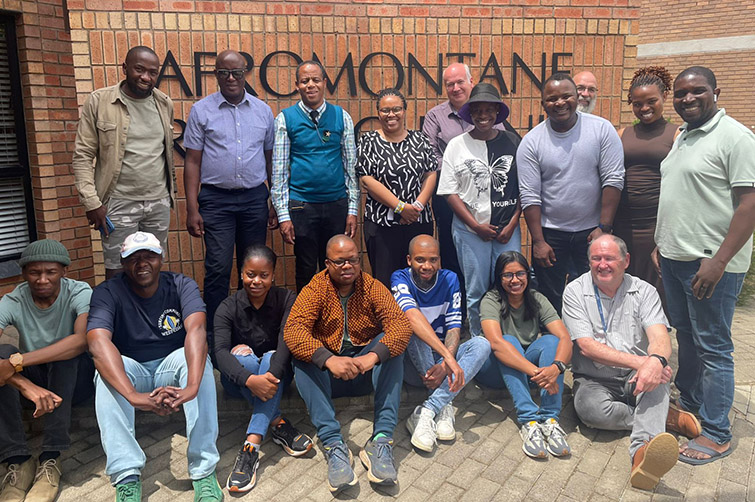 The OHRatSA group on the Qwaqwa Campus with Campus Principal, Prof Prince Ngobeni, and the Campus Vice-Principal: Academic and Research, Prof Cias Tsotetsi.
The University of the Free State (UFS)
Qwaqwa Campus recently served as the focal point for international scientific collaboration, hosting a crucial week-long workshop for the
OHRatSA project.
Held from 24 to 28 November 2025, the event brought together leading experts from the
University of Venda and the University of Greenwich (UK), uniting researchers in a determined effort to address one of the most pervasive challenges facing agriculture – rodent infestation.
Profs
Peter Taylor,
Lourens Swanepoel, and
Steven Belmain – along with their research teams – visited several farms in the region, meeting directly with farmers to understand the real-world challenges they face. Many farm owners spoke about the extensive damage rodents cause to crops, and the high costs of managing these pests year after year.
The researchers introduced an innovative approach that has gained global attention: using contraceptives to humanely and sustainably curb rodent populations. Farmers were briefed on how these fertility-control methods work and how they could form part of a long-term solution. Several promising field sites were also identified as potential locations for pilot studies.
Full-scale field experiments are set to begin in 2026, with teams from all three institutions monitoring progress and deepening collaboration. For local farmers, the project offers hope for a future with fewer rodents – and for South African science, it marks another step towards pioneering pest-management solutions with global relevance.
A collaborative mission
The workshop highlighted a vital partnership, with the OHRatSA project receiving substantial support from the
South African Medical Research Council (SAMRC) and the UK Research and Innovation - Medical Research Council (UKRIMRC). This joint backing highlights the global significance and urgency of the project's goal.
Attendees engaged in intensive discussions, planning sessions, and collaborative work aimed at developing innovative and effective solutions to mitigate the extensive crop damage and disease transmission caused by rodents. The gathering leveraged the diverse expertise of the participating institutions, focusing on translating cutting-edge research into practical applications for farmers and agricultural communities.
Impacting food security
The success of the OHRatSA project holds promise for enhancing food security and public health, particularly in regions heavily affected by agricultural losses due to pests.
The UFS Qwaqwa Campus is proud to have hosted this high-level meeting, reinforcing its commitment to scientific excellence and its role as a key contributor to solutions to pressing societal and environmental issues.
Prof Peter Taylor said, “Our project will use demonstration trials within identified smallholder and commercial farmer communities and food vendors to showcase simple ecologically based real-world solutions to reduce food contamination and the risk of disease transmission by rats, as a much more effective alternative to using harmful pesticides. We are confident that the community we have targeted will benefit from these recommendations,” said Prof Taylor.