20 August 2026
|
Story Andre Damons
|
Photo Stephen Collett
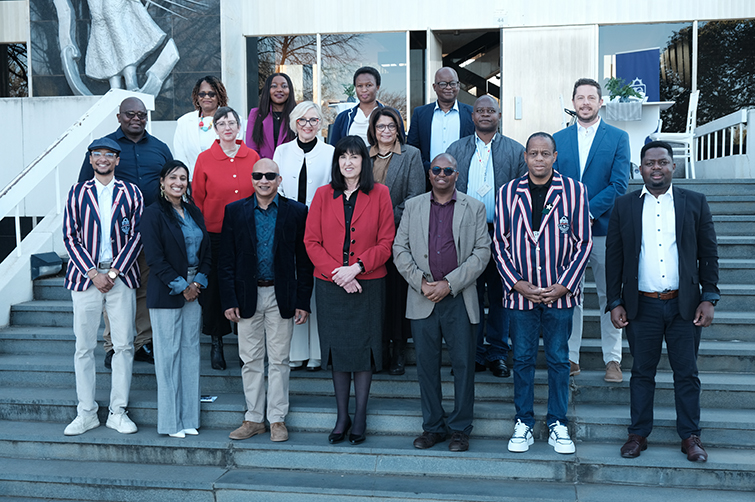 Members of the Local Organising Committee of the MIT Conference with Prof Vasu Reddy, Deputy Vice-Chancellor: Research, Innovation and Postgraduate Studies; (third from the left); Prof Hester C. Klopper, UFS Vice-Chancellor and Principal (in the middle); Prof Anthea Rhoda, Deputy Vice-Chancellor: Academic (third from the right, second row); and Profs Prof Narnia Bohler-Muller (second from the left, second row) and Glenda Gray (third from the left, second row), who both delivered keynote addresses.
No single discipline can provide answers to the challenges facing the world today such as improving health systems, strengthening food security, advancing technology, or responding to climate change. Researchers from different fields need to come together to find solutions for these complex questions.
Prof Vasu Reddy, Deputy Vice-Chancellor: Research, Innovation and Postgraduate Studies, said the purpose of the conference “is to move us beyond isolated expertise towards shared solutions for complex global challenges. It is our commitment to knowledge that is integrated, inclusive, and capable of transforming lives. Collaboration is no longer optional. It is the currency of meaningful impact”.
All disciplines need to make a contribution
In her welcome address, Prof Klopper said this conference responds to a reality that many researchers know well: the most complex questions rarely recognise the boundaries of our disciplines. The challenges do not arrive neatly packaged within a single discipline. They are interconnected, shaped by social, economic, environmental, technological and human factors. This is not an abstract claim; she continued, that the science being celebrated right now makes the point vividly.
“The 2025 Nobel prizes were awarded for work sitting precisely at these intersections: metal-organic frameworks now advancing carbon capture and clean water, quantum phenomena underpinning next-generation computing, and the discovery of regulatory T-cells that reshape how we treat cancer and autoimmune disease. Each of these breakthroughs drew on chemistry, physics, biology and engineering, increasingly working alongside artificial intelligence.
“We are seeing the same pattern closer to the ground: artificial intelligence paired with biology to map disease-causing proteins, with genomics to help interpret the human genome, and with materials and climate science to design more sustainable building materials and better predict extreme weather,” she said.
Prof Klopper said when researchers work together, it deepens the understanding of complex problems and increases the likelihood that the research will make a meaningful contribution. Importantly, creating spaces like this (the conference) for researchers is critical because this is the space where they learn from one another, challenge assumptions, but then build partnerships.
“Our vision is to be an innovative research-led, student-centred, and regionally engaged university that contributes meaningfully to responsible societal futures. That’s the essence of what we want to achieve, and I believe that this conference gives practical expression to our vision.
“If I have to summarise my understanding of Multi-, Inter- and Transdisciplinary, and it is not easy to simplify, I will say Multidisciplinary adds, Interdisciplinary integrates and Transdisciplinary transcends. That is probably the challenge as you engage in this conference to make sense of how we get ourselves to an integration where this university can make a contribution to impactful research, where we challenge the problems, but in a new way, with all the expertise in this room contributing towards solutions.”
Team science
One of the keynote speakers, Prof Glenda Gray, Distinguished Professor and Director, Infectious Diseases and Oncology Research Institute (IDORI), Wits University, made the point about team science. “The lone investigator,” she said, “never makes transformative research as we want, and that it's better to work in a team and collaborate. You share the burden and you also line yourself to do work that you might not have been able to do.”
“One of the biggest aspirations with the work we do is to get to that transdisciplinary area when boundaries are transcended, we co-create the shared framework, and we work with non-academic partners to tackle real-world problems holistically.”
The focus of her address, titled From HIV to COVID-19: Building Transdisciplinary Research Capacity for Pandemic Response in Africa was on sustained investment in transdisciplinary HIV research that created infrastructure, expertise and networks that could be rapidly redirected to COVID-19 in sub-Saharan Africa.
“When COVID hit, the infrastructure was in place and we could easily pivot. We went from the HIV vaccine, working with young women and young people to working with old people.
“I have learned in my earlier work that sustained investment in one epidemic, builds infrastructure for the next. What we as clinicians try to do, is to make sure that the work that we do, even in Soweto, makes global impact and a lot of the work we did at Chris Hani Baragwanath Academic Hospital changed clinical guidelines. It’s important to say even a research trial in Soweto can change the life of someone living in New York,” Prof Gray said.
From flourishing denied to flourishing life: A transdisciplinary Imperative
With her keynote address, Prof Narnia Bohler-Muller, Research Theme Leader: Flourishing Life at the UFS, presented the gap between constitutional promise and lived reality in South Africa, where progressive socio-economic rights jurisprudence coexists with profound inequality.
“Flourishing Denied is the name I have given to a condition I encounter everywhere in my research: in constitutional jurisprudence, in gender studies, in empirical survey data, in the testimony of communities navigating poverty, climate stress, and democratic fragility.
“It is the condition of lives that have the form of rights without the substance of well-being. People who, on paper, live in a constitutional democracy that guarantees dignity, equality, and access to basic services; but who, in lived reality, are denied the conditions under which a uniquely human life can unfold,” she told the audience.
According to Prof Bohler-Muller, the South African context makes this visible with sharpness. “We have one of the most progressive constitutions in the world. We have a Constitutional Court that has, in landmark cases affirmed the justiciability of socio-economic rights, the relational obligations of the state, and the dignity of those most vulnerable.
“And yet ... we have some of the highest rates of inequality on earth. We have communities without water, without adequate shelter, and without safety. We have women whose constitutional personhood is not matched by their material circumstances. We have children whose future is foreclosed before it begins.”
Flourishing Denied, she said, is everything the right promises and the judgment, alone, cannot deliver. Bridging barriers is not an administrative challenge for conference organisers. It is a moral commitment that follows from taking seriously what they are trying to understand.
For Prof Reddy the strongest message from this conference is that knowledge grows when it travels across disciplines, sectors, communities, and continents. The papers and conversations demonstrated that diversity of perspectives is not a barrier to excellence; it is its foundation. “Forging responsible societal futures requires intellectual courage. It requires us to intentionally cross boundaries, challenge assumptions, and co-create knowledge with others. This conference will become an annual feature on the UFS calendar.”