16 April 2026
|
Story Leonie Bolleurs
|
Photo Stephen Collett
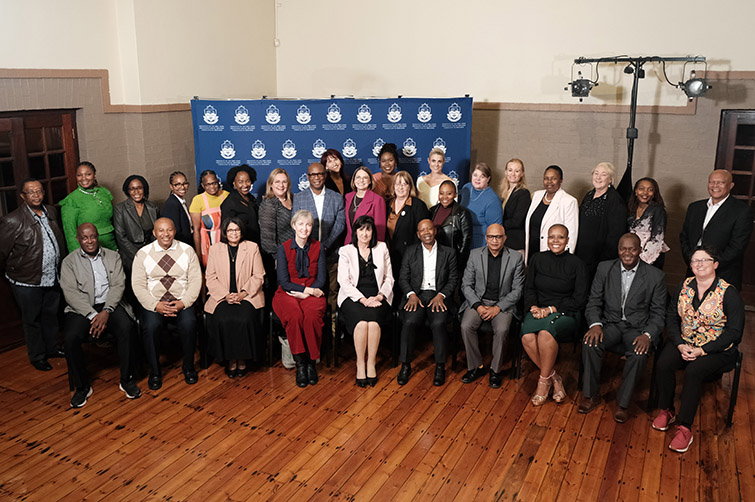 The UFS Gender Parity Working Group, a group driving transformation, equity, and sustainable gender justice at the University of the Free State.
A room filled with purpose, honesty, and momentum set the tone for a powerful evening of reflection and recognition at the dinner engagement with the UFS Chancellor, Executive Management, and colleagues shaping gender equity in academic leadership at the University of the Free State (UFS). Conversations moved beyond celebration and into the heart of institutional change, where policy meets lived experience and where leadership begins to reflect the full depth of talent across the university.
Opening the evening,
Prof Vasu Reddy, Deputy Vice-Chancellor: Research, Innovation and Postgraduate Studies, said the purpose of the gathering was to recognise the Gender Parity Working Group, with the UFS Chancellor as its Ambassador. Prof Reddy reflected on the origins of the initiative. “It is born, to a large extent, from the transformation imperatives of the institution,” he said.
Prof Reddy also explained that the work is being approached in a deliberate and thoughtful way. “It is purpose driven and also has a data-led orientation, informing not simply feelings, but also what the status quo is in terms of gender issues within the institution,” he said. Collaboration remains central. “It is engaging so many stakeholders within the institution, not just the management, but the ground level of academic staff, support staff.”
At the heart of this work is a long-term commitment. “It is constantly about shifting culture, norms, and systems. And it is really about the sustainability of gender justice in an institution that is future-orientated and focused,” he added.
Changing institutional culture through evidence and experience
The reflections that followed revealed both progress and complexity.
Prof Helene Strauss, a distinguished professor in the
Department of English, spoke about the depth of the work. “This is fundamentally about shifting institutional culture,” she said. She highlighted the strong academic foundation of the initiative. “We have, from the outset, tried to harness the expertise of scholars – both nationally and internationally – who have worked in institutional transformation.”
Tracing the roots of the work,
Prof Aliza le Roux, Professor in the
Department of Zoology and Entomology on the UFS Qwaqwa Campus, offered a personal perspective. “I perceived and experienced in myself that there was some serious lack of women represented in leadership,” she said. That insight led to the Women’s Academic Advancement Programme (WAAP), which later gave rise to both the Gender Parity Working Group and the WISE leadership initiative.
Her reflections pointed to a powerful realisation. “It really highlighted to me that not only was the institution unaware of the challenges that women were facing in its ranks, but it was also unaware of the absolute goldmine of talent that was already there,” she said. The impact of visibility and support became clear. “This just showed how women can thrive when they feel seen.”
Research within the institution confirmed these lived experiences.
Prof Brownhilder Neneh, Vice-Dean: Research, Engagement and Internationalisation in the
Faculty of Economic and Management Sciences, shared insights from a survey looking at the experiences of women academics. “The survey was conducted to gather information about the unique experiences and perceptions of women academics regarding gender equality on campus,” she said. She pointed to the importance of leadership capacity. “Participants indicated that line managers require more training to effectively foster a culture of gender justice, flexibility, and care at the workplace.”
Looking ahead, Prof Grey Magaiza, Deputy Director of the Centre for Gender and Africa Studies and Head of the Community Development programme on the Qwaqwa Campus, called for courage and clarity. “For us to move forward with efforts towards gender equality, we have to be brave as an institution,” he said. Prof Magaiza mentioned the deeper structural challenge. “What we are knocking against is patriarchy.” His vision remains clear. “What we really need to emphasise is a gender-sensitive culture where everyone feels like they belong.”
From commitment to action and impact
The evening then turned to the impact of the Women Influencing and Shaping Education programme.
Dr Henriette van den Berg, Manager: Transformation of the Professoriate Mentoring Programme, shared outcomes that speak to both excellence and urgency. “We had eight colleagues from that first cohort who applied successfully for Associate Professor,” she said. Yet her message carried a deeper call. “We work with excellent colleagues. They are carrying departments, managing programmes, and serving their communities, and yet some remain in the same position for years,” she said. “We cannot go on wasting our potential.”
Personal testimonies brought these successes to life.
Prof Boke Moloi, Associate Professor in the
Department of Plant Sciences, reflected on the change made possible through support. “My training in the WISE programme is actually a story about recognition and support,” she said. “The programme made a difference not because I lacked ability, but because I just needed that guidance, the structure, and encouragement.”
Prof Ntombizandile Gcelu from the
Department of Education Management Policy and Comparative Education in the Faculty of Education said, “I am excited not because I have arrived, but because I have been carried through the guidance of a programme that has truly shaped my journey,” she said. The impact goes beyond individual achievement. “The greatest gift WISE has given me is an understanding that mentorship is not something we receive and keep. It is something we learn. It has ignited a new responsibility to uplift others,” she added.
The Chancellor,
Prof Bonang Mohale, spoke with candour, conviction, and a sense of urgency. “Let me start with the ending,” he said. “Why gender equality matters, is because most of us are products of women, and most of us were raised by our grandmothers.”
He drew on both lived experience and global evidence. “Those countries that have women as heads of state and those companies that have women as heads are more profitable and the best to work for,” he said, pointing to environments where people feel free to speak and contribute without fear.
His message challenged both mindset and practice. “It is not about having conferences and meetings,” he said. “It is about having one man genuinely believing that this is good for the world and then putting a plan in place to close that gap.”
Prof Mohale ended with a call for shared responsibility and action. “Our job as men is to set up women for success,” he said, urging leaders to move beyond intent and actively remove barriers that limit opportunity.
Closing the evening,
Dr Molapo Qhobela, Deputy Vice-Chancellor: Strategic Initiatives, Internationalisation and Institutional Affairs, reflected on the broader vision guiding the work. “This Gender Parity Working Group is part of a broader commitment of our university to advance gender justice within our broader social justice agenda,” he said.
To Prof Hester C. Klopper, the Vice-Chancellor and Principal, he said: “You have broken the glass ceiling in this 122-year-old university. Under your leadership, we look forward to shattering the ceiling and ensuring that it can never be constructed.”
His call was clear and direct. “Challenge our university,” he said. “If we did not challenge ourselves, we would not have taken the opportunity.”