18 April 2026
|
Story Siqhamo Hlubi Jama
|
Photo Siqhamo Hlubi Jama
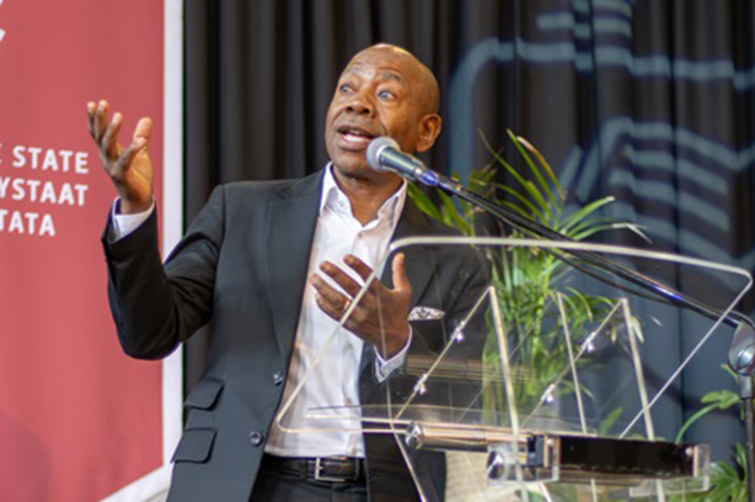 The University of the Free State Chancellor’s Luncheons offer an opportunity for Prof Bonang Mohale to address newly hooded PhD graduates, family members, and supervisors.
Newly hooded PhD graduates sat with family members and supervisors. The weight of years of academic research finally settled. Between celebration and relief, a pause hung in the room – a space to consider what would come next.
It is in this space that the message of the University of the Free State Chancellor’s Luncheons landed. Addressing the graduates, the Chancellor, Prof Bonang Mohale, returned to the essence of a doctorate. It is not simply a qualification, but an original contribution to knowledge – something brought into the world that did not exist before.
Yet the significance of that contribution lay beyond the thesis itself.
In a society shaped by inequality, climate pressure, and social challenges, knowledge must move, reach, and contribute to society. Graduates were encouraged to consider how their work extends beyond the university – into communities, institutions, and systems that shape daily life.
This responsibility is grounded in Ubuntu. “To be human means that I find my being, my significance, through others,” the Chancellor said. The idea reframes achievement: intellectual success gains meaning through its connection to people.
From this perspective, postgraduate excellence is measured differently. It is found in work that shifts conditions, expands access, and responds to real needs. The graduates gathered in the room are not only specialists in their fields; they are positioned to influence how knowledge is used, shared, and applied.
The address acknowledged the realities facing higher education. Historical debt continues to prevent many students from graduating, limiting opportunity and reinforcing inequality. It is a challenge that calls for new thinking – approaches that are sustainable, equitable, and attentive to students' lived realities.
For those sitting at the luncheons, the message was both affirming and demanding. Their expertise carries value, but also an obligation. It asks for engagement beyond the self – through research that informs policy, work that strengthens communities, or contributions that open pathways for others.
The journey to this point required discipline and persistence. Long hours of study not only built knowledge but also shaped ways of thinking – the ability to question, to analyse, and to imagine alternatives. Those moments of ‘burning the midnight oil’ offered entry into a world of meaning, challenge, and possibility.
What remains is the question of how that access will be used.
A doctorate marks an ending, but also a shift in responsibility. The graduates leave not only with recognition but also with a charge: to carry their knowledge into spaces where it can shape a more just, thoughtful, and sustainable society.