29 April 2026
|
Story Martinette Brits
|
Photo Barend Nagel
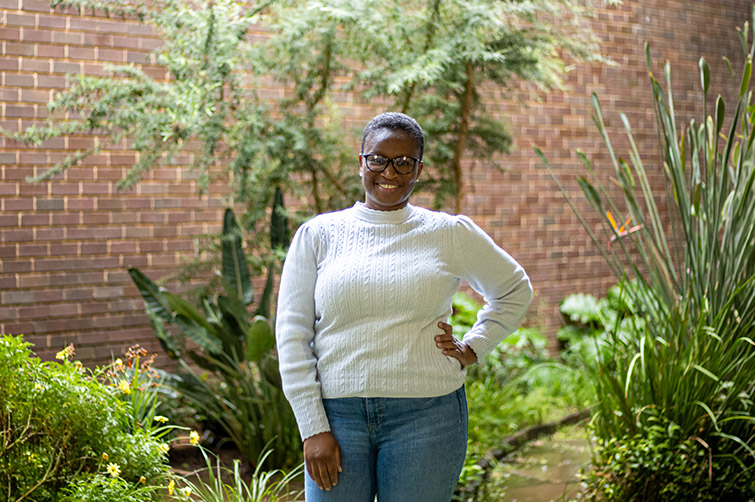 Prof Mahlako Linah Makgahlela, Vice-Dean: Research and Postgraduate Studies in the Faculty of Natural and Agricultural Sciences at the University of the Free State.
The University of the Free State (UFS) recently welcomed Prof Mahlako Linah Makgahlela as Vice-Dean: Research and Postgraduate Studies in the Faculty of Natural and Agricultural Sciences – a role she officially assumed on 1 April 2026. With a distinguished background in animal breeding and genetics, as well as extensive leadership experience in research management, she brings a strategic and globally informed perspective to the faculty’s research agenda.
Prof Makgahlela joins the UFS from the Agricultural Research Council (ARC) in Pretoria, where she served as Research Team Manager for Animal Breeding and Genetics, as well as Germplasm Conservation and Reproductive Biotechnologies.
A strategic vision for research and postgraduate success
“I was drawn by the opportunity to shape the research and postgraduate landscape at a strategic level during this pivotal era of institutional renewal. After many years in research, I wanted to contribute to building systems that strengthen impact, collaboration, and researcher development. The UFS offers a unique platform to connect locally relevant research with global engagement, aligning with my commitment to cultivating postgraduate talent and advancing a research culture that is both innovative and socially responsive.”
Her career is rooted in agriculture, where she progressed from researcher to senior researcher before moving into management at the ARC. In this leadership capacity, she oversaw multidisciplinary programmes spanning animal breeding, genomics, reproductive technologies, and conservation. Her academic journey also includes a PhD completed in Finland, complemented by collaborations across Europe, Africa, and the United States, as well as contributions to global high-level multilateral forums, including the G20 and the United Nations General Assembly (UNGA).
At the UFS, her immediate priorities centre on strengthening postgraduate support and research systems, with a focus on effective supervision, student success, and collaboration.
“My immediate priority is to strengthen postgraduate support, supervision capacity, and student success in the faculty by enabling effective systems, supervision frameworks, and collaborative structures. This will be informed by engagements with departments to better understand current research activities and opportunities for interdisciplinary collaboration. I will also focus on strengthening the innovation ecosystem, increasing research funding, and building strategic partnerships to enhance impact and partnerships.”
She also sees strong potential in advancing transdisciplinary research at the UFS.
“I see a significant opportunity to strengthen research by transitioning from a discipline-specific focus to a transdisciplinary framework that mirrors the complex, interrelated challenges of our time. By identifying and nurturing specialised research priorities, particularly where the UFS’ strengths in natural and agricultural sciences innovation meet societal needs, we can create frontier research hubs that are globally competitive and locally transformative.”
Driven by impact, grounded in purpose
Prof Makgahlela’s scientific background continues to shape her leadership approach. She is particularly inspired by developments in animal genetics and the move towards more sustainable and resilient systems.
“What excites me most is the shift towards a holistic and sustainable approach to genetic improvement. We’ve already seen how improved genetics can significantly increase productivity, even with fewer animals. However, the future lies in developing livestock that are not only high performing, but also resilient to climate change, disease, and resource constraints. I am particularly energised by the potential of genomics and genotype-by-sequencing to boost how we address global challenges, allowing us to balance efficiency with animal welfare, environmental health, and food security and safety, all of which are increasingly interconnected.”
A key part of her vision is to develop postgraduate students as future leaders.
“My vision is to complement the UFS’ strong academic foundation by deliberately cultivating our postgraduates as the next generation of scientific leaders. Students will benefit from a strengthened research pipeline situated within mentored, high-impact environments that bridge the gap between academic theory and real-world application. By establishing dynamic communities of practice, we will provide students with seamless access to a broad pool of expertise, drawn from both within the UFS and through established networks in industry and partner institutions locally and internationally. This framework ensures that our postgraduates are never researching in isolation; instead, they are embedded in strategic partnerships and global dialogues that help them build professional networks long before they graduate.”
Her motivation is rooted in the broader impact of her field.
“What motivates me is the realisation that agricultural research isn’t just about data, it’s about the literal ‘bread and butter’ of human survival. In challenging times, I am anchored by the higher purpose of our work – ensuring food security and building resilient systems for the most vulnerable.”
Outside of her professional life, she prioritises balance through activities such as yoga, strength training, hiking, and running.
“Outside of my professional life, I focus on maintaining a balance between physical strength and mental clarity. I practise yoga for flexibility, strength training for resilience, and hiking to find the space to think. Interestingly, my newest hobby is running; a complete turn of events, as I never used to enjoy jogging. It has become a powerful teacher, reminding me of the importance of patience, pacing, and the discipline required to reach a long-term goal.”