14 May 2026
|
Story Martinette Brits
|
Photo Supplied
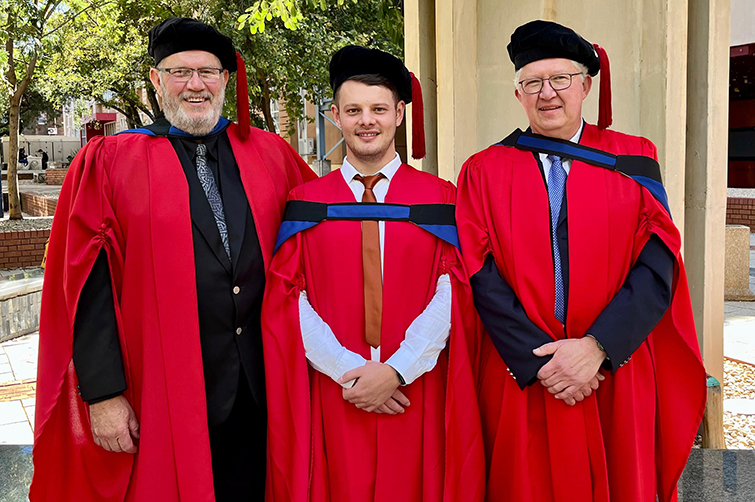 From the left are Prof Andreas Roodt, Dr Shaun Redgard, and Prof Johan Venter at Dr Redgard’s graduation ceremony at the University of the Free State. The trio recently received the prestigious Douw Greeff Award for their research on CO₂ capture and conversion.
The Douw Greeff Award recognises a research or review article of outstanding scientific quality in the natural sciences published in the journal during the preceding year.
According to the Suid-Afrikaanse Akademie vir Wetenskap en Kuns, the article represents “an important contribution to chemistry and the broader natural sciences” and reflects “deep scientific research, methodological precision, and meaningful contributions to the field”.
Prof Vasu Reddy, Deputy Vice-Chancellor: Research, Innovation and Postgraduate Studies, congratulated the colleagues and remarked: “This award affirms that intellectual rigour, when coupled with imagination, can convert one of humanity’s most pressing liabilities, namely carbon, into an asset for responsible societal futures. What is especially compelling is how advanced catalytic science is being harnessed to deliver solutions that are not only effective, but socially and economically viable.”
Research with global relevance
The study focuses on the use of epoxides as substrates to capture CO₂ through cyclocarbonate formation – a process that could contribute to future carbon reduction and sustainable chemistry initiatives.
Prof Roodt explained that the research forms part of continuing efforts to develop negative emission technologies (NETs) capable of reducing atmospheric CO₂ while simultaneously creating value-added products.
“The research presented focuses directly on the potential use of epoxides as substrates to capture CO₂ via cyclocarbonate formation,” he said. “It evaluates the homogeneous catalysis via organometallic and organic systems and reports a detailed and systematic kinetic-mechanistic study of the process as a potential workable option to generate a value-added ‘green’ product to be used as industrial solvent.”
Highlighting the scale of the global carbon challenge, Prof Roodt noted that global CO₂ emissions from fossil fuels reached approximately 37 gigatonnes annually.
“Mitigation strategies are required to complement nature’s efforts by reducing or removing pollutant emissions in the form of renewable energy sources or negative emission technologies,” he said.
Dr Redgard added that future studies in this field could help reduce the energy and cost associated with CO₂ capture and conversion by developing systems that operate under milder conditions.
“Practical CO₂ technologies need to be not only effective, but also economically and energetically viable,” he said. “This is particularly important for businesses such as Sasol and Eskom, which are under increasing pressure to meet emission targets while remaining financially sustainable.”
He added that computational chemistry studies could further improve the modelling of CO₂ reaction pathways and reaction conditions, helping researchers to better understand the mechanisms involved and to tailor reaction parameters more effectively.
“By converting CO₂ into useful, value-added products, this work embodies a shift towards circular thinking. In other words, where waste becomes input in building more sustainable economies. This achievement reflects a broader responsibility in research: to align deep scientific insight with real-world impact that supports cleaner industries and resilient futures,” observed Prof Reddy.
A long-term UFS collaboration
The award-winning publication originated from Dr Redgard’s MSc and PhD studies at the UFS between 2017 and 2022. The research was made possible by long-term funding from SASOL, the UFS, and the National Research Foundation (NRF). Prof Roodt supervised the research, while Prof Venter served as co-supervisor and co-author. The NRF also provided a doctoral bursary at the initiative of, and grant to Prof Venter, which allowed Dr Redgard to complete his studies.
Dr Redgard described the project as being inspired by both first principles thinking and biomimicry.
“From a first principles perspective, I was interested in going back to the fundamental problem: how can we capture CO₂ more efficiently, under milder conditions, and with lower energy requirements?” he said.
“Biomimicry then offered a second lens – looking at how nature manages carbon-based processes and considering whether similar principles could be replicated or modelled in engineered systems.”
He added that the possibility of upcycling captured CO₂ into useful building blocks for value-added products was particularly exciting.
Prof Roodt described Dr Redgard as “an excellent young researcher” who was working on a long-term project initiated in his research group nearly a decade earlier.
Creativity and science
Reflecting on his doctoral research journey, Dr Redgard said that one of the most valuable lessons was the importance of creativity in scientific research.
“Scientific research is often associated with logic, structure, discipline, and rigour – and rightly so. But I have found that creativity was just as important,” he said.
He said creativity allowed him to make unexpected connections and approach complex scientific problems from new perspectives.
Quoting Albert Einstein, he added: “‘Logic will get you from A to B. Imagination will take you everywhere.’ Logic provided the discipline and direction, but imagination and creativity allowed me to make unexpected connections, approach problems differently, and find novel ways to work through complex challenges.”
Prof Roodt, a distinguished professor and former head of the UFS Department of Chemistry, played a major role in establishing the department as a globally recognised research environment.
Since completing his PhD, Dr Redgard has worked in strategy and innovation consulting and recently founded Karvaura, a company focused on creative wellness products and innovation.
The recipients will be honoured during the awards ceremony in Pretoria on 2 October 2026.
“This recognition underscores the power of sustained collaboration and curiosity-led enquiry to generate globally relevant, locally anchored knowledge. At its core, this work illustrates how innovation in chemistry can help society transition from carbon dependency to carbon stewardship,” commented Prof Reddy.