14 August 2026
|
Story Siqhamo Hlubi Jama
|
Photo Kaleidoscope Studios
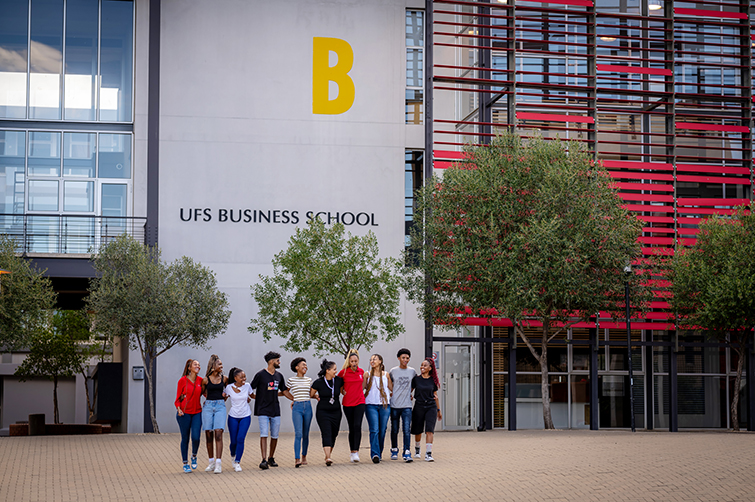 The UFS Business School is proactively shaping management education by combining global standards with African perspectives, preparing future leaders to respond to real-world challenges and opportunities.
Business schools across Africa are rethinking how they prepare future leaders for a continent where many of the most pressing management challenges cannot be addressed through imported models alone.
Universities are increasingly looking beyond traditional management theories to ensure that graduates are equipped to respond to the realities of the societies and economies they will serve. At the University of the Free State (UFS) Business School, this means combining internationally recognised standards with knowledge and approaches grounded in African contexts.
For Prof MacDonald Kanyangale, Acting Director of the UFS Business School, this is one of the defining questions facing management education today.
"Africanisation should not mean dilution of standards. It is about retaining global excellence and global standards, while reinforcing relevance to the African context," he says.
This philosophy is shaping the renewal of the UFS Business School's Master of Business Administration (MBA). Rather than viewing Africanisation as an alternative to internationally recognised management education, the School is embedding African perspectives in a curriculum grounded in global best practice.
From case studies to real-world challenges
A key aspect of the renewed MBA is a stronger focus on learning through real organisational challenges.
The Business School is exploring partnerships with government departments, entrepreneurs and industry, enabling students to work with organisations that act as "problem sponsors". Instead of analysing hypothetical scenarios, students will develop practical responses to challenges facing organisations and communities.
Among the collaborations under discussion are partnerships with the Department of Health and entrepreneurial ventures, creating opportunities for students to apply management thinking where it can make a tangible difference.
"We want our students to grow with the spirit of being solution providers," says Prof Kanyangale.
The aim is to develop graduates who understand leadership as a means of creating value not only for organisations, but also for society.
Responsible leadership for Africa's future
Together, these frameworks encourage students to consider sustainability, ethical leadership and long-term societal impact alongside organisational performance.
Modules such as Strategic Human Capital, Strategic Operations Management and Supply Chain Management are being redesigned to strengthen this focus, encouraging students to consider how management decisions can contribute to sustainable development and positive societal outcomes.
Building an African management ecosystem
Central to this approach is the idea of an African Management Ecosystem – one in which universities, government, business, entrepreneurs and communities work together to generate knowledge and develop solutions that address Africa's development priorities.
Rather than viewing business education as something that happens primarily in the classroom, the model encourages students to work across sectors, co-create solutions with communities and organisations, and develop leadership grounded in the realities of the continent.
In this model, students do not simply learn about management; they contribute to solving real problems, build relationships across sectors and develop leadership that is responsive to the needs and opportunities of Africa.
For the UFS Business School, renewing the MBA is therefore part of a much larger ambition: contributing to a model of management education that is globally respected, distinctly African and focused on creating positive societal impact.
As Africa's economies continue to evolve, business schools have an opportunity to help shape a new generation of leaders who are as comfortable engaging with global markets as they are addressing local challenges.
At the UFS Business School, the renewal the MBA represents one contribution to this broader ambition – ensuring that management education remains internationally respected, distinctly African and relevant to the continent's future.