25 August 2026
|
Story Queen Sigebedu
|
Photo Supplied
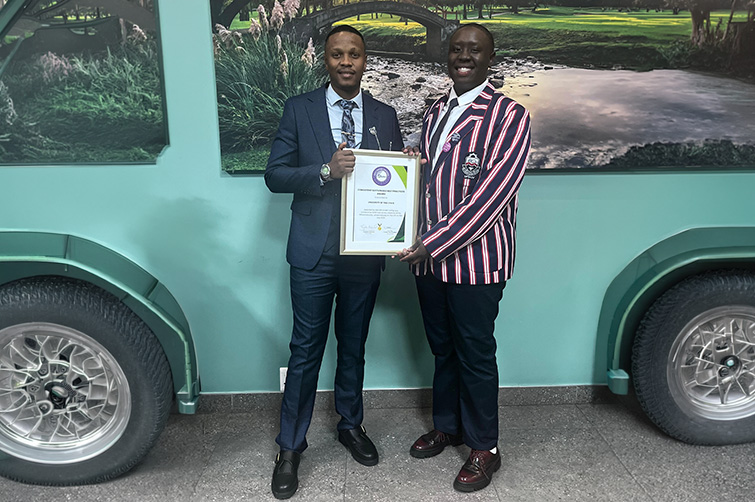 Residence Head Itumeleng Lebusho with student Lefa Mohapi at the University of the Free State, following the institution’s recognition for being the Most Consistent Green institution.
The University of the Free State (UFS) has strengthened its position as an institution committed to sustainability, innovation, and student-led solutions after receiving the Most Consistent Green Practice Award at the 13th Annual Green Campuses Conference (GCC) 2026.
The recognition, which marks the UFS’ second consecutive Most Consistent Green Practices award at the conference, highlights the University’s continued efforts to create opportunities for students to develop practical responses to environmental and campus-related challenges.
The achievement reflects the UFS’ broader commitment to embedding sustainability across its campuses while empowering students to contribute meaningfully to the development of more sustainable campus communities.
Through initiatives such as the UFS Green Campus Initiative (GCI), the University creates platforms for students to identify challenges, explore innovative ideas, and develop practical solutions that have the potential to improve the campus experience.
UFS sustainability and innovation showcased at national conference
The 13th Annual Green Campuses Conference was held from 12–16 July 2026 at the University of the Witwatersrand (Wits University) in Johannesburg, under the theme ‘Shaping Sustainable Campuses for a Sustainable Future’.
Hosted in partnership with the Association of College and University Housing Officers – International, South Africa Chapter (ACUHO-I SAC), the conference brought together higher education institutions, student leaders, and housing professionals to exchange ideas, showcase innovations, and explore practical approaches to creating more sustainable university environments.
The conference places a strong emphasis on student participation, providing young people with opportunities to identify environmental challenges and develop solutions in areas including energy conservation, waste management, carbon reduction, and sustainable campus operations.
Participation in the conference provided the UFS with an opportunity to showcase how student innovation is contributing to the University’s sustainability agenda.
Student innovation driving practical solutions
Twelve UFS students represented the University at the 2026 conference: Thandolwethu Nyathikazi, Lefa Mohapi, Clement Tenyane, Relebohile I. Mokhotsoa, Xolani Msimanga, Tekekgoadi Komane, Zanele Motubane, Mbalenhle Khumalo, Phemelo Stuurman, Prosper Mthembu, Khanyisile Semela, and Precious Ntsibulane.
Their work demonstrated the role that students can play in identifying challenges within their environment and developing innovative responses to them.
“Attending the Green Campuses Conference at Wits was a beautiful experience,” Komane said. “Beyond the networking, it helped me really grasp why sustainability matters, not just as a concept, but as something we live out daily. I left inspired to keep pushing that mindset forward.”
Among the projects showcased in 2026 was a Smart Washing Machine, developed in response to the challenges of water and electricity consumption. The concept explores ways of reducing the resources used during the washing process through water recycling, energy-efficient operation, and the use of renewable energy. The proposed system incorporates a water treatment and filtration process that allows water to be collected, treated, and reused, while solar energy and battery storage are incorporated to support its operation.
The project also seeks to improve the student experience in residences. A cellphone-enabled system is proposed to notify users when their washing cycle is complete, potentially helping to reduce queues and improve the use of shared laundry facilities. Through its focus on water conservation, energy efficiency, and convenience, the project demonstrates how students are exploring solutions to everyday challenges while considering the broader sustainability needs of the campus.
Another 2026 project was the Smart Waste Collection Plant, which focuses on the management of food waste generated at campus food courts. The concept responds to both environmental and health-and-safety concerns associated with the incorrect disposal of food waste.
The proposed plant uses solar panels, battery storage, and motors to support its operation. Food waste collected from designated bins would be transported via a conveyor system to a crusher, where it would be processed before being transferred into a sealed tank. The concept is designed to capture gases produced during the decomposition process, with the potential for these gases to be used to generate electricity. In this way, the project explores the potential of converting food waste into an energy resource, while supporting the UFS’ broader ambition of developing more sustainable campus operations.
Building a culture of sustainability at UFS
The consecutive recognition at the Green Campuses Conference is significant not only for the projects presented but also for what it represents about the UFS’ approach to sustainability.
By creating opportunities for students to participate in sustainability initiatives, present their ideas, and engage with peers from other institutions, the UFS is supporting a culture in which students are encouraged to become active contributors to the development of sustainable campus communities.
The University’s participation also creates opportunities for knowledge exchange, allowing UFS students and staff to learn from other higher education institutions while sharing approaches and innovations developed within the UFS environment. The recognition therefore speaks to more than a single exhibition. It highlights the value of creating institutional platforms where student creativity, innovation and sustainability intersect.
“At the University of the Free State, we ensure the holistic development of students whose graduate attributes empower them to contribute positively to societal futures leading to innovation and sustainability,” said Dr Temba Hlasho, Executive Director: Student Affairs, Sport, Arts and Culture.
From ideas to impact
As the UFS continues to advance its sustainability agenda, the achievement reinforces the University’s commitment to creating an environment where student ideas can contribute to institutional innovation and more sustainable futures.
The recognition at the 2026 Green Campuses Conference is therefore both an achievement for the participating students and a reflection of the UFS’ broader commitment to sustainability, innovation, and student success.
The UFS continues to empower students to turn ideas into action – contributing to sustainable solutions on campus and beyond.