16 October 2026
|
Story Andre Damons
|
Photo Andre Damons
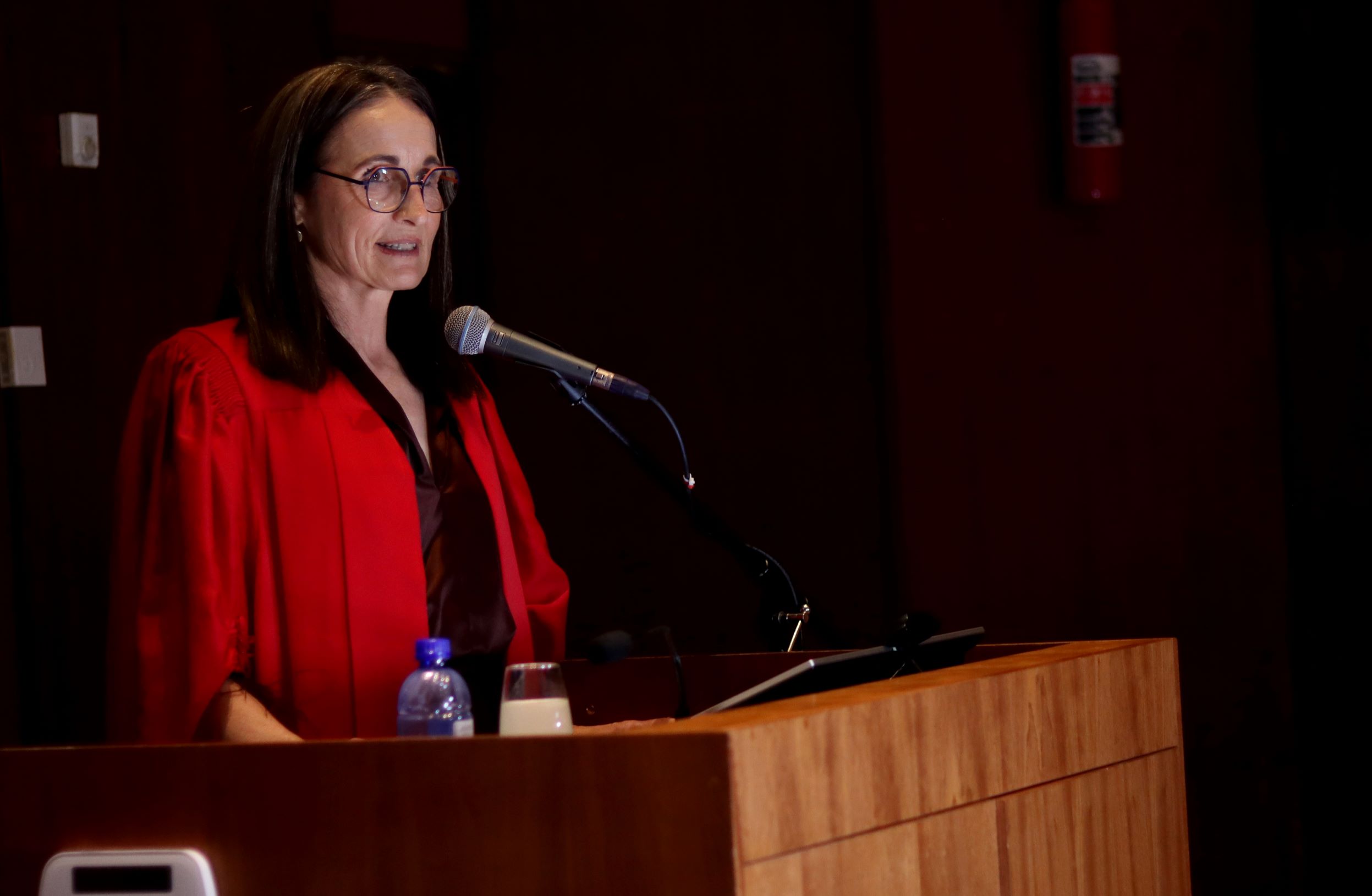 Prof Lynette van der Merwe, Academic Head of the Division Health Sciences Education in the Faculty of Health Sciences at the University of the Free State.
Health Professions Education (HPE) is a growing knowledge-producing field that lies at the intersection of healthcare and education, which are both considered inalienable human rights. Healthcare professionals are not simply shaped by what they learn in classrooms; their knowledge, skills and attitudes develop through years of experiences, relationships, challenges and transitions.
Introducing Prof Van der Merwe, the Dean said this occasion it not merely a celebration of academic achievement, it is an opportunity to accompany a scholar who has devoted more than two decades to health professions education. “Prof Van der Merwe’s recent research on resilience, burnout, and coping strategies is no accident. Her publications examine how medical students, registrars, and educators themselves navigate high-pressure environments.”
“The Kintsugi metaphor finds practical resonance here: brokenness is not the end; repair is itself part of professional growth. Her scholarship is not abstract philosophy. It is grounded in the concrete realities of South African health sciences education; resource constraints, student diversity, the demands of remote learning, and the pressure of clinical practice.”
Prof Vasu Reddy, Deputy Vice-Chancellor: Research, Innovation and Postgraduate Studies, remarked that “Clay, Kiln, and Kintsugi teach us that our greatest strengths often emerge from the very experiences that test and transform us. Prof Lynette’s lecture reminds us that growth is not about avoiding cracks but transforming them into sources of strength. Healthcare begins long before the clinic. It begins in the spaces where identity, purpose, and belonging are formed.”
Titled Clay, Kiln, and Kintsugi: (Trans)forming a Health Professions Educator, the lecture examined professional identity formation – being, becoming, and belonging – reflecting on identity development through multiple transitions and role tensions as clinician, researcher, and educator. At the centre of her lecture was a simple but important message: Health Professions Education (HPE) matters because the students that are trained will ultimately be responsible for caring for patients.
From clay to healthcare professional
“Ultimately, HPE matters because patients’ lives – including our own – will be entrusted to the care of our students as healthcare professionals of the future. HPE research on professional identity formation gives us language to explain how socialisation takes place as an individual with an existing personal identity, based on unique background, experience, personality, motivation, culture and context develops a new self-concept, with personal and professional identity as a healthcare graduate,” Prof Van der Merwe told attendees.
Prof Van der Merwe used the metaphor of clay to describe how undergraduate medical students are shaped during their journey of becoming healthcare professionals. External factors, including the learning environment and healthcare system, curriculum and assessment methods, interactions with peers, family and friends, as well as the norms and traditions of the prevailing context, all contribute their formation.
“Various transitions through pre-clinical training in lecture venues, dissection halls and laboratories to clinical training in hospital wards, clinics, theatres and community sites demand adaptability and surrender on the part of the emerging clay form, as well as wisdom, skill and vision from role models and mentors. Students learn through consciously reflecting on their experiences, and by unconsciously acquiring behaviours and attitudes throughout the socialisation process,” said Prof Van der Merwe.
Becoming an educator through kiln-firing
Using personal examples and humour, she described her own journey from medical student sitting in the same lecture room in the Faculty of Health Sciences where she also presented her inaugural lecture, to clinical practice, doing her PhD and ultimately finding her niche research field. “Entering teaching is a pivotal transition for healthcare professionals, constituting a disorienting dilemma as identity is renegotiated whilst dealing with the tensions and contradictory perceptions and vagueness about how clinical, research and educator roles are recognised and rewarded.” This is represented in the refining fire of the kiln where identity is consolidated
“Mezirow’s Transformative Learning Theory explains how a disorienting dilemma leads to self-examination and critical assessment of assumptions, forcing us to confront flawed thinking and to recognise shared experiences with others who have faced similar challenges to help us explore new ways of thinking about our roles, relationships and actions. As we develop new perspectives, we are motivated to equip ourselves with knowledge and skills to attempt new roles, and build competence and self-confidence. We deliberately plan personal change, seeking out education, training and tools, testing new skills and practising new behaviours to gain mastery,” she explained.
Finding strength in the cracks
Facing disorienting dilemmas, and challenging existing frames of reference towards renewed identity is not a single achievement. It is ongoing work. You are never fixed or ideal. This idea is captured in the third part of her metaphor: Kintsugi – the Japanese art of repairing broken pottery by highlighting the cracks rather than hiding them.
“My research provides data from a Global South context, offering an understanding of how individuals within health professions education experience stress, develop resilience, and adapt to changing educational and professional realities so that we may move beyond deficit-based accounts of distress and rather emphasise adaptive processes, as represented in the art of Kintsugi. We are increasingly realising that well-being is both an educational and institutional concern, and not simply an individual characteristic”.
“Far from being inadequate”, Prof Van der Merwe continued, “health professions educators practising Kintsugi are adaptable, creative, and connected for having broken and been reconstructed. We realise that our fractures don’t simply happen because of personal weakness but are often due to competing institutional value systems. Therefore, in this metaphor, I present Kintsugi not as a celebration of suffering, but as call for recognising that formation and renewal require supportive, enabling environments alongside reflective practice.”
The power of connection
For Prof Van der Merwe, the value of being a health professions educator ultimately lies in the people whose lives are influenced through education. After more than 30 years in the field, she sees her impact not only through the healthcare professionals she has helped train, but also through the educators, mentors and researchers she has developed along the way.
“Each healthcare professional whose training I have been involved in across a career of more than 30 years would treat many more patients in their lifetime than I could ever do on my own. Every health profession educator I teach, mentor or supervise is involved in the training of more health professions students or educators than I could manage alone.” she explained.
Always becoming
Prof Van der Merwe’s lecture ultimately offered a reflection on what it means to develop and maintain a professional identity in a demanding and constantly changing environment. “Our identity is continuously under construction, changing with time. We are shaped, like clay, into becoming, and then kiln-fired into being. Obstacles, hardships, and uncertainty may lead to fractures. Yet transformative learning theory teaches us that nothing is wasted; everything is mendable. The shards of our old identities may be glued with gold towards new forms of belonging. Our resilience is revealed in the golden veins of repair of the fractured vessels we have become.”
Reflecting on this insight, Prof Reddy observed that: “In a world of constant change, our greatest calling is not simply to succeed but to remain always becoming. And this is about shaping potential, embracing challenge, and transforming experience into enduring contribution. Our greatest impact lies not in what we have achieved, but in our willingness to keep growing, adapting, and advancing the common good.”