09 February 2026
|
Story Martinette Brits
|
Photo David Chui
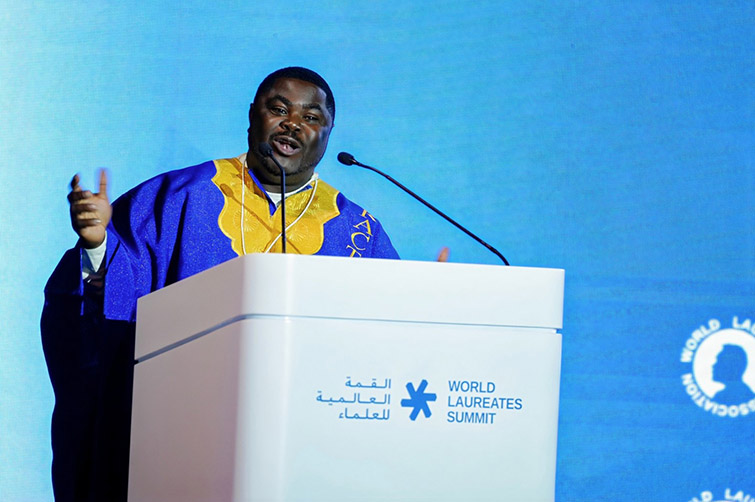 Prof Abdon Atangana from the University of the Free State speaks at the World Laureates Summit, where he was one of only 16 scientists worldwide invited to address global leaders and policymakers.
Amid growing global uncertainty marked by pandemics, climate disruption, and geopolitical instability, Prof Abdon Atangana of the University of the Free State (UFS) addressed global leaders and top scientists as a keynote speaker at the World Laureates Summit (WLS) on Monday 2 February. Held alongside the World Governments Summit (WGS), the event marked a historic convergence of science and governance, bringing together Nobel, Turing, Wolf, and Lasker laureates with heads of state, ministers, and senior policymakers to engage on present and future global development challenges. Prof Atangana was one of only sixteen scientists worldwide invited to participate in this edition of the summit, representing African excellence in fundamental and applied science.
Reflecting on the invitation, Prof Atangana described it as both recognition and responsibility. “This invitation is both an honour and a responsibility,” he said. “The World Laureates Summit represents a historic moment where science and governance meet as equal partners. In a world facing pandemics, climate disruption, and geopolitical tension, fundamental science becomes the common language of humanity, the place where truth is negotiated beyond ideology.”
He added that the invitation affirmed the broader societal relevance of his work. “To be invited means that my work is not only mathematically relevant, but socially and globally meaningful. It allows me to contribute to shaping a future where decisions are guided by evidence, models, and long-term thinking rather than short-term reaction.”
Science and policy at the same table
A central theme of Prof Atangana’s address was the urgent need to embed scientific knowledge directly into governance structures. He argued that many of today’s most pressing challenges can no longer be addressed through political processes alone.
“Today’s problems are no longer political alone, they are scientific,” he explained. “Climate change, epidemics, energy transitions, AI governance, and water security are governed by equations before they are governed by laws. When policy is disconnected from science, it becomes blind.”
According to Prof Atangana, effective governance requires scientists and policymakers to work together as equals. “Science provides prediction, optimisation, and risk understanding, while governments provide implementation. Together, they transform knowledge into action.”
Fundamental science as a source of truth
Prof Atangana emphasised that fundamental science should form the foundation of global decision-making, particularly in times of uncertainty. “Calling science the source of truth means that every decision – from national policy to international strategy – must be anchored first in evidence, rigorous modelling, and careful verification, rather than ideology, opinion, or emotion,” he said.
He stressed that science strengthens leadership rather than replacing it. “Science disciplines leadership. It transforms belief into measurement, intuition into calculation, and vision into simulation. When fundamental science leads, decisions cease to be reactive; they become predictive and strategic.”
From theory to real-world impact
As both a fundamental and applied scientist, Prof Atangana highlighted how theoretical research can translate into practical solutions to global development challenges. “Scientific theory is the blueprint of reality,” he explained. “Fundamental science reveals the rules that govern nature, societies, and technology. Applied science then translates these rules into tools, models, and systems.”
Referring to his own work in mathematics, he noted that abstract concepts often have direct real-world applications.
“Concepts that seem abstract, such as fractional calculus or trinition geometry, are not theoretical curiosities. They model memory, deformation, and uncertainty in real systems. Using these models, we can predict groundwater depletion, optimise energy grids, simulate epidemics, and improve AI systems in ways that classical mathematics cannot.”
Representing African excellence
As one of only sixteen scientists invited to the summit, Prof Atangana said African representation in global scientific forums is essential.
“African scientific representation at global forums is not just important; it is a matter of survival and dignity,” he said. “African scientists bring unique perspectives – solutions rooted in our realities, creativity forged in adversity, and insights that can transform the world if given the platform.”
He emphasised that meaningful representation must be supported by long-term investment in science and higher education. “Fundamental science is not a luxury; it is the engine of long-term development. Nations that harness it will not only survive crises; they will define the future.”
Significance for the UFS and South Africa
For Prof Atangana, his participation at the World Laureates Summit also carries an important message for South African science and for institutions such as the University of the Free State.
“This invitation signifies that African science has the potential to be recognised on the world stage, but only if we stop being content with being local champions,” he said. “If Africa wants to matter in world science, we must invest in fundamental research, build strong institutions, and pursue excellence that transcends borders.”
As global leaders and leading scientists continue to grapple with complex development challenges, Prof Atangana’s contribution at the World Laureates Summit underscores the growing role of African scholarship – and the importance of universities such as the UFS as drivers of knowledge, innovation, and global dialogue.