12 February 2026
|
Story Martinette Brits
|
Photo Supplied
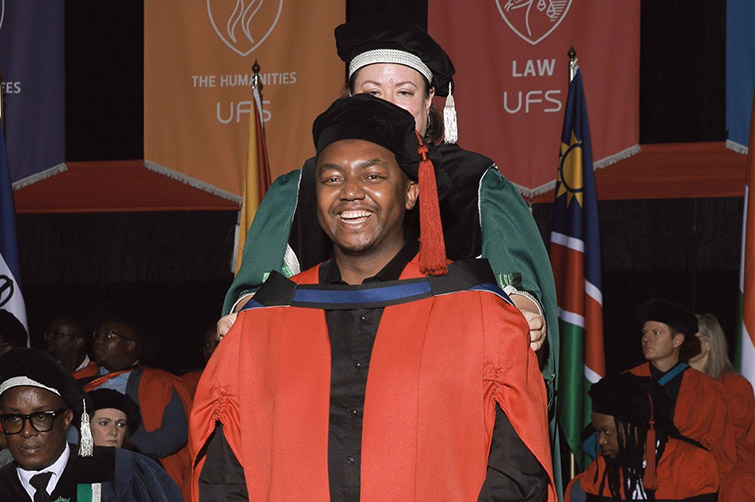 Samkelo Radebe, a postdoctoral researcher at the University of the Free State, has been awarded the prestigious Oppenheimer Memorial Trust (OMT) Postdoctoral Fellowship for research using artificial intelligence to advance global groundwater prospectivity.
A University of the Free State (UFS) researcher has been awarded one of South Africa’s most competitive postdoctoral scholarships, recognising research excellence with the potential to address pressing global challenges.
Samkelo Radebe, a postdoctoral researcher at the UFS, has been selected for the Oppenheimer Memorial Trust (OMT) Postdoctoral Fellowship. The OMT awards a limited number of scholarships annually to outstanding scholars pursuing postdoctoral study at local and international higher education institutions, supporting candidates with a proven record of academic excellence who intend to build careers in academia, research, or development in South Africa.
This year, the fellowship attracted 998 applications of which only 43 candidates were shortlisted, with only a handful ultimately awarded.
The fellowship includes a R650 000 local scholarship over two years to support Radebe’s postdoctoral research at the UFS, as well as a six-month research placement at the University of Copenhagen in Denmark, where he will collaborate with a globally recognised geohydrological research group.
“The OMT Fellowship is regarded as prestigious because it identifies researchers whose work has strong scientific merit, real-world relevance, and global applicability,” Dr Radebe says. “Opportunities that combine advanced research, international collaboration, and applied societal impact are rare, which is why this fellowship stands out as career-defining.”
Reflecting on the selection process, he describes the award as a meaningful affirmation of his work. “Being selected from nearly 1 000 applicants was incredibly humbling,” he says. “It affirmed that there is a genuine need for innovative, science-driven solutions to global water challenges.”
Transferable AI for global groundwater prospectivity
Radebe’s research focuses on developing transferable artificial intelligence models for global groundwater prospectivity, with particular relevance to arid and water-limited regions.
“In simple terms, this research aims to train a machine learning model to identify areas where groundwater is most likely available, and to do so in a way that works across different countries, climates, and geological settings,” he explains.
Using globally available remote sensing data, the model will generate groundwater prospectivity maps at a global scale.
“Most existing machine learning studies are built for small, data-rich regions, which limits their usefulness elsewhere,” Radebe says. “By making groundwater prediction models more transferable, the research helps make groundwater exploration faster, more cost-effective, and more equitable.”
This work is particularly important in regions where groundwater is the only reliable water source.
“Improving groundwater prospectivity mapping reduces uncertainty, saves financial resources, and strengthens long-term water security and climate adaptation,” he adds.
Strong UFS foundation and international collaboration
Radebe’s research is grounded in the MAGIC Research Programme at the UFS, which engages geohydrological problems as a component of the programme’s focus on earth system science.
“Within this systems thinking, we see that the geohydrological system links climatic aspects with the structure of the surface and subsurface, and therefore we aim to constrain groundwater holistically,” he says.
During his six-month stay at the University of Copenhagen, Radebe will collaborate with experts in hydrogeology, environmental modelling, and machine learning.
“Groundwater systems vary widely around the world, so cross-regional collaboration helps ensure that the science is rigorous and globally relevant,” he says. For South Africa, this is especially important. We are acutely aware of how sporadic rainfall patterns and prolonged droughts shape water availability, making it critical that groundwater research reflects the realities of semi-arid and water-stressed regions.
Building capacity at the UFS
The expertise gained through the fellowship will feed directly back into UFS research and teaching.
The engagement in Denmark will enable the transfer of globally recognised excellence in groundwater analysis back to the UFS. Exposure to advanced methodologies and integrated approaches to hydrogeological research will strengthen both research and training within the institution.
The way groundwater systems are studied in Denmark, particularly the emphasis on high-resolution data integration, modelling, and interdisciplinary earth system analysis, has the potential to significantly influence how we approach and understand our own geohydrological systems. These insights will also feed into broader earth system research within the MAGIC Research Programme, supporting more holistic and data-driven environmental science at the UFS. For emerging researchers, his advice is simple: “Focus on research that addresses real-world problems and believe that your work has global value. Self-doubt can hold people back more than a lack of ability.”