19 January 2026
|
Story Nitha Ramnath
|
Photo Supplied
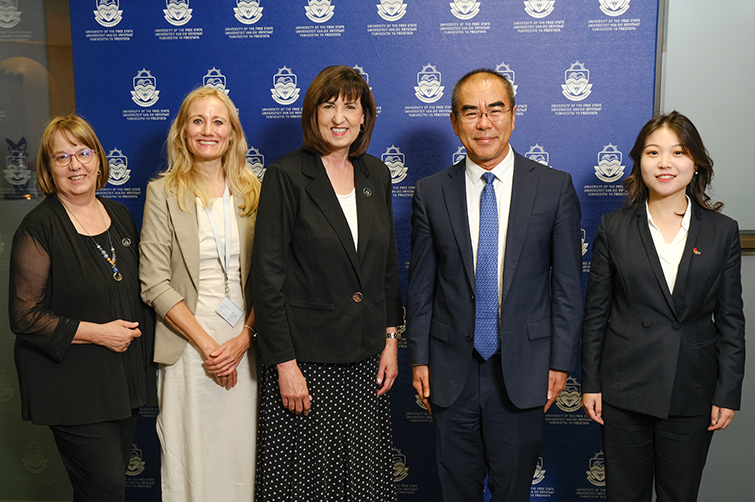 From left to right: Prof Lynette Jacobs, Acting Director: Office for International Affairs; Prof Ylva Rodny-Gumede: Executive Director: Advancement; Prof Hester C. Klopper: Vice-Chancellor and Principal; Consul General Pan Qingjiang; Zoey Zhang, Consul Attaché.
The engagement formed part of ongoing relationship-building efforts aimed at exploring institutional collaboration, expanding academic and student exchanges, and identifying new opportunities for joint research and innovation. Also in attendance were Prof Ylva Rodny-Gumede, Executive Director: Advancement, and Prof Lynette Jacobs, Acting Director of the Office for International Affairs.
Value of partnerships and emerging opportunities
Reflecting on the longstanding relationship between South Africa and China, Consul General Qingjiang emphasised the importance of cooperation, mutual understanding and people-to-people engagement in fostering global progress and shared learning. “The role of education, youth development and cultural exchange in strengthening international relationships is important, and we are keen to expand student scholarships, academic mobility and cultural initiatives,” added the Consul General.
He further announced that 2026 has been designated the Year of China–Africa People-to-People Exchange, presenting valuable opportunities for universities to deepen educational and cultural engagement initiatives across the continent.
Prof Jacobs outlined UFS’s existing academic partnerships with Chinese institutions, noting that the university currently collaborates with more than 230 institutions in China. Between 2020 and 2025, these collaborations resulted in over 370 co-authored research publications. She also highlighted ongoing student exchange programmes and emerging opportunities in linguistics and language studies, where new institutional linkages are being explored.
Prof Klopper shared insights into UFS’s research strengths, including biodiversity, environmental sustainability, climate change and astrophysics. She highlighted the work of the Afromontane Research Unit (ARU), which focuses on mountain systems, biodiversity conservation and environmental change in Africa’s high-altitude regions. She emphasised the importance of enabling student participation in global platforms such as the United Nations Climate Change Conferences (COP), for student development, global exposure and meaningful scholarly contribution.
“International partnerships create powerful learning ecosystems for our students and researchers,” said Prof Klopper. “They open pathways for mobility, innovation, intercultural learning and global policy engagement, while positioning UFS as a meaningful contributor to international knowledge networks.”
Indigenous knowledge systems
This work has received international recognition, including engagement with the World Health Organisation, global research funding, and the establishment of a formal bilateral partnership with the Beijing University of Chinese Medicine (BUCM). The collaboration encompasses joint laboratories, postgraduate training, translational research, clinical trials, and the co-establishment of the BRICS Natural Medicines Institute, positioning UFS as a key contributor to continental and global advancement in traditional and natural medicine research.
Future-oriented collaboration
Discussions during the visit also highlighted future-oriented collaboration opportunities in agriculture and food security, climate-smart and sustainable rural development, health sciences and community wellbeing, student entrepreneurship and innovation, as well as expanded student and academic mobility to promote intercultural learning and skills development. Language and cultural engagement initiatives were also identified as important enablers of deeper people-to-people connections.
Prof Rodny-Gumede noted the strong alignment between student entrepreneurship development at the UFS and China’s innovation-driven economic focus, underscoring the potential for mutually beneficial collaboration.
The engagement concluded with Consul General Qingjiang extending an invitation to Prof Klopper and the university to attend the Spring Festival reception celebrating the Chinese New Year, signalling continued dialogue and collaboration in the months ahead.
The visit underscores UFS’s commitment to building globally connected partnerships that advance knowledge production, innovation and social impact, while strengthening South Africa’s role within international academic networks.