21 July 2026
|
Story Christelle du Toit
|
Photo Stephen Collett
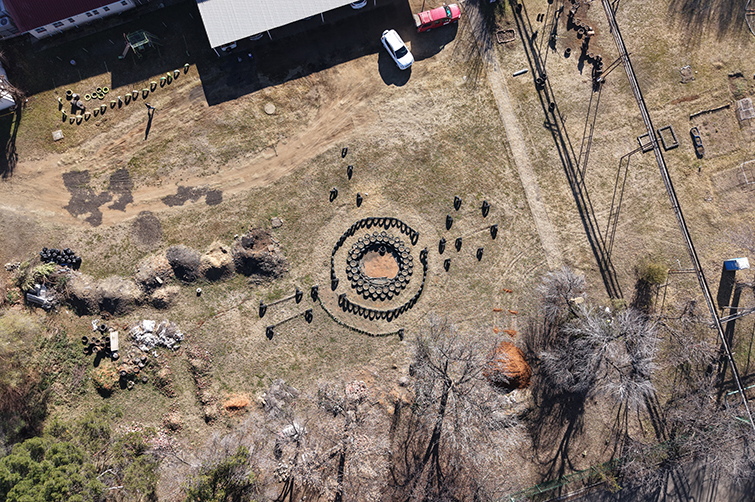 University of the Free State staff, students, and partners worked together at the National District Hospital in Bloemfontein, using earth, discarded tyres, and glass bottles to help build the Great Wall to Freedom – A Living-Lab, eARTherapy Extravaganza. Inspired by African building traditions, the Mandela Month initiative is creating a lasting space for earth therapy and community engagement.
A wall does not have to divide.
At the National District Hospital in Bloemfontein, a curved wall taking shape from earth, discarded tyres, and glass bottles is intended to do something quite different: create a place for healing, connection, and community.
On 17 July, staff and students from the University of the Free State (UFS) spent part of Mandela Month washing glass bottles, filling old tyres with sand, and working together on the Great Wall to Freedom – A Living-Lab, eARTherapy Extravaganza.
But this was not an act of service that ended when the day was over. The structures are intended to become a lasting space for earth therapy and community engagement, connecting people with art, one another, and the natural world.
Fittingly, the wall is not straight.
Why the wall curves
The name – Great Wall to Freedom – as well as the artistic design of the site, came from local indigenous artist Lenosa Mahapang.
Drawing on African building traditions, including the circular forms familiar in structures such as rondavels, Mahapang incorporated curved walls into the design. Earth and repurposed materials are used to create a contemporary space that carries traces of an older architectural language.
The project builds on collaboration involving Dr Anita Venter of the UFS Centre for Development Support and visiting professor and researcher-artist Prof Keith Armstrong, whose work has explored how art, earth, discarded materials, and different ways of knowing can contribute to thinking about sustainable futures.
At the hospital, these ideas now have a permanent destination.
Corne Thomas, occupational therapist at the Free State Department of Health, hopes the space will allow patients and the wider community to slow down, work with their hands, and reconnect with nature.
“Earth therapy is about creating, building, and engaging with the earth in ways that remind us we are part of the natural world, not separate from it,” she says.
That connection extends to the design itself. By drawing on local building traditions, Thomas says the project recalls ways of living that recognise the relationship between people and the earth.
“My hope is that people leave with a renewed understanding that caring for ourselves and caring for the natural world go hand in hand.”
Building differently
There is something unexpected about a Faculty of Economic and Management Sciences (EMS) helping to build an earth wall at a hospital.
That is partly the point.
The faculty has deliberately created space for disciplines and ways of knowing that do not traditionally sit together. Its appointment of Prof Armstrong – an artist from Queensland University of Technology – as a visiting professor in the Centre for Development Support is one example.
At the National District Hospital, that transdisciplinary thinking became tangible – quite literally.
For Dr Venter, who played a central role in bringing the project to fruition, the significance of the wall lies as much in how it is being built as in the finished structure.
“For me, this wall is less about construction than about method: rather than positioning African knowledge as an alternative to ‘book’ theory, it asks what theory looks like when physically built from earth, reclaimed materials, and care.”
The wall, then, is not simply a structure informed by African knowledge. It asks whether knowledge can also be made visible through materials, methods, and the act of building together.
Prof Brownhilder Neneh, Vice-Dean: Research, Engagement and Internationalisation in EMS, sees this kind of collaboration as part of the faculty’s responsibility beyond classrooms and research publications.
“We are committed to building partnerships where academic knowledge, diverse disciplines, and community wisdom come together to co-create sustainable solutions to societal challenges,” says Prof Neneh.
“The Great Wall to Freedom is a powerful example of how collaboration can create spaces that promote healing, dignity, and social transformation. By working across disciplines and alongside community partners, we are building more than just a physical structure – we are strengthening relationships, generating new knowledge, and fostering a shared commitment to healthier, more resilient communities.”
But knowledge did not move only outwards from the university.
Prof MacDonald Kanyangale, Professor and Interim Head of the UFS Business School, spent the day at the hospital and saw potential for the learning to extend beyond the site. A dedicated film crew documented the project, creating material he hopes can be used with MBA students.
“The project relates to sustainability, leadership, and followership in providing service in a regenerative manner that preserves the natural resources in Africa,” he says.
For Prof Kanyangale, the experience also offers a practical way to explore leadership as service. “The video that will be produced can be used to help MBA students learn the capability of leadership as service to others without always thinking, ‘what’s in it for me?’”
In this way, an act of community engagement can travel back into the classroom. Those who arrived to contribute also found something to learn.
Beyond 67 minutes
Many hands made that exchange possible.
UFS University Estates prepared the hospital site, while Bishop Billyboy Ramahlele and Dr Karen Venter from the Directorate for Community Engagement helped facilitate the logistics. Staff, students, and partners then did the physical work of washing, filling, carrying, and building.
Mandela Day is often associated with 67 minutes of service. At the National District Hospital, those minutes contributed to something intended to remain: a space where art, health, African knowledge, and community can meet.
Giving back, after all, does not have to follow a straight line from giver to receiver.
Sometimes, it curves back towards us.