10 July 2026
|
Story Siqhamo Hlubi Jama
|
Photo Supplied
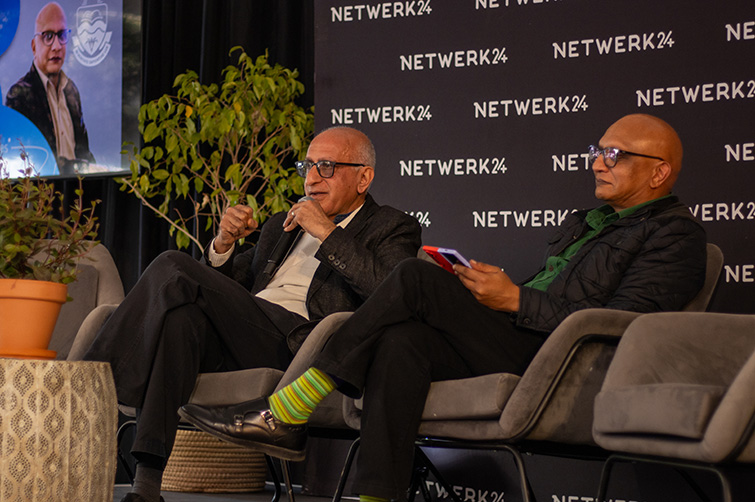 Prof Saleem Badat and Prof Vasu Reddy in conversation at the Vrystaat Arts Festival during the session Universities, Change, and Memory on 9 July 2026.
What does it mean for a university to take its own history seriously? Not to commemorate it, not to celebrate it selectively, but to subject it to the same rigorous, unflinching scrutiny it applies to everything else?
The occasion was partly a celebration of Prof Badat's new book, Roads to Rhodes University and Beyond: Adventures in Knowledge and Activism, published by UKZN Press – the fifth book he has written or edited on universities in South Africa since 1999. But the conversation quickly extended beyond the book itself to the larger questions that have defined Prof Badat's career: what universities are for, how they have shaped and been shaped by the societies around them, and what it takes to transform institutions that are, by nature, resistant to change.
In his opening remarks, Prof Vasu Reddy observed: “This session has many meanings. It is about universities as keepers of memory. This has much to do with how institutions preserve histories, knowledge traditions, and collective identities. It is also about how memory shapes change. It is about how we confront difficult, shared histories and how innovation is rooted in heritage, with respect to renewal, relevance, and future-focused thinking. But perhaps it is also about how we reflect on transformation – not simply as nostalgia, but how the university is always a catalyst for meaningful change and is always in flux.”
A book that is also an argument
Roads to Rhodes University and Beyond is not an ordinary academic memoir. According to one anonymous peer reviewer, it "will certainly rank among the best" works on South African higher education, sitting alongside landmark texts by Stuart Saunders, GR Bozzoli, and Mervyn Shear. What sets it apart, the reviewer notes, is that it "draws upon finely ground autobiographical detail to tell a hopeful tale, notwithstanding that it is peppered with critique".
Media pioneer and former BBC journalist Waseem Mahmood describes it as "an extraordinary work: rich, layered, and deeply reflective". For Mahmood, "Saleem's life becomes a mirror of the country's own trajectory: from the segregated spaces of his Durban childhood, through the fervour and defiance of activism, to the moral complexities of leadership in the democratic era. It is autobiography and national history in dialogue with one another."
The book combines memoir with critical reflections on Prof Badat's tenure as vice-chancellor of Rhodes University – the first black South African to hold that post in 102 years – and with analytical essays on the challenges of leading and transforming South African universities in the democratic era.
Mamphela Ramphele has written that she "cannot think of a better person in South Africa who has the depth, breadth, intellect, and passion to be a witness to the unfolding journeys of higher education transformation in South Africa than Saleem Badat". The book, she adds, is "a life well lived in service of humanity".
What it means to take history seriously
In the conversation at the festival, Prof Badat directly addressed the question of what it takes for a university to engage honestly with its own past.
"Universities tend to be coy to critically analyse their histories in all their complexity," he observed. "For a university to take its history seriously means to critically analyse its character, purposes, functions, roles, and goals – how it has functioned and what roles it has played at different times, including under colonialism, segregation, apartheid, and in the post-1994 period."
This is not, he argued, merely an exercise in institutional introspection. It is about understanding who gets educated, how, and to what end. "It is about building knowledge and understanding. Undertaken well, it can have great institutional value and inform the challenge of transforming and decolonising our universities."
On the question of how universities make decisions and who shapes those decisions, Prof Badat was equally direct. "Universities are shaped by diverse social forces, the state and government, business, donors, academics, students, and workers. Each may have different ideas about the purposes, functions, and roles of a university." Cooperative governance, he argued, is not simply a procedural value. It requires that decisions be taken 'deliberatively, consultatively, and democratically,' with the institutional machinery in place to make that possible.
For Prof Reddy, the conversation accentuated a set of convictions. "Memory matters at universities – to preserve, interrogate, and renew across generations. History is a resource, not a burden, because difficult pasts enable changed futures. Scholarship and activism reinforce each other when knowledge is connected to real transformation. Hope and critique belong together. Leadership is ultimately human, not corporatised. Transformation is a continuous journey. And above all, social impact is central to what universities are for – inspiring action and advancing humanity."
A body of work, a sustained argument
A book on the history of universities in South Africa is anticipated for publication next year, with further works in progress on the history of the University of the Free State, the University of Limpopo, and Ruth First as a teacher.
For the University of the Free State, the session was a fitting expression of the university's commitment to scholarship that is publicly engaged, historically grounded, and willing to turn its analytical gaze on itself.