24 July 2026
|
Story Christelle du Toit
|
Photo Kaleidoscope Studios
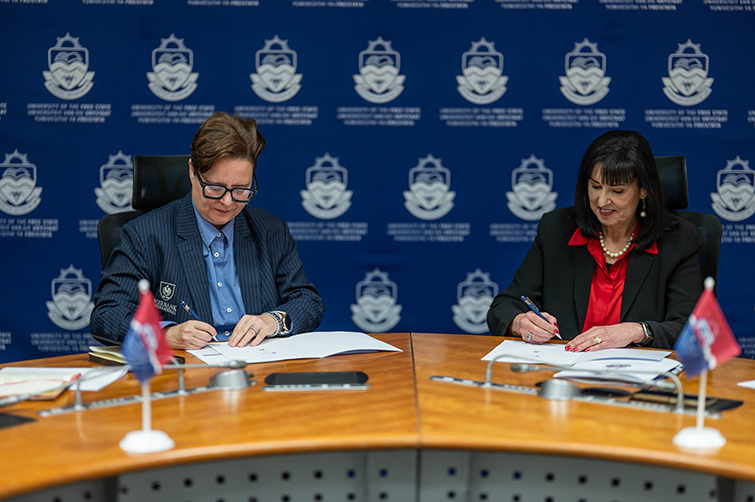 Prof Hester C. Klopper, Vice-Chancellor and Principal of the University of the Free State (UFS), and Prof Linda Meyer, Managing Director and President of Rosebank International, formalised a new partnership aimed at strengthening collaboration between public and private higher education and opening new opportunities for higher education development across Africa.
The University of the Free State (UFS) and Rosebank International have opened a new chapter in higher education collaboration, bringing together the strengths of public and private higher education to explore how institutions can respond collectively to the changing needs of South Africa and the continent.
The Memorandum of Understanding (MoU), signed by Prof Hester C. Klopper, Vice-Chancellor and Principal of the UFS, and Prof Linda Meyer, Managing Director and President of Rosebank International, establishes a five-year framework for cooperation in research, teaching and learning, community engagement, academic exchange, conferences, and collaborative virtual initiatives.
The signing brought together senior representatives from both institutions, including Prof Sam Tshehla, UFS Deputy Vice-Chancellor: Strategic Initiatives, International and Institutional Affairs; Prof Philippe Burger, Dean of the UFS Faculty of Economic and Management Sciences; Dr Oliver Seale, Executive Dean at Rosebank International; and Modisa Tlhame, Campus Head of Rosebank International in Bloemfontein.
For Prof Klopper, the significance of the agreement extends beyond the activities listed in the MoU. It is about deliberately choosing partnerships and using the complementary strengths of different institutions to create something with wider societal value.
“We need to be careful about who we make partnerships with,” she said, highlighting the importance of working with institutions that demonstrate steadfastness and credible leadership.
She described the partnership as purposeful and closely connected to the UFS vision of contributing meaningfully to responsible societal futures. It also speaks directly to an issue close to her heart: the future of higher education and the role that universities must play in shaping it.
Prof Klopper sees the agreement as a potential ‘springboard for many more things to come’.
“How can we collectively also serve the continent?” she asked.
Breaking through traditional boundaries
That question is particularly significant because the partnership brings together institutions from two parts of the higher education system that have traditionally operated largely in separate – and sometimes competitive – spaces.
Rosebank International brings the reach and agility associated with private higher education, while the UFS contributes the depth of a comprehensive, research-led public university with established academic and continental networks.
Rather than viewing these differences as boundaries, the partnership creates space to explore how complementary institutional models can generate new approaches to higher education.
Prof Meyer described the agreement as a ‘landmark achievement in the private and public education sector’.
She said the partnership is especially important within the context of South Africa’s youth unemployment crisis, where access to relevant, high-quality higher education can contribute to meaningful systemic change.
“We both understand the importance of higher education,” she said. “We see this as a meaningful partnership not only in South Africa, but also on the African continent.”
From competition to collaboration
Dr Oliver Seale, Executive Dean: Academic at Rosebank International, placed the partnership within an even broader shift needed in higher education.
Reflecting on his own journey – including completing his master’s degree at the UFS – he said universities and private higher education institutions have historically operated in a competitive environment, sometimes to their own detriment.
Africa’s growing need for higher education requires a different way of thinking.
The opportunity, he said, is to move beyond individual institutions and consider the wider higher education ecosystem: how public and private institutions can collaborate, expand capacity, and develop approaches that are increasingly Pan-African in their reach.
The MoU is therefore ‘the start of the process’, rather than an end in itself.
Building capacity for Africa
One potential expression of this ambition is Higher Education Futures Africa (HEFA), envisioned as a platform for institutions to strengthen leadership, governance, organisational capacity, and collaboration across African higher education.
The HEFA framework identifies the UFS and Rosebank International as founding higher education institutions. It envisages combining institutional advisory expertise with leadership and management development, knowledge creation, and communities of practice to help universities respond to pressures ranging from growing enrolments and financial constraints to technological disruption and changing labour-market demands.
The framework positions collaboration itself as central to the model: universities and other partners would share knowledge, strengthen institutional capacity, and develop solutions suited to African higher education contexts.
Prof Klopper believes this is where the partnership can become particularly consequential.
“There are so many opportunities for us to grow,” she said.
The signing creates the foundation for those opportunities. Its longer-term significance will lie in what the two institutions build from it – and whether a partnership that crosses the public-private higher education divide can offer new ways of expanding capacity, strengthening institutions, and serving a continent whose demand for higher education continues to grow.