21 July 2026
|
Story Siqhamo Hlubi Jama
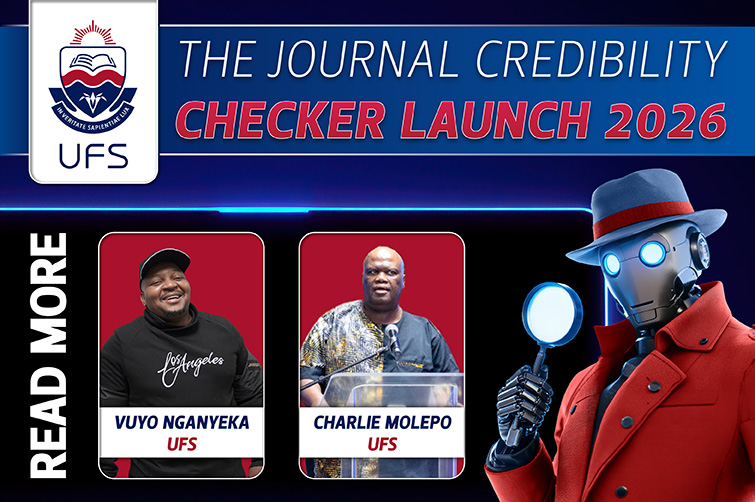 Charlie Molepo and Vuyo Nganyeka from the University of the Free State Library and Information Services will present the official launch of the Journal Credibility Checker on 22 July 2026 at the Sasol Library on the Bloemfontein Campus.
Every year, researchers lose time, money, and credibility to predatory journals – publications that mimic the appearance of legitimate academic venues while offering none of their rigour. Identifying which journals are credible, accredited, and worth submitting to has until now required navigating multiple databases, policy documents, and institutional agreements separately.
The University of the Free State Library and Information Services has built a solution. On 22 July 2026, it officially launches the Journal Credibility Checker, a web-based platform developed in-house and believed to be the first of its kind in South Africa. Available at Journal Credibility Checker, the tool brings together authoritative sources in a single intelligent platform, giving researchers the information they need to publish smarter and with greater confidence.
What the tool does
In practical terms, a researcher can use the platform to verify whether a journal is accredited by the Department of Higher Education and Training, determine its indexing coverage, assess its open access options, and establish whether it falls under a SANLiC read and publish agreement.
The SANLiC dimension of the platform deserves particular attention. The South African National Library and Information Consortium (SANLiC) negotiates agreements with major academic publishers on behalf of South African universities. A transformative agreement means that the university already pays for access to journals and, in certain cases, may also cover open-access publishing fees – known as article processing charges (APCs) – for its researchers.
In practical terms, a researcher at the University of the Free State may be able to publish a journal article with open access status without paying a single rand out of pocket, provided that the journal, publisher, and institutional eligibility requirements fall within the scope of the agreement. The Journal Credibility Checker enables this at a glance, eliminating what has historically been a time-consuming and often confusing process.
The platform is continuously being enhanced to deliver comprehensive, real-time journal data to the University of the Free State’s research community.
A tool built for researchers by the library
The Journal Credibility Checker was developed by the University of the Free State Library and Information Services, which has consistently positioned itself as a partner in the university's research enterprise rather than merely a custodian of its collections. The platform reflects the library's commitment to practical, evidence-based support for researchers at every career stage.
The official launch will take place at the Sasol Library on the Bloemfontein Campus on 22 July 2026 from 12:00 to 13:00. The event will be presented by Charlie Molepo and Vuyo Nganyeka from the University of the Free State Library. Attendance is open to all researchers, postgraduate students, and academics, with registration available online.
Why it matters
Predatory publishing is not simply an inconvenience. For researchers whose career progression depends on publishing in accredited, indexed journals, a single misstep can have lasting consequences affecting research output recognition, grant eligibility, and institutional standing. The Journal Credibility Checker addresses this risk directly by giving researchers immediate access to the information needed to make sound publishing decisions.
At the same time, it supports research visibility. Publishing in journals that are indexed in Scopus or Web of Science, or in open-access venues covered by transformative agreements, significantly increases the likelihood that research reaches the audiences it is intended to serve. For a university committed to building responsible societal futures, ensuring that knowledge is produced, protected, and widely accessible is not a peripheral concern. It is central to the mission.