21 July 2026
|
Story Onthatile Tikoe
|
Photo Stephen Collett
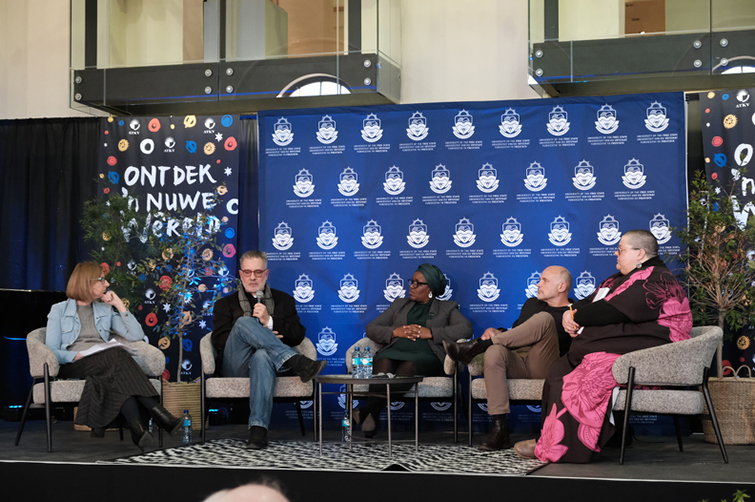 Panellists at the University of the Free State’s Reading Still Matters discussion explored the role of reading in developing critical thinking, creativity and informed citizenship in an increasingly AI-driven world. The discussion was held in collaboration with the Vrystaat Literature Festival.
As artificial intelligence changes how people find, process, and produce information, the ability to read critically may become more important, not less.
This was a central theme of the University of the Free State’s (UFS) Reading Still Matters panel discussion, held in collaboration with the Vrystaat Literature Festival. Bringing together perspectives from literature, philosophy, and Library and Information Services, the discussion explored why reading remains fundamental to critical thinking, creativity and informed citizenship in a world increasingly shaped by artificial intelligence (AI).
Reading as the foundation of a knowledge society
Against the backdrop of South Africa’s ongoing literacy challenges, Prof Brokensha highlighted the importance of developing reading and writing as essential human capabilities.
Molopyane reflected on the role of libraries in building a knowledge society, describing reading as a cornerstone of informed citizenship.
“As librarians, we are advocates for a knowledge society. We want communities that know how to identify, evaluate, critically analyse, and apply information.”
Drawing on her experience as a former teacher, she stressed that investment in reading should begin early. She also highlighted the UFS Library’s Collect a Book campaign, which has contributed to the establishment of approximately 25 school libraries over the past three years – extending access to books and opportunities for reading beyond the university’s campuses.
Reading critically in the digital age
The panel considered how digital technologies have transformed reading habits, while raising concerns about declining reading stamina and critical engagement. Dr Henning acknowledged the value of digital reading but argued that printed books continue to offer unique cognitive benefits. "I am a proponent of reading. I do not care how you read or what you read, as long as you read critically."
She argued that physical books can encourage deeper comprehension, reflection and information retention, while digital platforms often compete for readers’ attention through constant distractions. She further noted that many students arrive at university without the critical reading skills necessary to engage meaningfully with complex texts.
Human intelligence beyond artificial intelligence
Artificial intelligence emerged as a central theme throughout the discussion. Prof Rossouw challenged the popular understanding of AI, describing it instead as ‘intelligence simulation’ that reproduces existing patterns of knowledge rather than generating genuine human understanding.
Building on this, Dr Henning encouraged students to use AI responsibly as a tool to support learning rather than replace independent thought. "You are smarter than AI, because AI can only reproduce what it already knows. Human beings bring originality, creativity, reasoning, and a broader context."
The discussion highlighted that while technological innovation continues to reshape higher education, the ability to think critically, interpret information, and exercise sound judgment remains uniquely human.
Reading as an investment in humanity
Closing the discussion, Prof Brokensha reflected on reading as more than an academic exercise, describing it as a means of cultivating empathy, imagination, and thoughtful engagement with society. "In a digital age overflowing with more information than either knowledge or wisdom, reading is not just about consuming words. It is about thinking deeply, imagining freely, and engaging critically with the world around us. It is about being human."
As AI becomes increasingly embedded in education and everyday life, the discussion highlighted a challenge that extends well beyond how people consume information: how to retain the critical judgment, creativity and curiosity needed to make sense of it. Reading, the panellists argued, remains central to developing those distinctly human capabilities.