19 June 2026
|
Story Anthony Mthembu
|
Photo Supplied
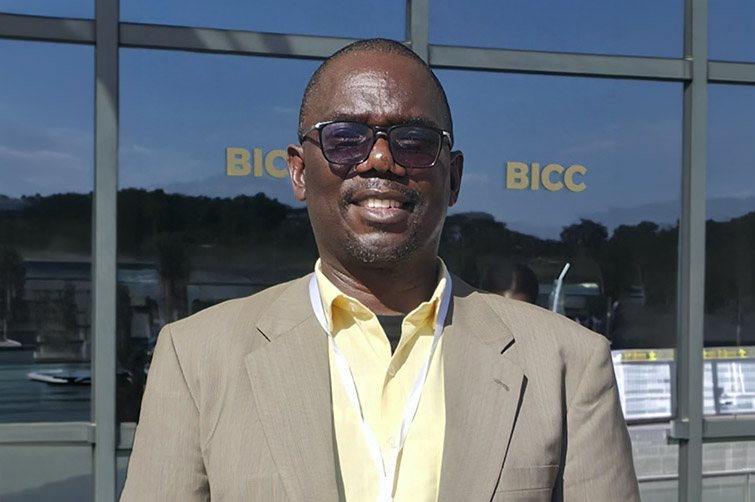 Prof Bryson Nkhoma: Research Fellow at the University of the Free State (UFS).
According to Prof Bryson Nkhoma, Research Fellow at the University of the Free State (UFS) and lecturer at Mzuzu University, lake-level fluctuations, climate variabilities, and cross-border state conflicts are some of the challenges plaguing communities around Lake Malawi. That realisation inspired a project aimed at investigating how colonial and post-colonial fisheries management and development programmes continue to shape the above contemporary sustainability challenges in Lake Malawi's transnational waters.
The project, titled ‘Colonial currents, contemporary countercurrents: historical legacies and collaborative futures in Lake Malawi's transnational fisheries’, is an interdisciplinary research project that was recently funded by the British Academy with a sum of two-hundred and ninety-nine thousand, one hundred and forty-one pounds (£299,141.00) under the International Interdisciplinary Research Project 2026. The project is a collaborative initiative between a team of historians, linguists, and scientists from both the University of Strathclyde, led by Dr David Wilson, Mzuzu University and Lilongwe University of Agriculture and Natural Resources led by Prof Nkhoma.
How the project unfolds
“The project will examine how non-state actors, from fishers and traditional authorities to international development agencies, have responded to challenges that transcend the borders of Malawi, Mozambique, and Tanzania since the mid-Twentieth Century,” said Prof Nkhoma. He explained that the project will operate across two carefully selected sites, namely Likoma Island and Mwenetete, as these reflect key aspects of transnational fisheries challenges. In addition, historical interrogation through archival documentation, and oral histories with participatory research methods and community-directed environmental analysis will be used to carry out that examination.
Consequently, this initiative, which is meant to run until 2028, is set to have several implications. For instance, “It provides a holistic framework for imagining historically grounded and environmentally informed fishing futures rooted in community realities and perspectives,” explained Prof Nkhoma. In addition, the findings of the project will offer new ways of addressing the planetary challenges of sustainable fisheries through equitable knowledge partnerships, especially where colonial legacies hinder effective governance with consequences for human, fish, and environmental health.
Successful completion of the initiative
Prof Nkhoma maintains that successful completion of the project is threefold. Firstly, it will be impactful for the British Academy, as some publications will materialise from this research. Secondly, it will be impactful from a policy perspective, since after the project, they plan to prepare policy briefs and scenarios for effective fisheries governance that will inform policy action in the areas around Lake Malawi. Finally, this project will be impactful to communities surrounding these sites as they will be empowered through the amplification of their voices. “We hope to share their voices with policymakers, and through participatory approaches, we hope to discuss with them fisheries governance issues to improve their understanding,” explained Prof Nkhoma.
Furthermore, he highlighted that this project is imperative, because Africa needs locally made solutions to its problems. Additionally, research led by Africans increases local voices, which is critical to sustainability and fisheries governance.