10 June 2026
|
Story Prof Hester C. Klopper
|
Photo Kaleidoscope Studios
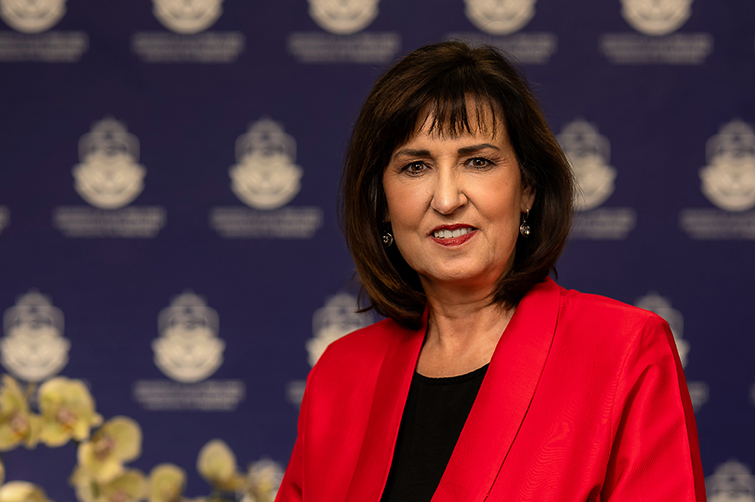 Prof Hester C. Klopper reflects on her first year as Vice-Chancellor and Principal of the University of the Free State.
The first year of any leadership journey invites reflection. For me, that journey began on 9 June 2025 when I was inaugurated as the 15th Vice-Chancellor and Principal of the University of the Free State (UFS) – the first woman to hold this office in the 122-year history of the university. As I reflect on the year that followed, I do so with deep gratitude, humility, and a renewed sense of purpose.
From the outset, I spoke about the importance of ‘walking with purpose’. For me, this was never intended as a slogan. It was a commitment to deliberate leadership, thoughtful decision-making, and ensuring that every strategic choice contributes to building a university that remains relevant, impactful, and responsive to the society it serves.
Refining our strategic direction
Perhaps the most consequential work of the past year has been the strategic refinement of our institutional direction. Through consultation across the university community, we undertook a mid-term review of our Strategic Plan, not simply to assess progress, but to ensure that the University of the Free State is in sync with the geopolitical shifts we are seeing in the multipolar world. It became clear that the rapidly evolving higher education landscape required not only reflection, but recalibration.
This process resulted in a renewed vision for the university as an innovative research-led, student-centred, and regionally engaged institution contributing meaningfully to responsible societal futures. More importantly, it sharpened our focus around five strategic priorities: advancing academic excellence and research impact; building institutional agility and responsiveness; nurturing a transformational institutional culture; strengthening long-term sustainability; and accelerating collaborative innovation and global integration.
To support these priorities, we identified several strategic themes that now guide our investment decisions and institutional planning. These include academic renewal, the development of an innovative and entrepreneurial ecosystem, comprehensive internationalisation, systemic sustainability, and the optimisation of our multi-campus model. Together, these themes provide a framework for ensuring that every initiative, partnership, and investment contributes to long-term impact and institutional excellence.
This strategic refinement has provided greater clarity of purpose across the institution. It has enabled us to move beyond incremental change and to position the UFS to lead confidently in an era defined by technological disruption, societal complexity, and rapidly evolving expectations of higher education.
This strategic direction has also informed the strengthening of our leadership team and the continued alignment of our institutional priorities. Together, we are building a university that is innovative, research-led, student-centred, and deeply engaged with the region, continent, and world around us.
One of the most valuable lessons I have learned during this first year is the importance of listening. Through engagements with students, staff, alumni, government, industry partners, donors, and community stakeholders, I have gained an even deeper appreciation of the role the University of the Free State plays in shaping lives, communities, and futures. These engagements have reinforced my belief that our greatest strength is our people – our students, staff, alumni, partners, and supporters. It is their talent, resilience, and commitment that enable us to achieve excellence, drive innovation, and make a meaningful contribution to society.
Student success and investing in people
Our commitment to student success remains at the centre of our academic enterprise. Universities exist because of students, and their success remains our most important measure of impact. I highlighted in my inauguration speech that one of the questions that keeps me up at night is, ‘How do we further unlock the potential that lies dormant in our own university?’
During the past year, we introduced several interventions aimed at strengthening student support, improving access to financial assistance, and reducing barriers that often compromise academic success. The launch of the VC-ISRC Imbewu Legacy Fund stands as one of the clearest expressions of this commitment. Developed in partnership with student leaders, the fund reflects our shared belief that no deserving student should be denied the opportunity to succeed because of financial hardship.
More than a funding initiative, Imbewu embodies our conviction that investing in students is an investment in the future. It challenges us to think differently, act boldly, and walk with purpose in building a university where opportunity, belonging, and success are accessible to all. Guided by the principle that every seed counts and every student matters, the fund serves as a powerful reminder that even the smallest contribution can help transform a life and unlock potential.
Equally important has been our continued focus on creating an environment in which both students and staff can thrive. I remain convinced that institutional excellence and human well-being are mutually reinforcing. This conviction has informed initiatives aimed at strengthening student wellness, leadership development, staff growth, and the advancement of women in academia through programmes such as Women Influencing Scholarship and Education (WISE).
At the same time, we have focused on building a more agile and future-ready institution through the alignment and optimisation of professional and support services, the renewal of our academic programme portfolio and structures, and the development of a Strategic People Development Strategy. Central to this effort is the UFS Training Academy, which will be the home of staff learning and development, reinforcing our commitment to investing in our people as the foundation of our long-term success.
Innovation, research, and academic renewal
The rapidly changing world of work requires universities to continually reimagine how they prepare graduates for the future. During the past year, we have advanced the renewal of our academic programme portfolio to ensure that our qualifications remain relevant in an era increasingly shaped by technological disruption, artificial intelligence, sustainability challenges, and changing labour market demands.
This renewal is reflected in the development of new qualifications, including the planned Bachelor of Veterinary Science programme, Agricultural Biosystems Engineering, and innovative postgraduate programmes in Ecological and Nature-based Engineering Sciences, which address emerging societal and environmental challenges. Alongside disciplinary expertise, we are placing greater emphasis on developing graduates who possess critical thinking, ethical judgement, entrepreneurial capability, digital fluency, and the ability to navigate complexity.
Our commitment to being a university in Africa, and for the world, has remained central throughout the year. We continue to strengthen research that is globally competitive while remaining locally relevant. The establishment of thematic research leadership areas focused on sustainability, societal advancement, planetary health, and social flourishing demonstrates our determination to produce knowledge that contributes meaningfully to addressing the most pressing challenges of our time.
The year also yielded several noteworthy achievements, from exceptional student success in national competitions to pioneering advancements in health-care innovation and research excellence. We became the first clinical site in the world to integrate artificial intelligence into cancer treatment planning through a Radiation Planning Assistant. We launched a first-of-its-kind Giraffe Research Programme. And we achieved Platinum status under the Good Financial Grant Practice accreditation – the only South African university to do so. As part of our digital transformation, we recently launched a new learning management system to support innovative, accessible, and student-centred teaching and learning experiences.
From the outset, I have consistently emphasised the importance of ethical leadership and institutional integrity. Excellence cannot exist without accountability. We have reinforced our commitment to transparency, good governance, and a zero-tolerance approach to corruption, fraud, gender-based violence, and academic misconduct. The values we espouse must be reflected not only in our policies, but also in our daily actions and decisions that demonstrate exemplary integrity and shared accountability.
Turning vision into action
A defining principle of my first year has been that strategy only has value when it is translated into action. Many of the commitments outlined during my inauguration have since evolved into concrete institutional initiatives that are shaping the future trajectory of the University of the Free State.
Preparations are advancing for the launch of the Free State Futures Forum, which will serve as a platform for thought leadership, dialogue, and collaborative problem-solving around the most pressing societal challenges facing our province, country, continent, and world. At the same time, we have consolidated our research agenda around four transdisciplinary thematic areas: Sustainable and Green Futures, Systems for Societal Advancement, Planetary Health Futures, and Social Dynamics for a Flourishing Life. These themes provide a coherent framework for addressing complex societal challenges through integrated and impactful research.
To support this ambition, the consolidated UFS Strategic Fund has been positioned as a catalyst for transdisciplinary research and innovation, including strategic investments in initiatives such as the expansion of the Interdisciplinary Centre for Digital Futures. We are also advancing the completion of the Transdisciplinary Innovation Hub on the South Campus, creating a space where researchers, students, industry partners, government, and communities can collaborate to develop solutions with real-world impact.
At the same time, the implementation of a comprehensive Transformation Scorecard is underway to strengthen accountability, measure progress, and accelerate our commitment to inclusivity, equity, and institutional transformation.
Our commitment to sustainability has similarly translated into action. The VC Talent Magnet Fund has made new appointments and continues to attract talent. We have created new institutional vehicles, including the UFS Knowledge Enterprise and UFS Commercial, to diversify revenue streams, optimise institutional assets, and strengthen the long-term sustainability of the university. Collectively, these initiatives reflect our determination to move beyond aspiration and ensure that our vision is realised through measurable impact, responsible stewardship, and meaningful societal contribution.
Internationalisation has remained a strategic priority throughout the year, strengthening our global profile and extending our contribution to responsible societal futures. Against this backdrop, we are performing well in major international rankings, with the Times Higher Education (THE) Africa Rankings placing us ninth on the African continent, and the inaugural QS World University rankings for Sub-Saharan Africa placing us eighth, based on our research and discovery, learning experience, and global engagement.
Through an Africa-first approach – complemented by carefully cultivated international partnerships – we have expanded opportunities for student and staff mobility, diversified our global collaborations, and strengthened networks that advance research, innovation, and mutual learning. Equally important, we have ensured that the university is represented in influential international forums where the future of higher education is being shaped. These efforts continue to position the UFS as a globally engaged, regionally relevant institution that contributes meaningfully to scholarship, leadership, and societal impact at both continental and international levels.
Building a sustainable future
While there is much to celebrate, leadership also requires honesty about the challenges we face. The higher education sector continues to operate within a demanding financial environment, and our university is not immune to these realities. Addressing long-term sustainability remains one of our most important responsibilities. Throughout the year, we have taken deliberate steps to strengthen institutional resilience while ensuring that our core academic mission remains protected.
As I look ahead, I do so with optimism and conviction. The past year has been one of listening, learning, building relationships, and refining our collective direction.
Together, we have established a stronger strategic foundation, anchored in academic excellence, innovation, sustainability, transformation, and societal impact. The future will demand courage, innovation, and adaptability from universities everywhere. I am confident that the University of the Free State is ready for that future. We have a clear direction, a committed community, and a shared belief that higher education can be a force for societal progress. As we enter our next year, we do so with purpose, conviction, and an unwavering commitment to shaping responsible societal futures.