27 March 2026
|
Story Christelle du Toit
|
Photo Stephen Collett
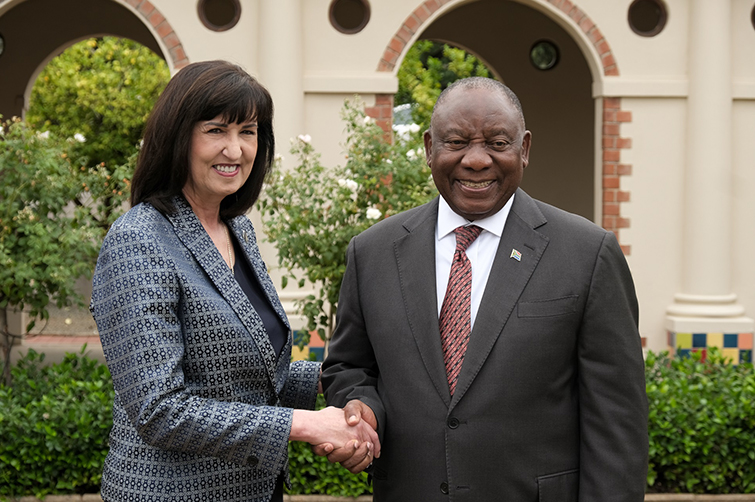 Vice-Chancellor and Principal of the University of the Free State, Prof Hester C. Klopper, engages with President Cyril Ramaphosa during the National Cabinet’s visit to the Bloemfontein Campus, where national and provincial leaders met to discuss service delivery and inclusive growth in the Free State.
President Cyril Ramaphosa and members of the National Cabinet visited the University of the Free State’s (UFS) Bloemfontein Campus on Friday, 27 March, where they met with the Free State Executive Council at the Centenary Complex to engage on some of the province’s most pressing challenges.
The closed session brought national and provincial leadership into direct conversation on service delivery, economic inclusion, and the conditions shaping growth across the Free State. The visit forms part of ongoing efforts to strengthen collaboration between spheres of government and to identify practical responses to challenges affecting communities.
While the discussions took place at the government level, the themes raised resonate strongly with work already underway at the university.
Across its campuses, the UFS is engaged in research, teaching, and community partnerships that respond to issues such as youth development, access to healthcare, and social cohesion. From projects that support young people navigating education and employment, to research that addresses health risks in vulnerable communities, the university’s work is closely tied to the realities facing the province.
Hosting the engagement reflects the role universities can play as spaces where knowledge, policy, and lived experience intersect. It also highlights the importance of grounding national priorities in the contexts where they are most keenly felt.
Vice-Chancellor and Principal, Prof Hester C. Klopper, welcomed the opportunity to host the engagement on campus.
“Universities have a responsibility to contribute to the broader societal context in which they exist,” she said. “Moments like this strengthen the relationship between higher education and government and create opportunities to align our work more closely with the needs of communities.”
By bringing together national leadership in a university setting, the engagement points to a shared responsibility: translating knowledge into action and shaping responses that are both inclusive and sustainable.
In this way, the UFS continues to contribute to building responsible societal futures – where collaboration, evidence, and community insight inform the path forward.