10 March 2026
|
Story Christelle du Toit
|
Photo Supplied
 The premiere of What remains through time, slowness and stillness will take place at the University of the Free State on 13 March. While attendance is limited, the film will be screened the following week in the Centre for Development Support.
How can a decolonisation exhibition breathe life into history without becoming an echo of the past? How do we dismantle inherited narratives without simply rearranging them?
These questions lie at the heart of What remains through time, slowness and stillness – a documentary born from a live art performance and exhibition that were first staged at the Oliewenhuis Art Museum during the Vrystaat Arts Festival in July 2025. What began as an interdisciplinary collaboration has evolved into a sustained enquiry into memory, material, and whose knowledge is recognised.
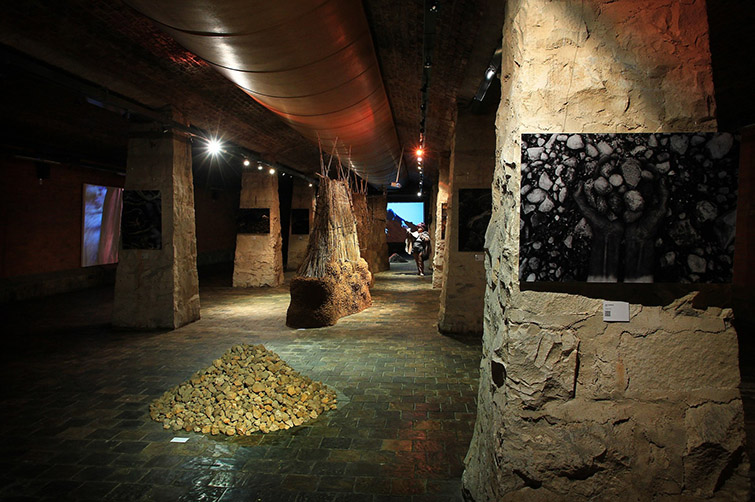
The project brought together, among others, interdisciplinary artist Sonya Rademeyer, Prof Keith Armstrong – Visiting Professor in the Centre for Development Support – and Dr Anita Venter from the University of the Free State (UFS). At its centre stood a cultural wall, or meraka – a gathering place – constructed using post-natural and indigenous methodologies, including clay and animal dung. In a later phase, live snails were introduced into the installation space, feeding on high-end Fabriano art paper – a deliberate unsettling of hierarchies between material, method, and meaning.
For Prof Vasu Reddy, Deputy Vice-Chancellor: Research, Innovation and Postgraduate Studies, the significance of such work extends beyond exhibition. “Decolonising knowledge begins with interrogating what we choose to remember. At the UFS, we turn to art not as ornament, but as a radical catalyst for reimagining just and inclusive futures. Art gives voice to memories that institutions have long overlooked. At the UFS, such work strengthens our commitment to cognitive justice and responsible knowledge production,” says Prof Reddy.
Prof Armstrong, who collaborated on one of the projected elements of the performance, argues that art enables society to confront coloniality in ways that traditional discourse cannot.
“Art can slow us down, shift our perspectives, and make structural issues of colonialisation emotionally real,” he says. “It shows how marginalised voices can shine through the cracks of old systems. Art does not just illustrate decolonisation; it enacts it. It gives us a way to unlearn, relearn, and imagine more just futures together.”
Dr Venter describes her role as co-conceptualist and community bridge, linking the project to more than a decade of grassroots building practice through the Meraka Cultural Village and Sekoele Holistic Living Arts Centre.
“The central altarpiece – composed of waste and earth materials – carried years of history, healing, and memory from communities whose arts-based practices had never received formal acknowledgement,” she explains. “Bringing that into a colonial museum space was itself an act of decolonisation.”
The accompanying documentary captures the slow, relational process of co-creation. Together, installation and film pose a quiet but disruptive question: what endures when we slow down? What remains when urgency is stripped away and we sit with stillness, with making, and with each other?
The collaboration has since extended into Radiant Walls, Prof Armstrong’s permanent community arts installation at the Sekoele Holistic Living Arts Centre. Recognised as an accredited non-traditional research output (artefact) at the Queensland University of Technology, it signals a growing acknowledgement that art can constitute rigorous research.
“Art is a way of knowing,” Dr Venter emphasises. “When an artefact, performance, or documentary produces new knowledge that conventional methods cannot, it meets every criterion of research. The reason it remains the exception rather than the norm is structural. Our universities inherited colonial frameworks that privilege written, propositional knowledge over visual, performative, and experiential ways of knowing.”
At its methodological core, the documentary draws on auto-ethnographic storytelling, a qualitative research approach that uses personal narrative to interrogate broader cultural and political realities. In doing so, it moves beyond autobiography to ask whose histories are preserved, whose are erased, and who decides.
“Art disrupts,” Dr Venter says. “It makes the familiar strange and the invisible visible – precisely what decolonising a curriculum requires. A colonised curriculum presents one way of knowing as universal. Art cracks that open. It redistributes narrative authority. Communities become authors, curators, and knowledge producers, not objects of study. This is cognitive justice in practice.”
The premiere of What remains through time, slowness and stillness will take place at the University of the Free State on 13 March. While attendance is limited, the film will be screened the following week in the Centre for Development Support.
Prof Reddy remarked, “True transformation demands more than rewriting history. It requires reshaping how we come to know. This project exemplifies the power of creative scholarship to expand our intellectual horizons. This is research with soul and purpose.”
By slowing down, the project offers more than just critique. It offers a practice. It asks not only what history we remember, but also how we choose to remember – and whether, in stillness, we might begin to imagine differently.