07 May 2026
|
Story Tshepo Tsotetsi
|
Photo Blackhood Photography
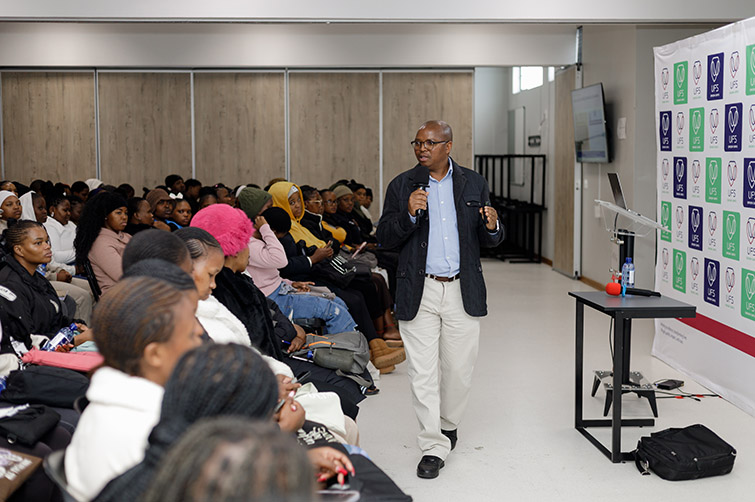 Students and academics participate in discussions on multilingualism and access to knowledge at the University of the Free State’s Qwaqwa Campus.
What happens when the language of learning is not the language you think in? This is a question that sits at the centre of many students’ educational experiences – and one that continues to shape how knowledge is accessed, shared, and understood in higher education.
At the University of the Free State (UFS) Qwaqwa Campus, this question framed a four-day Language for Sustainable Futures Series that drew together voices from health, education, economics, and the social sciences. The conversations focused on how language influences not only academic success but also participation, confidence, and inclusion in everyday learning spaces.
For Dr Tholani Hlongwa, Deputy Director of the UFS Academy for Multilingualism, the link between language and knowledge is fundamental. “Language is a tool for communication. This means that knowledge production and knowledge dissemination can only occur through language.”
Where disciplines meet through language
Across the series, speakers from different fields offered perspectives on how language shapes their disciplines and the people within them. Prof Motlalepula Matsabisa, Director of Indigenous Knowledge Systems in the Faculty of Health Sciences, reflected on indigenous knowledge systems within health, while Prof Nomalungelo Ngubane, Director of the Academy for Multilingualism, situated multilingualism within education and institutional practice. Dr Calvin Mudzingiri, Assistant Dean of the Faculty of Economic and Management Sciences, explored how language affects understanding in economics, and Dr Sello Sele, Sociology Lecturer, brought in insights from the social sciences, grounding the discussions in lived realities.
Together, these perspectives highlighted a shared challenge across disciplines: knowledge cannot be separated from the language through which it is taught and understood. When that language excludes, so does the knowledge itself.
Dr Hlongwa emphasised the role of multilingualism in addressing this imbalance. “Our diverse languages as tools of communication allow us not only to have a single access avenue.” Her reflection speaks to a broader shift in higher education towards recognising linguistic diversity as central to equity and access.
At the UFS, this approach is already taking shape. Through its Language Policy, the university has introduced translanguaging tutorials that allow students to engage with content using multiple languages. These practices acknowledge that understanding is often strengthened when students can process information in ways that reflect their own linguistic realities.
For Phindile Khoza, a third-year Education student, this makes a tangible difference in the classroom. “Language plays a huge role in our everyday lives, especially in how we access information and express ourselves.” Her experience points to the value of teaching approaches that allow students to fully participate in their learning.
Beyond the classroom, the work of the Academy for Multilingualism continues to extend into research and community engagement, including collaborations with local schools and participation in initiatives such as International Mother Language Day (celebrated annually on 21 February). These efforts create platforms where different language communities can engage openly and share perspectives.
The strong response to the series has also shaped its future. “The participation and the robust engagements have shown us how diverse language users have been hungry for such platforms,” Dr Hlongwa said. The series is set to become an annual feature on the Qwaqwa Campus, sustaining dialogue across campuses and disciplines.
In centring language within teaching, research, and engagement, the University of the Free State continues to align its work with the realities of the communities it serves. These conversations not only deepen academic understanding but also contribute to preparing graduates who can engage responsibly and meaningfully in a diverse and changing society.