06 May 2026
|
Story Siqhamo Hlubi Jama
|
Photo Stephen Collett
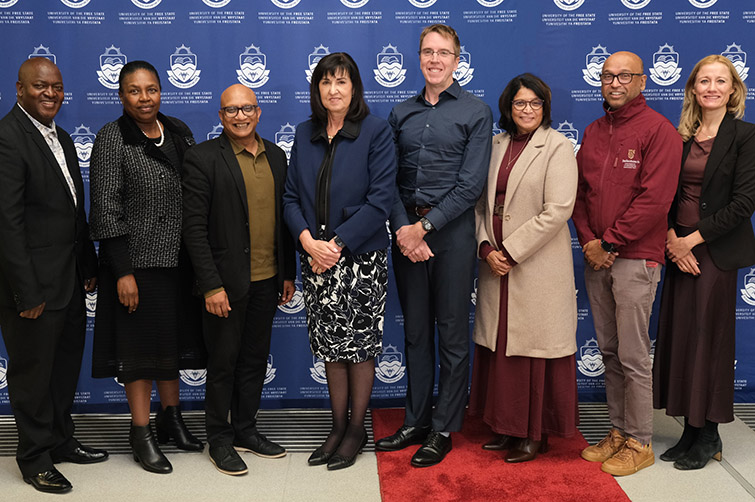 University of the Free State executives with Dr Ulrich Paquet from Google DeepMind (fourth from right) and Prof Kanshukan Rajaratnam (second from right) during the 2026 UFS Senate Conference in Bloemfontein, where discussions explored artificial intelligence, ethics, and the future of higher education.
“We cannot contribute meaningfully towards responsible societal futures if we do not first understand the forces shaping those futures before our eyes.”
With those words, the University of the Free State (UFS) Vice-Chancellor and Principal, Prof Hester C. Klopper, opened the 2026 UFS Senate Conference in Bloemfontein, setting the tone for discussions on artificial intelligence, ethics, and the future of higher education.
Under the theme Making Sense of the New Technological Era, the conference explored how universities can remain relevant and socially responsive amid accelerating technological and geopolitical change.
Prof Klopper emphasised that producing globally competitive graduates now requires more than technical proficiency. It also demands moral courage and the ability to think ethically in conditions of deep uncertainty.
The task, she argued, is not only to describe the crises shaping society, but to navigate them responsibly. Invoking the words of South African intellectual Njabulo Ndebele, she challenged Senate members to ‘make the ordinary extraordinary’ and to recognise transformative possibilities in everyday commitments.
From Gutenberg to the digital frontier
To understand where we are going, we must understand where we have been. Prof Johann Rossouw of the Department of Philosophy & Classics provided a vital historical lens, comparing the current technological transition with the Gutenberg era.
He noted that the widespread adoption of the printing press in 1450 ushered in monumental global shifts, including mass literacy and the democratisation of science. However, it also became a tool of colonial subjection. Relying on the work of philosopher Walter Ong, Prof Rossouw cautioned against repeating history by allowing new technologies to overshadow essential human contexts.
"There is no reason to fetishise the printed word as the only medium of science and thought as it was done in Eurocentric colonial times," Prof Rossouw explained. He stressed that the spoken word and face-to-face teaching remain vital for transmitting cultural memories and deep understanding, particularly in South Africa.
“The conference frames AI as an enabler and disruptor of higher education. We revisit the role of the university in a post-print, algorithmic world and positions the university as ethical, critical, and a strategic actor, not merely a spectator,” remarked Prof Anthea Rhoda, Deputy Vice-Chancellor: Academic and Co-Chair of the conference.
Democratising AI from the Global South
The conversation inevitably turned to artificial intelligence, addressing widespread anxieties about obsolete faculties and unemployable graduates.
Dr Ulrich Paquet, co-founder of the Deep Learning Indaba and a leading voice in global AI democratisation, presented a highly practical vision. Drawing on his work with Google DeepMind, he detailed the creation of a free, Afrocentric AI course that is already being integrated into university curricula across the continent.
He quoted physicist Richard Feynman to illustrate his point. "What I cannot create, I do not understand." For Dr Paquet, the solution to AI anxiety is active creation and continuous reinvention.
He left the Senate with a clear challenge, borrowing Steve Jobs' famous mantra. "My challenge for myself and for all of you as Senate members of universities is to also stay hungry and stay foolish, and not become all-in boring, but continuously reinvent ourselves."
Beyond the keynotes, a lively panel discussion focused on academia and industry to explore how AI is reshaping knowledge, work, and institutional relevance. Facilitated by Prof Kanshukan Rajaratnam (Stellenbosch University), the panel brought together Dr Herkulaas Combrink (UFS) and Chris Coetzee (from afrAIca – an industry partner of the UFS). This panel also highlighted the partnerships needed to address today’s most complex societal challenges. The panel invited discussion about rethinking what future-ready, ethically grounded institutions should look like in the future.
A highlight was the premiere of the documentary film, In Our Hands, which grounded debates in human stories and social realities. Prof Vasu Reddy, Deputy Vice-Chancellor: Research, Innovation and Postgraduate Studies and co-chair of the conference, says: “The film reminds us that technology is never abstract; it always lands in bodies, communities, and futures. The film complements academic debate by widening how we know, feel, and understand change. This film invites deeper reflection on agency, stewardship, and what is truly ‘in our hands.’ If the 2026 Senate Conference proved anything, it is that technology alone cannot chart the course of higher education. The true test for universities will be marrying that technology with human insight, strong ethical foundations, and the unique contexts of the Global South.