03 November 2026
|
Story Tshepo Tsotetsi
|
Photo Stephen Collett
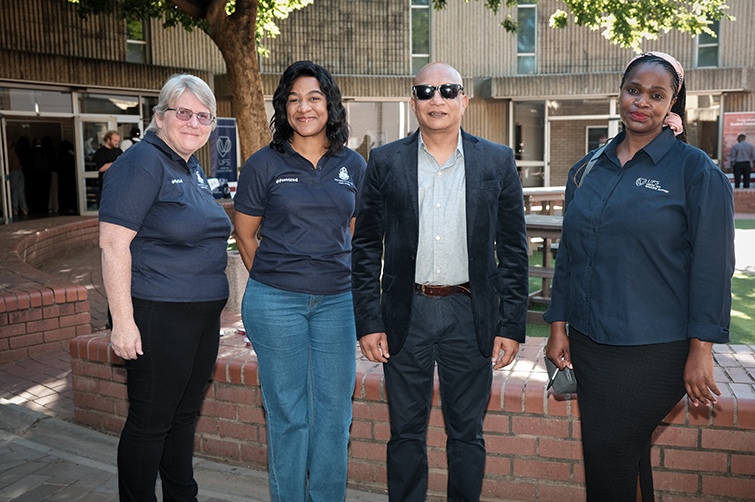 From left: Dr Danila Wessels, Acting Director of the Centre for Graduate Support (CGS); Dr Pamela Makati, Chief Academic Writing Officer, CGS; Prof Vasu Reddy, Deputy Vice-Chancellor: Research, Innovation and Postgraduate Studies; and Tshepiso Mokoena, Research Capacity Development Coordinator, CGS.
The questions explored through postgraduate research do not exist in isolation from the world around us. They emerge from the challenges communities face, the systems that shape people's lives, and the need to find new ways of understanding and responding to an increasingly complex society. Creating opportunities for emerging researchers to interrogate these challenges, share their findings, and learn from one another is central to building a research culture that extends beyond the university.
This thinking informed the University of the Free State's (UFS) 2026 Postgraduate Conference, held on 29 and 30 October under the theme Sustainable Systems for Planetary Well-being: Centring Student Voices towards Transdisciplinary Pathways to Just, Resilient, and Flourishing Societies. Bringing together honours, master's, and doctoral students from the University's three campuses, the two-day conference provided a platform for postgraduate researchers to present their work, engage with fellow scholars, and explore connections between different fields of study. The programme featured research on water security, food systems, environmental sustainability, social justice, education, healthcare, and several other areas, illustrating how diverse academic disciplines can contribute to addressing interconnected societal challenges.
In his welcome and opening remarks, Prof Vasu Reddy, Deputy Vice-Chancellor: Research, Innovation and Postgraduate Studies, remarked, “A postgraduate degree is more than just an academic qualification. Our postgraduate students are future-orientated. They are creators of knowledge rather than simply being recipients. The capabilities we facilitate for our students are important in a rapidly changing world. When student voices are centred in research, we unlock new pathways towards more just, resilient, and flourishing societies.”
The importance of this engagement was further underscored by keynote speaker Prof Narnia Bohler-Muller, leader of the UFS Flourishing Life Research Theme, who challenged participants to consider what it truly means for students and communities to flourish. Drawing attention to the structural and social conditions that can prevent people from reaching their potential, she argued that universities must look beyond access and academic performance when considering student success. "Social justice in a university cannot be measured by access alone; it must also ask whether students flourish once they arrive," she said, emphasising the importance of listening to students and recognising them as partners in shaping more just institutions and societies.
Research beyond disciplinary boundaries
The conference’s emphasis on student voices and societal relevance also raises questions about how research is approached and whose perspectives shape it. In her keynote address, Prof Bohler-Muller argued that universities must recognise students not merely as recipients of knowledge, but as contributors whose experiences can inform institutional thinking and decision-making. Drawing on ubuntu, she highlighted the importance of relationships and dialogue in creating environments where people can flourish.
Dr Danila Wessels, Acting Director of the Centre for Graduate Support, said the conference’s broad theme was deliberately chosen to accommodate research across different fields, including those that may not traditionally be associated with planetary well-being. The intention, she explained, is to encourage students to look beyond the boundaries of their own disciplines and recognise the value of engaging with other areas of knowledge.
"We also want to bring students into the mindset of the University, where we engage in interdisciplinary, transdisciplinary, and multidisciplinary research," she said.
The conference is the second of its kind, following its inaugural edition on the Qwaqwa Campus in 2025. The rotation between campuses is intended to give postgraduate students across the University the opportunity to participate in this kind of academic exchange. Dr Wessels also highlighted the value of the questions and feedback students receive during presentations, which can open up new ways of thinking about their research.
Taking research beyond the university
For PhD student Sibabalwe Bonga, the opportunity to engage with fellow researchers provided a space to test her ideas, consider the feasibility of her research objectives, and learn from the experiences of others. "It helps you unpack all the thoughts that you have in mind. It helps you translate all your ideas and weigh the feasibility of your objectives," she said.
Her own research is rooted in a personal connection. Having grown up in a village in the Eastern Cape, where she helped her father herd cattle and immunise calves, Bonga developed an appreciation for the socioeconomic importance of cattle. This experience helped shape her interest in researching Mycobacterium bovis, a zoonotic form of tuberculosis, and exploring its potential links to the burden of multidrug-resistant and extensively drug-resistant tuberculosis in the province. She hopes her work will contribute to the betterment of communities such as the one she grew up in.
The conference also offered a valuable perspective for Mpho Mokgabudi, an honours student in Curriculum Studies in the Faculty of Education on the Qwaqwa Campus. Engaging with research beyond her own field gave her a clearer sense of the breadth of postgraduate scholarship and the kinds of questions that can emerge when different disciplines come into conversation.
She also reflected on how the experience had changed her understanding of academic presentations. Having received feedback on how to communicate her research more clearly, she now feels better equipped to approach the expectations of postgraduate study at master's level. "I got to broaden my horizons because there are different topics, and I haven't even considered much of those things in my study," she said.
The experiences shared by Bonga and Mokgabudi speak to the value of creating spaces where postgraduate researchers can learn from one another, sharpen their thinking, and see their work in a wider context. Beyond the thesis or dissertation, the challenge is to consider how the knowledge they produce can engage with the realities of society and contribute to the futures they seek to shape.
“Research excellence and social relevance are not competing goals. Together, they strengthen the capacity of universities to serve society. Our postgraduate student conference is a reminder and a commitment that discovery is not a solitary act. It is built through dialogue, mentorship, collaboration, and a shared commitment to advancing the public good,” observed Prof Vasu Reddy.