03 November 2026
|
Story Siqhamo Hlubi Jama
|
Photo Supplied
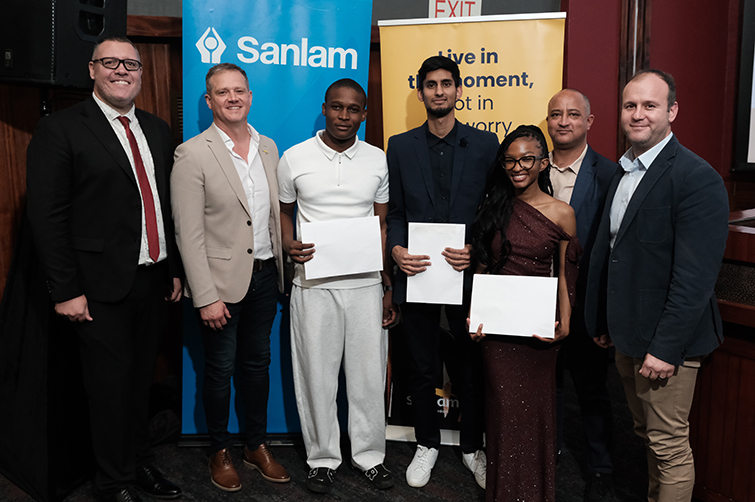 Students were recognised for outstanding performance in the 2026 Sanlam Investments/Santam Economist of the Year competition, a collaboration between the Department of Economics and Finance and industry partners.
Predicting the future is never easy. Making sense of economic trends through evidence, analysis, and informed judgement, however, is what distinguishes skilled economists.
This was demonstrated at the third Annual 2026 Sanlam Investments/Santam Economist of the Year competition, hosted by the Department of Economics and Finance at the University of the Free State (UFS). Over six months, students applied their knowledge to forecasting key economic indicators before presenting and defending their findings before a panel of academics and industry experts.
The competition culminated in the recognition of three outstanding students whose analytical abilities, economic insight and forecasting skills distinguished them in a highly competitive field.
Taking first place was Suhail Malek, a BCom Honours Finance student, Rhulani Nkomo, a first-year Actuarial Science student, secured second place, while Ntsekiseng Letlela, a second-year BCom Economics student from Lesotho, took third place.
Beyond economic forecasting
Established to bridge the gap between academic theory and professional practice, the competition challenges students to apply economic concepts to real-world scenarios. Participants were required to forecast a range of economic indicators over a six-month period and were assessed not only on the accuracy of their predictions, but also on their ability to articulate their economic reasoning and defend their conclusions.
Opening the event, Prof Johan Coetzee, Head of the Department of Economics and Finance, reflected on the broader purpose of the initiative. He emphasised that today’s employers seek graduates who can think critically, solve problems, communicate effectively and adapt to different working environments and cultures.
According to Prof Coetzee, studying economics involves more than acquiring technical knowledge. It also requires developing the judgement, analytical abilities and communication skills needed to interpret complex realities and make informed decisions in an increasingly uncertain world.
"Part of that process is that we ensure that you have the skills. That implies that we need to create an environment that allows you to think critically and solve problems," he said.
He also highlighted the unprecedented opportunities that technology and access to information offer students, noting that continuous learning and self-development are now more accessible than ever before.
Developing responsible future economists
For the finalists, the competition offered more than an opportunity to demonstrate their academic knowledge. It provided a practical platform to engage with real-world economic challenges, strengthen their analytical capabilities and develop the confidence to present and defend their perspectives before a professional audience.
The initiative reflects the UFS’s commitment to developing graduates who can apply their knowledge and skills to address complex societal challenges. By engaging with economic trends, policy developments and financial indicators, students gain valuable practical experience that can prepare them for careers in economics, finance, policymaking and research.
The competition recognised the top 11 finalists, rewarding excellence in both forecasting and presentation. The judging panel comprised industry professionals and academic staff, giving participants valuable exposure to professional standards and expectations.
Top-performing students from each year group also received certificates in recognition of their achievements. Prof Coetzee expressed the Department’s intention to nurture and retain emerging talent at the University.
“We want to grow our own timber,” he said, adding that the competition is set to expand next year, with school learners also being invited to participate.
By creating opportunities for students to apply economic theory, engage with real-world challenges and develop the skills required in the workplace , the competition demonstrates how the UFS is preparing the next generation of economists to contribute meaningfully to society.
It is also a practical expression of the University’s commitment to shaping responsible societal futures through relevant learning, critical thinking and the development of future leaders.