03 November 2026
|
Story Siqhamo Jama
|
Photo Supplied
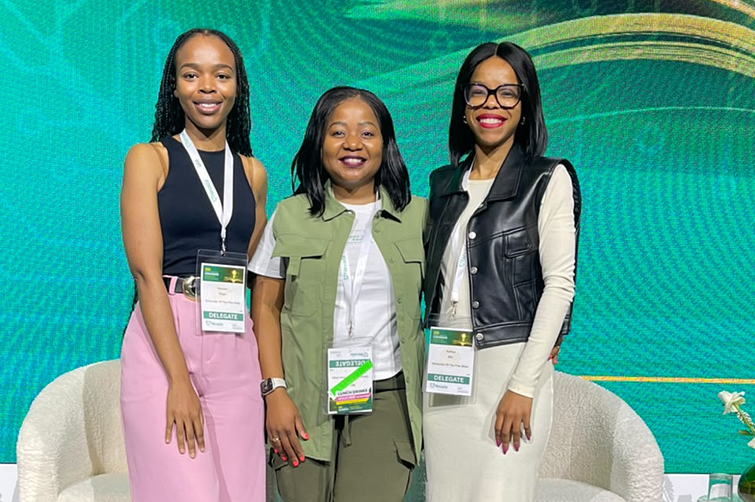 From left to right: Ayanda Dlepu, Tsholofelo Maleho and Refiloe Zim, whose presentation on embedding podcasting in the music curriculum won the lightning talk competition at the 2026 LIASA Conference.
National recognition for an innovative teaching and learning partnership has placed the spotlight on how podcasting is creating new opportunities for student engagement and knowledge creation at the University of the Free State (UFS). The initiative received top honours at the 2026 Library and Information Association of South Africa (LIASA) Conference, where a UFS team won the lightning talk competition with a presentation demonstrating how podcasting can be integrated into higher education.
A studio with a broader purpose
Representing the University of the Free State were Refiloe Zim, Ayanda Dlepu, and Tsholofelo Maleho, who presented Embedding podcasting in the music curriculum: Linking methodologies. Their presentation explored how podcasting can be incorporated into teaching and learning activities while also supporting the university’s broader research agenda.
Drawing on the collaboration between the UFS’s Library’s LisPod podcast studio and the Odeion School of Music, the team demonstrated how a podcast studio can serve a purpose far beyond providing a space for recording. It can become an innovative learning environment where technology, academic practice, and student engagement come together to create meaningful educational experiences.
Putting students at the centre of learning
At the heart of the initiative is an approach that positions students as active participants in their own learning. Rather than simply consuming information, students are encouraged to research, interpret, and communicate ideas through the creation of podcast content. The studio thus becomes a space where knowledge is explored, developed, and shared.
Podcasting promotes active learning and reflective practice by encouraging students to engage critically with course content while building the confidence to communicate their understanding to wider audiences. Through this process, they also strengthen their research, communication, and digital literacy skills – competencies that are increasingly valuable in a rapidly evolving world.
The initiative further supports innovative teaching approaches, including the flipped classroom model. By engaging with recorded learning material before class, students arrive better prepared to participate in discussions, collaborate with their peers, and apply their knowledge during face-to-face sessions.
Advancing responsible societal futures
The value of the project extends beyond the classroom. By using digital platforms to capture scholarly conversations and communicate research findings, podcasting creates opportunities to make academic knowledge more accessible to wider audiences and demonstrate its relevance to society.
The collaboration brings together complementary strengths: academics contribute disciplinary expertise and curriculum direction; students bring fresh perspectives and creative ideas; and the Library provides the support and infrastructure needed to translate these contributions into meaningful learning experiences. This includes research support, information and digital literacy guidance, copyright expertise, technology, and dedicated learning spaces.
The LIASA recognition highlights the importance of partnerships that bring innovation, teaching, and research together. More importantly, the initiative demonstrates how the University of the Free State is creating learning opportunities that empower students to become active contributors in knowledge creation, while extending the university's impact beyond its campuses and advancing responsible societal futures.
The team also expressed its appreciation to Library and Information Services management for its continued support in creating opportunities for innovation, professional development, and engagement with the broader library and information services community.