12 October 2026
|
Story Christelle du Toit
|
Photo Siqhamo Hlubi Jama
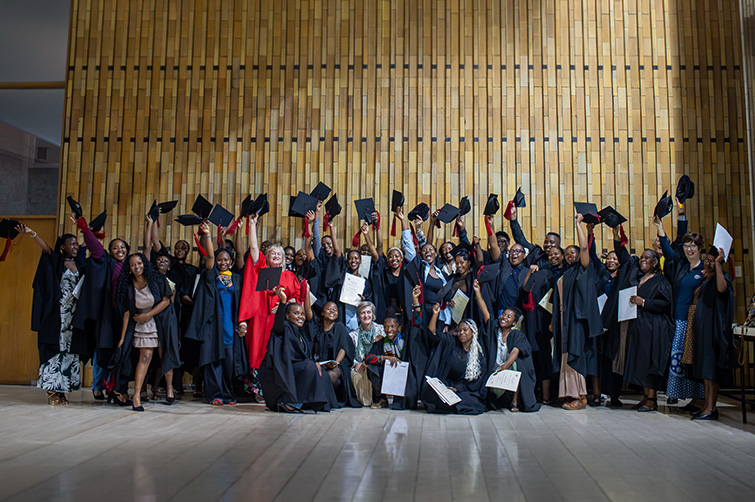 GULL graduates from across the University of the Free State’s three campuses celebrate their achievements at the 2026 graduation ceremony. The programme has grown from seven students in 2022 to 47 students this year, reflecting the expanding reach of lifelong action learning at the UFS.
For the 47 students recognised through the Global University for Lifelong Learning (GULL) programme at the University of the Free State (UFS) this year, learning has happened in places far removed from a conventional lecture hall.
The programme has grown from seven students in 2022 to 47 this year, with students from all three UFS campuses now involved. At the GULL graduation ceremonies in Qwaqwa and Bloemfontein on 5 and 6 October respectively, the students were recognised for learning developed through action, reflection, community engagement and practical problem-solving.
For Prof Richard Teare, President of GULL, this approach creates opportunities for people who may have been excluded from conventional pathways into education.
GULL was established 19 years ago and has worked in 60 countries. Teare told graduates that many people lack access to formal education, but still have the same desire to learn, develop and contribute.
“Most of the people on the planet today have a dream about developing themselves, being able to learn and grow and develop. But actually, it’s not possible much of the time,” he said.
GULL’s approach is rooted in self-determination and working with local knowledge rather than imposing solutions on communities. That philosophy has found a home at UFS through the Active Community Citizens through Engaged Scholarship for Sustainability (ACCESS) programme.
For Rene Pelser, acting Director for Student Life and a champion of ACCESS, GULL recognises forms of learning that may not always appear on a conventional academic transcript.
“Some of life's most valuable lessons are not always lectured in lecture halls,” she said. “They are learned through service, through meaningful relationships, through responding to challenges, and through reflecting on our experiences.”
From learning to action
The approach was visible earlier this year when ACCESS students took part in a four-day boot camp focused on community-based research, environmental sustainability and social justice. Through practical activities and reflection, students developed research goals and action plans while exploring ways of responding to challenges in their communities.
For ACCESS student Olwethu Ngcebetsha the programme changed how she understood her role as a student.
She recalled initially knowing ACCESS as “the group on campus that's always carrying boxes of worms around the entire campus,” (a reference to the project’s earthworm farming initiatives). Through dialogues, reflection sessions and community initiatives, she came to see it as a space that challenged students to think differently about their communities and their own contribution.
“I’m really grateful to ACCESS because they’ve really contributed to me being a more well-rounded student,” she said.
Learning that can become a livelihood
The GULL graduates also include participants connected to UFS’s Wool Wise programme, which links practical learning with opportunities in the wool value chain.
Through the Department of Sustainable Food Systems and Development, small-scale farmers and community members have received training in areas including wool production, marketing and processing. Community members, predominantly women, have also learnt to turn wool into products that can be sold.
The programme grew from a 2020 US$300 000 Regional Universities Forum (RUFORUM) grant aimed at developing the wool value chain among communal farmers in the Free State.
For participants, the learning can translate into income and greater economic opportunity.
The UFS-GULL relationship also connects with the UNESCO Knowledge for Change (K4C) South Africa Northern Hub, linking the UFS with North-West University and the Central University of Technology in community-based research.
Dr Karen Venter has played a central role in developing the UFS’ work in action learning and community engagement. Her contribution to the partnership was also recognised at the graduation, where she received an honorary degree from GULL.
Prof Teare recalled working with Dr Venter at Bloem Shelter, where she developed a programme for women affected by trauma to support them in starting micro-enterprises.
“They all now go through this and they all have a micro-enterprise at the end,” Prof Teare said. “The difference is amazing.”
The growth of GULL at the UFS – from seven students in 2022 to 47 across three campuses this year – reflects an expanding approach to learning that connects personal development with practical action.
For Prof Teare, however, the graduation itself remained a moment to celebrate.
“For me, a graduation really has only one particular point. It’s that you should feel special on this day, that you should feel that you’ve achieved something memorable,” he told the graduates.
The certificates recognise a particular kind of learning. Its value will ultimately be seen in what graduates do with it in their communities, workplaces, and lives.
Full list of recipients:
Professional Bachelor level 2 Certificate (Leadership Development): Favour Odili.
Professional Bachelor level 3 Diploma (Leadership Development):
Lebo Lucia Ndebele, Pretty Maredi, Reitumetse Valencia Ndayi, Rethabile Maduna, Neo Motsamai, Nothando Dubazane, Abulele Jebese, Khotso Moiketsi, Smelokuhle Ngcobo, Tiisetso Motsoane, Endrica Maredi, Bukho Maqutu, Inathi Nombungu, Vukona Khosa, Teboho Pitso, Kwanele Langa, Banele Nicolas Masina, Noluthando Buda, Mokgadi Sathekg, Ntombinkulu Khumalo, Zamokuhle Ngubane, Nonhlanhla Mokoena, Nelisiwe Deyi, Mbali Thungo, Snezuzo Buthelezi, Gift Mphalele, Mbalenhle Mguni, Kedifentse Serati, Siphethile Nkosi, Avele Mzizi.
Professional Bachelor level 4 associate degree (Leadership Development): Banele Gumede, Oarabile Sehunoe, Semola Khumalo,Tebogo Moja.
Professional Bachelor level 5 Professional Degree (Leadership Development): Ayanda Sinxezi, Eshly Mabokwane, Alicia Shibane, Cleo Sono.
Wool Wise - Professional Bachelor level 5 Degree (Leadership Development): Doretha Jacobs, Elizabeth Mnwana, Malejara Sarah Lenong, Manyefolo Eliza Tema, Nthabeleng Sophia Mekhoe, Nthabiseng Adelice Ndabeni.
Professional Masters Pathway Level 2 Certificate (Leadership Development): Olwethu Ngcebetsha, Amaze Thobeka Sibiya, Rearabetswe Ndlovu, Rose Masinga.
Professional Master Pathway Level 3 Diploma (Leadership Development): Mikie Serebudi Dikotse, Atlegang Letloenyane.
Professional Master Pathway Level 4 Advanced Diploma (Leadership Development): Lenosa Mahapang.
Professional Bachelor level 5 Degree (Leadership Development):Hope Motchesane.
Professional Master Pathway Level 5 Professional Degree (Leadership Development): Dr Gernus Terblanche.