13 October 2026
|
Story Siqhamo Hlubi Jama
|
Photo Centre for Teaching and Learning
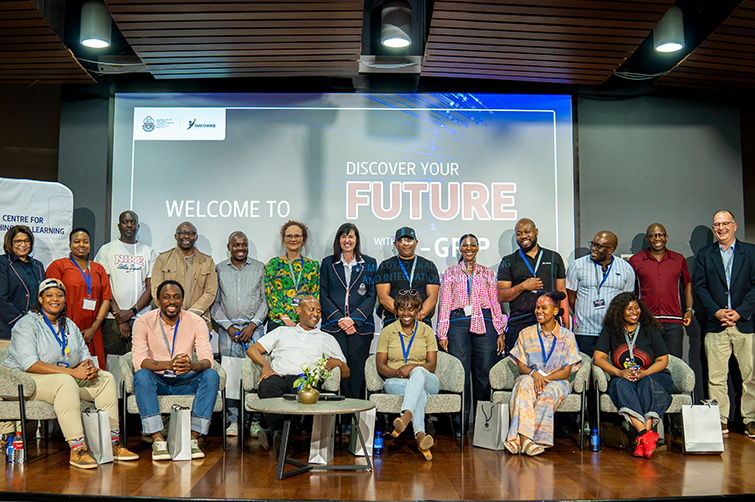 Vice-Chancellor and Principal Prof Hester C. Klopper with delegates attending U-GRIP 2026 at the University of the Free State's Bloemfontein Campus. The programme brought together students, industry leaders and entrepreneurs to explore graduate readiness and future opportunities.
A qualification may open a door. What ultimately matters is whether graduates are ready to walk through it.
A total of 343 students, with all three UFS campuses represented, joined 19 speakers from business, government, and entrepreneurship for a day of keynote addresses, panels, industry and mentorship sessions.
Opening the programme, Vice-Chancellor and Principal
Prof Hester C. Klopper put a practical question to the room. “What should a University of the Free State graduate be able to do that they could not do before they came to university?” she asked.
Her answer pointed to a shift that is already underway: from thinking about graduate preparation ‘primarily in terms of what students complete’ to asking ‘what they can actually do with what they have learned’. U-GRIP, she said, “is one expression of that shift”.
More than a qualification
Prof Klopper grounded the question in a changing labour market. The World Economic Forum estimates that almost 40% of workers’ existing skill sets will change between 2025 and 2030, with employers valuing resilience, leadership, and technological literacy alongside analytical thinking.
“These are not secondary skills,” she said. “They are part of being capable in a changing world.” The graduate unemployment rate in the second quarter of 2026 was 12,4%, against an official rate of 33,6%. This, she said, shows that higher education still matters, but also that “we have more work to do”.
Learning from people who make the decisions
The day’s proceedings were designed to put students in front of the people shaping employability and entrepreneurship opportunities. Delegates chose two of ten sector sessions – from technology and AI to financial services, agriculture, and mining. Speakers included Lungile Mginqi, entrepreneur and former Group CIO of Sasol; Dr Pulane Modiha, Chief Operating Officer: Home and Structured Lending at FNB; and Ziaad Suleman, CEO of Cassava Technologies, who delivered the executive keynote address on Africa’s digital future.
In the afternoon, seven mentorship circles allowed students to put forward their own questions to CEOs, executives, and entrepreneurs in small groups on everything from career direction and growth to resilience and starting a business.
“South Africa cannot afford a situation in which universities and employers understand each other only after a student has graduated,” Prof Klopper said. “The relationship has to begin earlier.”
Left inspired
For the visitors, the day worked in both directions.
“We came to inspire but left inspired. Exceptional organisation, visionary leadership from the Vice-Chancellor, and remarkable students made U-GRIP truly unforgettable,” says Nyimpini Mabunda, founder and CEO of TCLI.
Nyiko Shiburi, former CEO of MultiChoice South Africa, agrees. “Experiencing the UFS’ exceptional leadership, organisation, and vibrant students firsthand, it’s easy to understand why it ranks among South Africa’s best universities,” he says.
For Prof Klopper, this is where graduate development becomes more than a programme. The University’s Strategic Plan speaks of contributing meaningfully to responsible societal futures – and preparing graduates, she said, is “one of the most direct ways in which we give that idea substance”.
She described what that can look like: the first stable job in a family, a small enterprise that employs two other people, the confidence and networks to apply for an opportunity that once seemed out of reach. A graduate who can use knowledge well, think independently, and act responsibly, she said, is better placed to contribute to the society in which they live.
And that contribution, she told delegates, need not wait for graduation. “It can begin here.”