26 October 2026
|
Story Siqhamo Hlubi Jama
|
Photo Born2Shoot Photography
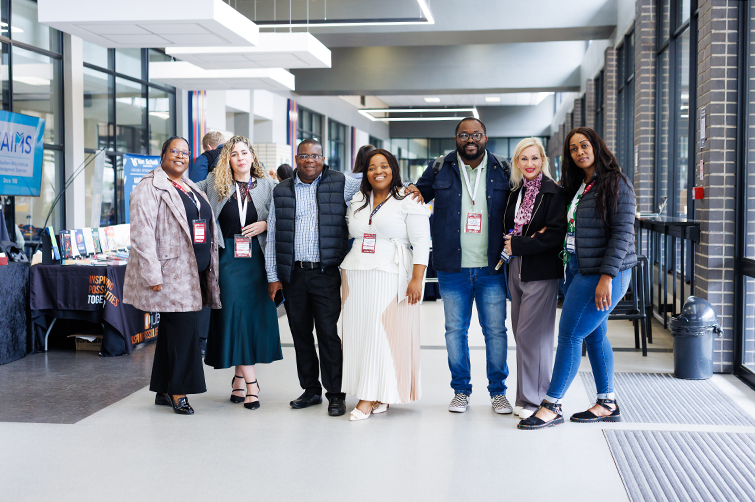 Delegates, researchers, postgraduate students and industry professionals gathered at the 37th annual SAIMS Conference, hosted by the University of the Free State, to explore how human and artificial intelligence can coexist in shaping the future of management and leadership.
Artificial intelligence can process information faster than any human. It can identify patterns, generate content and automate decisions at remarkable speed. Yet one of the key messages to emerge from a national gathering of management scholars at the University of the Free State (UFS) was that the qualities that matter most in leadership and learning remain profoundly human.
Hosted by the Department of Business Management, the 37th annual conference of the Southern African Institute for Management Scientists (SAIMS) brought together academics, postgraduate students and industry professionals from across South Africa and beyond. Under the theme Co-existing with Intelligence: Rethinking Management in the Age of AI, the conference challenged delegates to look beyond what AI can do and consider what humans must continue to do well.
Beyond efficiency: The importance of human judgement
AI is already transforming how organisations operate, how universities teach and how researchers engage with information. For many delegates, however, the real conversation centred on judgement.
Discussions throughout the conference explored how organisations can embrace technological innovation while upholding accountability, trust, ethical responsibility and meaningful human connection. Researchers considered how leaders can balance AI-driven efficiency with critical thinking and how institutions can prepare graduates for workplaces in which intelligent technologies are becoming integral to everyday decision-making.
This shift in focus moved the conversation beyond automation and optimisation. Instead, delegates considered how distinctly human qualities - curiosity, creativity, empathy, discernment and courage - become even more valuable in an age of intelligent systems.
Preparing graduates for an AI-enabled future
The conference highlighted an important responsibility for universities: higher education institutions must not only adapt to AI but also prepare the next generation of graduates to navigate its opportunities and challenges responsibly.
Research presentations and discussions addressed issues including graduate employability, financial literacy, student well-being, experiential learning and academic burnout. Emerging researchers and postgraduate students also had opportunities to present their work, test new ideas and engage with experienced scholars from across the management sciences.
These interactions reinforced the importance of developing graduates who can critically evaluate information, question assumptions and make informed decisions in increasingly complex environments.
Connecting research with society
A recurring theme throughout the conference was the relationship between academic knowledge and real-world application.
Research presented across four parallel streams addressed topics ranging from marketing and entrepreneurship to human resource management, governance, finance, management education, consumer behaviour and tourism. Collectively, these contributions demonstrated how management research can help organisations respond to contemporary social, economic, and technological challenges, particularly within African contexts.
Keynote speakers included UFS alumni Prof Andrew Smith, Adjunct Professor and Chief of Next at AND Digital in London, and Dr André de Wet, a technology entrepreneur and CEO of Flood. Their presentations encouraged delegates to rethink how human and artificial intelligence can work together to foster more responsive, innovative and responsible organisations.
The future remains human
Although technology featured prominently throughout the programme, the conference also served as a reminder that research advances through people.
The questions that challenged assumptions, the conversations between presentations, the exchange of ideas and the collaborations formed throughout the event all reflected the enduring value of human engagement. In a world increasingly shaped by AI, the conference suggested that the future may depend less on competing with machines and more on strengthening the uniquely human capacities that give technology purpose and meaning.
For the University of the Free State, the conference provided a platform to contribute to a national conversation about leadership, learning and responsible innovation. It also reinforced the university’s role in preparing graduates and researchers to engage confidently and critically with an AI-enabled future.