03 September 2026
|
Story Leonie Bolleurs
|
Photo Supplied
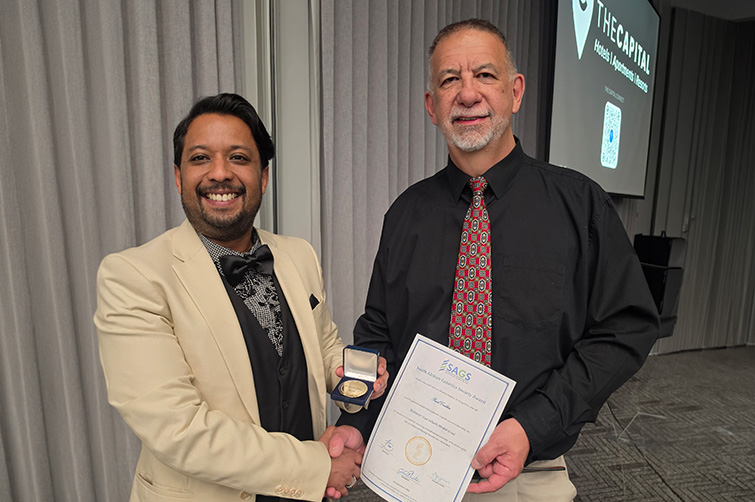 Prof Paul Grobler, Professor and Academic Head of the Department of Genetics, recently received the SAGS Hofmeyr-Van Schaik Medal (Gold) for his contributions to genetics, research, leadership and mentorship. He is pictured with Prof Clint Rhode, President of the SAGS at the event where he was handed the medal.
Prof Paul Grobler, Professor and Academic Head of the
Department of Genetics at the University of the Free State (UFS), has been honoured with the
South African Genetics Society Hofmeyr-Van Schaik Medal (Gold). The medal is awarded to a distinguished established academic or professional for excellence in research, teaching, or professional practice in genetics. Prof Grobler was recognised for his lifelong achievements, leadership and mentoring in genetics, as well as his broader impact as a scientist.
His route into genetics began with a love of nature.
“I have always enjoyed nature and the outdoors, and I am a natural history enthusiast at heart,” he says. During his early postgraduate studies, he became interested in how genetics could help to answer conservation questions, particularly the effects of isolation on wildlife populations in small reserves and on game ranches. At the time, the late 1980s, conservation genetics was still a relatively young field in South Africa.”
That interest eventually led to a PhD combining wildlife management and conservation genetics, a field he has continued to pursue throughout his career.
Deputy Vice-Chancellor, Research, Innovation and Postgraduate Studies, Prof Vasu Reddy, remarked “that excellence in research is measured not only by discovery, but by its enduring impact on people, policy, and the future of our planet. Prof Grobler's achievement reminds us that world-class science begins with curiosity and flourishes through sustained commitment, mentorship, and collaboration. Conservation genetics demonstrates how knowledge can serve both humanity and biodiversity. This recognition affirms the power of research that matters.”
Prof Grobler believes, however, that science makes the most sense when it remains connected to the animal behind the sample.
“I always tell my students never to lose sight of the link between a sample in the lab and the living breathing organism it came from,” he says. His first encounter with a tranquilised rhino is one of those moments that stayed with him, giving him a very different perspective on the conservation questions being studied.
Over the years, his research has taken him from rhinos to antelope, monkeys, and even mussels, with projects producing practical management guidelines and policy recommendations for private game owners and government agencies. Other milestones that stood out in his career are his first accepted journal paper and first conference presentation. Three decades later, giving an overview of his work at two international keynote addresses were just as special. From a line manager perspective, the growth of the Department of Genetics over the last decade is another significant highlight.
A career connecting genetics, conservation and the people who carry science forward
Research, though, is only one part of the story.
Mentoring, to Prof Grobler, has meant watching people grow. Field trips have given students the opportunity to discover a deeper interest in nature and genetics. He still remembers the influence of his own MSc and PhD supervisor and hopes to play the same role in the lives of a new generation of students.
He is also candid about the less predictable side of academic life. Research does not always produce the expected result. Funding can fall through, students may leave because of financial pressures, staff move into different careers, and changes in legislation can create new obstacles. His response has been to focus on what he can influence: doing work as best as possible, supporting the people around him and making the most of opportunities.
The field continues to open up new possibilities. In conservation genetics, Prof Grobler is particularly excited by how much information researchers can now gather from environmental samples. He also points to the growing power of genetics in forensic investigations. “Even when evidence is old or degraded, or occurs in trace amounts, molecular markers can help researchers to extract information that may provide valuable evidence in criminal cases and contribute to prosecutions,” he notes.
Beyond this, genetics is moving from simply describing how much genetic diversity exists in a population to understanding what that diversity means. Researchers can increasingly investigate links between genetic variation and specific characteristics or conditions. At the same time, advances in technology and computing power are making it possible to work with increasingly large and complex amounts of genetic information.
These developments are part of what makes genetics such an interesting field to be in. They also reflect the collaborative nature of science. Perhaps that is why he sees his Gold Medal as something shared rather than something that belongs to him alone. He accepts it on behalf of his collaborators, colleagues and the many students he has guided throughout his career. He also acknowledges the support his wife has given him in a career in conservation genetics, involving many days away from home.
That feels fitting for a career built around connections: between genetics and conservation, research and practice, mentors and students, and a tiny sample in a laboratory and the living creature from which it came.
For Prof Reddy, “Behind every scientific accolade stands a legacy of students inspired, colleagues empowered, and new frontiers opened. Prof Grobler's contribution reflects all three. The future belongs to universities that advance discovery while cultivating talent. Prof Grobler's career is a compelling example of this dual mission in action. This honour celebrates more than scientific achievement; it recognises a career devoted to stewardship, innovation, and the advancement of knowledge.”