22 September 2026
|
Story Anthony Mthembu
|
Photo Johan Pretorius
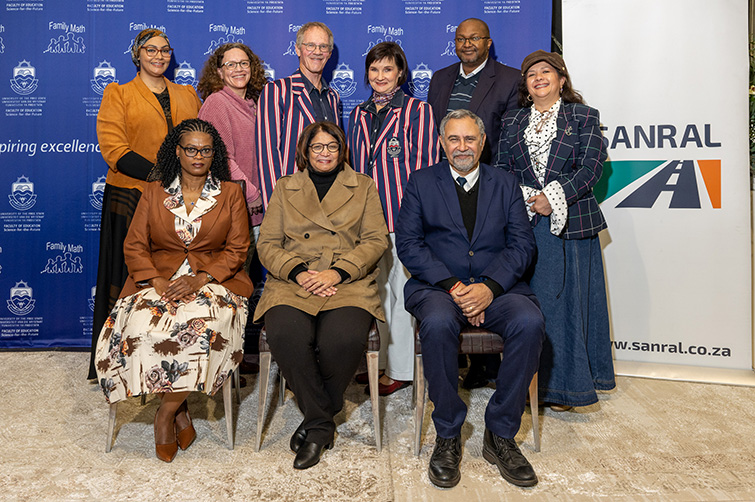 Attendees at the 16th annual Family Math and Family Science Summit held on 18 September on the UFS Bloemfontein Campus. Back row, from the left: Dr Saeeda Ismail, SANRAL Contracts Manager; Marlize Nel-Verwey, SANRAL Free State representative; Dr Cobus van Breda, Director of Science for the Future (S4F) at the University of the Free State; Dr Amaria Reynders, Family Math Manager at the University of the Free State; Monde Mondi, SANRAL CHRO; and Heidi Harper, SANRAL Skills Development Manager.
Front row, from the left: Rochelle Blaauw, SANRAL board member; Prof Anthea Rhoda, Deputy Vice-Chancellor: Academic at the University of the Free State; and Mahesh Fakir, SANRAL board member.
Attendees at the 16th annual Family Math and Family Science Summit held on 18 September on the UFS Bloemfontein Campus. Back row, from the left: Dr Saeeda Ismail, SANRAL Contracts Manager; Marlize Nel-Verwey, SANRAL Free State representative; Dr Cobus van Breda, Director of Science for the Future (S4F) at the University of the Free State; Dr Amaria Reynders, Family Math Manager at the University of the Free State; Monde Mondi, SANRAL CHRO; and Heidi Harper, SANRAL Skills Development Manager.
Front row, from the left: Rochelle Blaauw, SANRAL board member; Prof Anthea Rhoda, Deputy Vice-Chancellor: Academic at the University of the Free State; and Mahesh Fakir, SANRAL board member.
For children to become confident in mathematics and science, learning needs to extend beyond the classroom. Teachers need the tools to make these subjects accessible, parents need ways to participate in their children’s learning, and learners need opportunities to experience mathematics and science as subjects they can engage with and succeed in.
This idea has been at the heart of the University of the Free State’s (UFS) Family Math and Family Science programmes for the past 16 years.
On 18 September 2026, the Faculty of Education brought teachers, university partners, government representatives, and funders together on the UFS Bloemfontein Campus for the 16th annual Family Math and Family Science Summit. The gathering provided an opportunity to reflect on how the programmes have grown from initiatives serving communities in the Free State into a national collaboration reaching hundreds of thousands of participants.
The programmes form part of the Faculty of Education’s Science-for-the-Future (S4F) unit and are designed to strengthen mathematics and science education by involving teachers, learners, and families in the learning process.
Prof Matseliso Mokhele-Makgalwa, Vice-Dean: Research, Engagement and Internationalisation in the Faculty of Education, described the purpose of the initiatives as creating “environments in which children can be confident in science and mathematics, and where parents and teachers can participate meaningfully in the learning process”.
This focus on the environment around the learner has shaped the programme’s development. Dr Cobus van Breda, Programme Director of S4F, said the project includes the professional development of mathematics and science teachers across all nine provinces, while incorporating family-based mathematics and science learning activities into the curriculum.
The programme’s national reach has been supported by the Universities Collaboration initiative, through which nine other South African universities were commissioned to implement project components in their respective regions.
From local classrooms to a national network
For Prof Anthea Rhoda, Deputy Vice-Chancellor: Academic at the UFS, this growth reflects the relationships built over many years with teachers and communities.
She recalled how the initiatives initially focused largely on communities in the Free State, developing mathematics teachers and helping parents and caregivers support schoolchildren with mathematics. Between 2018 and 2026, S4F reached more than 669 385 participants, including more than 9 059 teachers, 495 977 learners, and nearly 154 922 parents.
The numbers indicate the scale of the work, but evidence from the programme also points to changes in learner achievement. An empirical evaluation of the Family Math programme in 16 schools in the OR Tambo district found significant improvements in learners’ mathematics achievement, with a positive effect extending beyond the grade in which the intervention took place.
For Dr Van Breda, the summit was therefore an opportunity to recognise the teachers who have carried the programmes into their classrooms, while also acknowledging the partners whose support has made the work possible.
Representatives from the Department of Basic Education, partner universities, and the South African National Roads Agency (SANRAL) attended the event. SANRAL has been a longstanding funder and partner, while South32 is also among the programme’s funding partners.
The contribution of these relationships was reflected in an address by Rochelle Blaauw, SANRAL board member, who spoke about the importance of sustaining the partnership beyond the current group of people involved. She said continued growth should include considering ‘who carries on with this mission after us,’ and mentioned plans to involve other entities in the partnership.
The programme’s growing recognition also extends beyond its reach. In 2026, Dr Van Breda received the National Research Foundation’s Societal Impact Award in recognition of research-led project implementation through S4F that has contributed to improving people’s quality of life.
Sixteen years after Family Math and Family Science began, the work therefore extends beyond teaching mathematics and science. It is about the conditions in which children encounter these subjects: the confidence they develop, the support they receive from teachers and families, and the opportunities created when universities, schools, communities, government, and industry work together.
For the UFS and its partners, sustaining those conditions may be as important as expanding the programme itself.