Latest News Archive

Please select Category, Year, and then Month to display items
Previous Archive
02 July 2019 | Story Eloise Calitz | Photo Keagan Nkwaira
Entrepreneurship Intravarsity
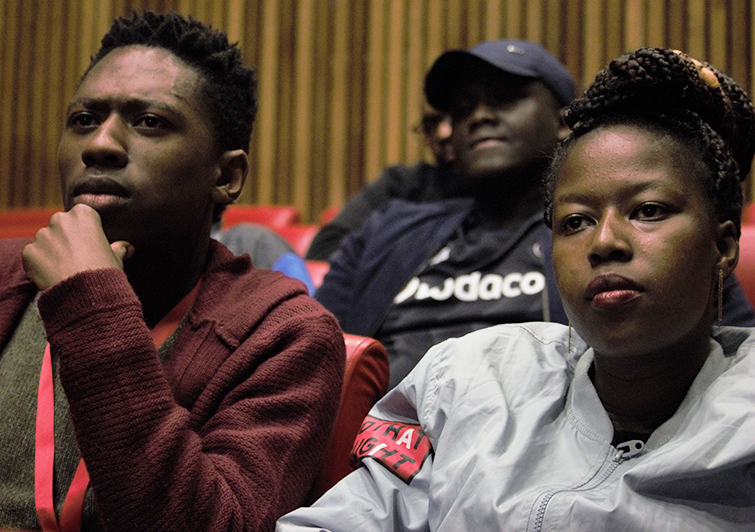
Audience members listening attentively to the presentations at the Entrepreneurship Inter-varsity on the Bloemfontein Campus.

The UFS continuously creates opportunities for students to develop and explore platforms where they can showcase their talents and share their innovative concepts. In the light of this, it is important for the institution to become a preferred academic knowledge partner that can conceptualise, develop, and successfully commercialise research activities, and through this foster an innovative and entrepreneurial culture that aligns to its Integrated Transformation Plan.

This is why opportunities such as the Entrepreneurship Intervarsity Competition are so important, since it encourages students to demonstrate their entrepreneurial talent, and through this connect with investors and industry leaders to start up a business.

The competition

Student entrepreneurs across the 26 public universities in South Africa were invited to submit their innovative ideas as part of a competition supported by Entrepreneurship Development in Higher Education (EDHE), in collaboration with the Allan Gray Orbis Foundation. The opportunities created through this initiative are twofold:

     1. For student entrepreneurs to present their innovative ideas and businesses. 
     2. For universities to demonstrate their entrepreneurial talent and the ways in which              they support and grow the next generation of business leaders.

The competition takes place in five stages. The process started with each student submitting their short videos and applications on the official competition site. Each institution also had the opportunity to select student entrepreneurs to take part in the competition. Fifteen students pitched their ideas during internal rounds at the UFS on 30 May 2019. Of these students, four were selected to represent the UFS at the regional rounds of the Entrepreneurship Intervarsity, where the finalists will be chosen. 

The students were judged in four categories:

Category 1: Innovative Ideas
Category 2: Tech Businesses (existing businesses, formal or informal, undergrad or postgrad)
Category 3: Social Impact Businesses (existing businesses, formal or informal, undergrad or postgrad)
Category 4: General (existing businesses, formal or informal, undergrad or postgrad)

The following UFS entrants were selected to take part in the regional finals: 
Christopher Rothman for his liquid yeast culture that can be used in the fermentation of beer. 
Driaan-Lou Kemp for his patented water-saving device. 
Grace Mthembu for her electricity-saving system.
Martin Clarke for his idea to use drone technology for the mining industry


News Archive

UFS keeps the power on
2015-06-24


At a recent Emergency Power Indaba held on the Bloemfontein Campus, support structures at the university met to discuss the Business Continuity Intervention Plan to manage load shedding on the three campuses of the UFS.

Currently, 35 generators serving 55 of the buildings have already been installed as a back-up power supply on the three campuses of the university. According to Anton Calitz, Electrical Engineer at the UFS, the running cost to produce a kWh of electricity with a diesel generator amounts to approximately three times the cost at which the UFS buys electricity from Centlec.

Planned additional generators will attract in excess of R4 million in operating costs per year. For 2015, the UFS senior leadership approved R11 million, spread over the three campuses. Remaining requirements will be spread out over the next three years. University Estates is also looking at renewable energy sources.

On the Bloemfontein Campus, 26 generators serving forty-one buildings are in operation. On South Campus, two generators were installed at the new Education Building and at the ICT Server Room. Lecture halls, the Arena, the Administration Building, and the library will be added later in 2015. Eight generators serving 12 buildings are in operation on the Qwaqwa Campus. In 2015, the Humanities Building, Lecture Halls and the heat pump room will also be equipped with generators.

Most buildings will be supplied only with partial emergency power. In rare cases, entire buildings will be supplied because the cost of connecting is lower than re-wiring for partial demand. According to Nico Janse van Rensburg, Senior Director at University Estates, emergency power will be limited to lighting and power points only. No allowances will be made for air-conditioning.

“Most area lighting will also be connected to emergency power,” he said.

Where spare capacity is available on existing emergency power generators, requests received for additional connections will be added, where possible, within the guidelines. The following spaces will receive preference:
- Lecture halls with the lights, data projectors, and computers running
- Laboratories for practical academic work and sensitive research projects
- Academic research equipment that is sensitive to interruptions
- Buildings hosting regular events

According to Janse van Rensburg, all further needs will be investigated. Staff can forward all emergency power supply needs to Anton Calitz at calitzja@ufs.ac.za

Staff and students can also manage load shedding in the following ways:

1. Carry a small torch with you at all times, in case you are on a stairwell or other dark area when the lights go out. You can also use the flashlight app on your phone. Download it before any load shedding occurs. This can come in handy if the lights go out suddenly, and you cannot find a flashlight. Load-shedding after dark imposes even more pressure on our Campus Security staff. We can assist them with our vigilance and preparedness by carrying portable lights with us at all times and by assisting colleagues.
2. Candles pose a serious safety risk. Rather use battery- or solar-powered lights during load shedding.
3. Ensure that your vehicle always has fuel in the tank, because petrol stations cannot pump fuel during power outages.
4. Ensure that you have enough cash, because ATMs cannot operate without electricity.
5. The UFS Sasol Library has study venues available which students can use during load shedding.
6. When arranging events which are highly dependent on power supply, especially at night, organisers should consult the load-shedding schedule before determining dates and preferably also make back-up arrangements. If generators are a necessity, the financial impact should be taken into consideration.

The senior leadership also approved a list of buildings to be equipped with emergency power supplies.

More about load shedding at the UFS:
Getting out of the dark
More information, guidelines and contact information


We use cookies to make interactions with our websites and services easy and meaningful. To better understand how they are used, read more about the UFS cookie policy. By continuing to use this site you are giving us your consent to do this.

Accept