Latest News Archive

Please select Category, Year, and then Month to display items
Previous Archive
29 October 2020 | Story Thokozane Ngcongwane | Photo Supplied
Thokozane Ngcongwane recommends that students and staff should actively seek help for their mental-health challenges.

My name is Thokozane Ngcongwane. I coordinate the UFSS1504 module in the Centre for Teaching and Learning (CTL). The journey of struggles and triumphs against mental illness has often peppered my life more than I thought. Having grown up in rural Free State, it was hard for my parents, as well as those around me, to believe that things such as mental illness exist – let alone their own son! 

I grew up with attention-deficit / hyperactivity disorder (ADHD) and was admitted numerous times as the illness was misdiagnosed and untreated. This laid the foundation for a childhood filled with amazing feats of energetic activity, but also had the downside of being misunderstood, or ill-treated due to this illness. Before I knew about this illness, I believed that because of my height (I have been given the names ‘Napoleon’ and ‘Goliath’ by various people, throughout) and stature. I was a prime target for bullying. 

Fast forward to university, and with the world as my oyster, I believed I would do well, graduate, and become the scientist I have always dreamed of becoming. Nothing could prepare me for the roller-coaster ride that, even to this day, has taught me highly valuable life lessons that I would never have received anywhere else. I started a degree in Chemistry (Extended) and was doing well in the first year. I was even fortunate enough to be selected for the F1 Leadership for Change exchange programme that took me to the USA. That was an incredible experience. Fast forward to my third year, and things took a turn for the worse. 

By 2013, I started getting panic and anxiety attacks, the origin of which was quite unknown to me at the time. I thought that I was starting to go insane and this caused a huge drop in my academics, as well as distorting my overall view on life. I started refusing to see friends and family and even shunned myself from engaging in academics. This was the start of my battles and little prepared me for the fight ahead. I took a trip outside of my surroundings and became aware of how the people I avoided cared for me, and the result was that I overcame anxiety for that period. Family, friends, and lecturers were supportive and encouraged me to do my best amid this unknown period in my life. My academics improved and I became social again. 

When I thought the worst was behind me, I was diagnosed with generalised anxiety disorder (GAD). I contacted Student Counselling and Development and received professional assistance. I started feeling better again and was on my way to graduating, albeit the journey was fraught with anxious moments. My graduation was delayed due to a credit shortfall, and this threw me in the deep end once again. This time, I dealt with it better by engaging myself in my passions – sports and the outdoors. I graduated in May 2016 and secured a temporary job as a Science teacher.

I returned home to the Qwaqwa Campus, where I became an intern in CTL. My troubles reached a boiling point in 2019, and I contacted Careways on recommendation of my head of department. It is now 2020, the year of global anxieties. I have learnt that institutions such as the South African Depression and Anxiety Group (SADAG) are available to help. Higher Health is also available to deal with issues around stigmatisation. In short, seek help and never abandon your support structures. Your mental health matters.

News Archive

UFS researcher engineers metal surfaces
2015-03-03

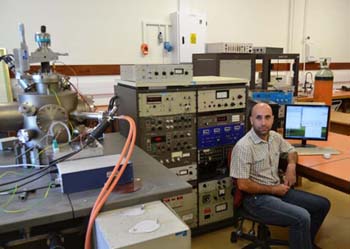
Shaun Cronjé, a PhD student, in a surface characterisation laboratory at the UFS.

It is well known that the surface of a component is much more vulnerable to damage than the interior, and that surface-originated degradation such as wear, corrosion, and fracture will eventually destroy the component.

“Engineering the surface, based on scientific knowledge, is essential to control these damaging processes. It also creates electronic and geometric structures on the surface which opens up a world of new devices, especially considering the properties on the nano-length scale,” said Prof Wiets Roos from the Department of Physics at the University of the Free State (UFS).

At elevated temperatures, atoms are more mobile and can migrate to grain boundaries and surfaces, which have a major influence on material properties. The redistribution of solute atoms between the surface and the bulk of the material is known as segregation. Knowing the behaviour of segregation at the surface/environment interface can be very useful in the development of new materials. As an example materials can be improved higher efficiency and lower fuel consumption, thus reducing environmental pollution.

The main aims of Prof Roos’s research are to understand surface segregation, use it as a tool, and contribute to the various surface engineering fields.

The surface characterisation laboratories at the UFS are well equipped to do high temperature segregation measurements, and have already proven a success, not only in the ability to prepare the specimens for characterisation, but also in developing models and procedures to quantify the segregation parameters.

The most recent results have demonstrated the importance of taking evaporation into account during quantification.” This has laid the foundation for future studies by installing the necessary hardware in a surface characterisation spectrometer, establishing experimental protocols, and improving an existing model (developed in this laboratory) for simulating segregation profiles,” said Prof Roos.

Segregation parameters allow the researcher to predict and utilise the surface concentration behaviour as a function of temperature and time. “This not only contributes to fields involving corrosion, oxidation, sintering, wear, chemical poisoning, powder metallurgy, and lubrication but adds to the development of self-healing devices,” said Prof Roos.

We use cookies to make interactions with our websites and services easy and meaningful. To better understand how they are used, read more about the UFS cookie policy. By continuing to use this site you are giving us your consent to do this.

Accept