Latest News Archive

Please select Category, Year, and then Month to display items
Previous Archive
29 July 2022 | Story André Damons | Photo André Damons
UFS Traditional Medicine
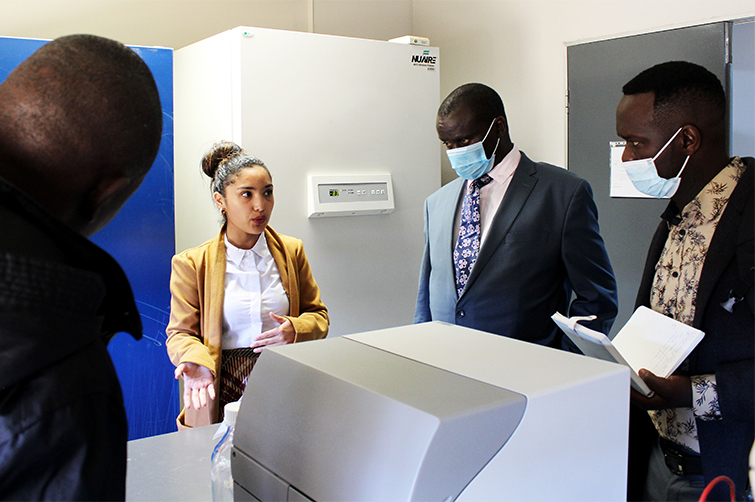
Recardia Schoeman, Scientific Officer in the Department of Pharmacology, gave Prof Paul Waako, Dr Samuel Baker Obakiro, and Dr Richard Oriko Owor from the Busitema University a tour of the department and its laboratories.

Prof Motlalepula Matsabisa, Director of Pharmacology at the University of the Free State (UFS), played host to academics from the Busitema University in Uganda for benchmarking on traditional medicine and to establish collaboration between the two institutions.

Prof Paul Waako, Vice-Chancellor of the Busitema University – who was part of the visiting party – and Prof Francis Petersen, UFS Rector and Vice-Chancellor, signed a collaboration agreement that enables the two institutions to work together and to get involved in the exchange of expertise as part of the collaboration.

Dr Samuel Baker Obakiro, Lecturer of Pharmacology and Therapeutics and Head of the Department of Pharmacology, and Dr Richard  Oriko Owor, a natural products chemist, accompanied Prof Waako on the visit to the UFS from 18 to 21 July, during which they undertook tours of various departments and laboratories, including Pharmacology, Virology, Chemistry, Genetics, Physics, Microbiology, and others. They also visited FARMOVS.


Establishing collaboration

Uganda – through their Ministry of Science, Technology, and Innovation – has a national drive to ensure that science contributes to socio-economic development through their major national agenda, which promotes local production, reduces importation, and increases exportation of goods. Dr Monica Musenero Masanza, Minister of Science, Technology, and Innovation, wants to ensure that the capacity of Ugandan scientists to conduct applied research will promote national development and reduce poverty.

Prof Waako said they came to the UFS to establish collaboration, as universities have an obligation to ensure that science improves the socio-economic situation in Africa. They would like to work with the UFS to ensure that science strengthens science in order to serve the people.

“Currently, one of the biggest challenges is the local manufacturing of pharmaceuticals, and that is why we came to the Department of Pharmacology. We need to come together as African universities and use all the existing capacities to transform the lives of our people.”

“African traditional medicine has a lot to offer, and a lot of research has been done, but we have not been able to take it to the level of final commercialisable products. This is the reason of us coming here, we want to create that link to ensure that the science – which has already been identified and established – is able to move to product production,” says Prof Waako.


At the right place

They decided to visit the UFS after meeting Prof Matsabisa during his visit to their country’s universities as part of the WHO team.

According to Dr Obakiro, when walking down the corridors of the department, they can see that they are in the right place. “We are also looking at mentorship, as our university is still very young. I am happy and privileged to be here. We cannot succeed on our journey if we do not stand on your shoulders.”

Dr Obakiro said they are also looking at how to set up partnerships between academia and industry, as well as collaboration between the different academic departments, such as pharmacology, chemistry, microbiology, and virology, and how these collaborative initiatives can be effective and efficient to drive their agenda.

In welcoming the colleagues from West Africa, Prof Matsabisa said, “Let’s find a way to crawl together and eventually run together. If you want to move into drug discovery and development, no single scientist can do it alone, it is a multidisciplinary approach. It is a team effort with a shared vision. We have some experience that we can share with you, but we are not perfect, and I think we can learn together.”

News Archive

Researcher on polymer science on sabbatical in Qatar
2014-09-09


Prof Riaan Luyt
Photo: Supplied

Prof Riaan Luyt from the University of the Free State’s Qwaqwa Campus has started a 12-month sabbatical in Qatar. This follows an invitation by the Qatar University in Doha to work as a research professor at the university's Centre of Advanced Materials.

In the 21 years that he has spent on the Qwaqwa Campus, Prof Luyt has published more than 165 research papers in international scientific journals and has had over 1 850 citations by other international scientists. He also reviews scientific research on polymer science in more than 10 journals.

“There were no science laboratories when I first came here and I made it my mission to establish them as soon as possible as I was passionate about research then, as I am now,” said Prof Luyt.

He has supervised twenty five master’s and eight doctoral students and is currently supervising five master’s and six doctoral students. Prof Luyt also serves on the International Advisory Board of eXPRESS Polymer Letters – one of the leading polymer science journals.

In 2012, he was listed as the second-best researcher at the UFS and is a regular keynote speaker at international conferences. He has mentored many students who are now leaders in the industry. One of his current doctoral students came to the university as a student in the University Preparatory Programme (UPP), who had not passed matric well enough to be admitted. Yet, Prof Luyt mentored her to where she is today –  currently finalising her PhD in Polymer Science.

We use cookies to make interactions with our websites and services easy and meaningful. To better understand how they are used, read more about the UFS cookie policy. By continuing to use this site you are giving us your consent to do this.

Accept