Latest News Archive

Please select Category, Year, and then Month to display items
Previous Archive
29 July 2022 | Story André Damons | Photo André Damons
UFS Traditional Medicine
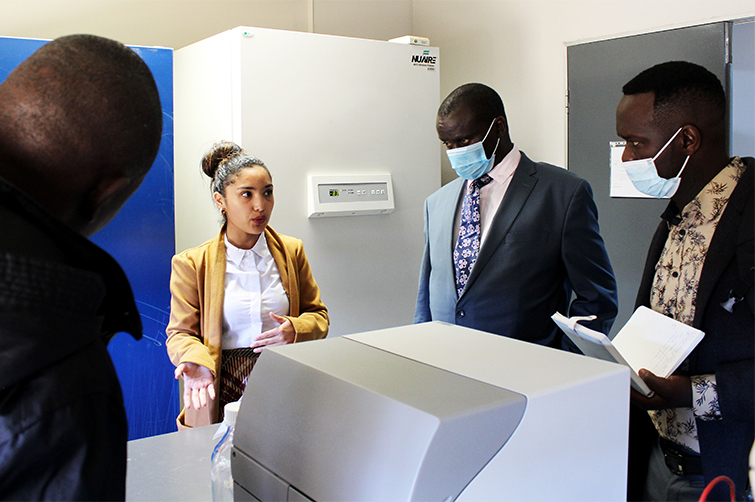
Recardia Schoeman, Scientific Officer in the Department of Pharmacology, gave Prof Paul Waako, Dr Samuel Baker Obakiro, and Dr Richard Oriko Owor from the Busitema University a tour of the department and its laboratories.

Prof Motlalepula Matsabisa, Director of Pharmacology at the University of the Free State (UFS), played host to academics from the Busitema University in Uganda for benchmarking on traditional medicine and to establish collaboration between the two institutions.

Prof Paul Waako, Vice-Chancellor of the Busitema University – who was part of the visiting party – and Prof Francis Petersen, UFS Rector and Vice-Chancellor, signed a collaboration agreement that enables the two institutions to work together and to get involved in the exchange of expertise as part of the collaboration.

Dr Samuel Baker Obakiro, Lecturer of Pharmacology and Therapeutics and Head of the Department of Pharmacology, and Dr Richard  Oriko Owor, a natural products chemist, accompanied Prof Waako on the visit to the UFS from 18 to 21 July, during which they undertook tours of various departments and laboratories, including Pharmacology, Virology, Chemistry, Genetics, Physics, Microbiology, and others. They also visited FARMOVS.


Establishing collaboration

Uganda – through their Ministry of Science, Technology, and Innovation – has a national drive to ensure that science contributes to socio-economic development through their major national agenda, which promotes local production, reduces importation, and increases exportation of goods. Dr Monica Musenero Masanza, Minister of Science, Technology, and Innovation, wants to ensure that the capacity of Ugandan scientists to conduct applied research will promote national development and reduce poverty.

Prof Waako said they came to the UFS to establish collaboration, as universities have an obligation to ensure that science improves the socio-economic situation in Africa. They would like to work with the UFS to ensure that science strengthens science in order to serve the people.

“Currently, one of the biggest challenges is the local manufacturing of pharmaceuticals, and that is why we came to the Department of Pharmacology. We need to come together as African universities and use all the existing capacities to transform the lives of our people.”

“African traditional medicine has a lot to offer, and a lot of research has been done, but we have not been able to take it to the level of final commercialisable products. This is the reason of us coming here, we want to create that link to ensure that the science – which has already been identified and established – is able to move to product production,” says Prof Waako.


At the right place

They decided to visit the UFS after meeting Prof Matsabisa during his visit to their country’s universities as part of the WHO team.

According to Dr Obakiro, when walking down the corridors of the department, they can see that they are in the right place. “We are also looking at mentorship, as our university is still very young. I am happy and privileged to be here. We cannot succeed on our journey if we do not stand on your shoulders.”

Dr Obakiro said they are also looking at how to set up partnerships between academia and industry, as well as collaboration between the different academic departments, such as pharmacology, chemistry, microbiology, and virology, and how these collaborative initiatives can be effective and efficient to drive their agenda.

In welcoming the colleagues from West Africa, Prof Matsabisa said, “Let’s find a way to crawl together and eventually run together. If you want to move into drug discovery and development, no single scientist can do it alone, it is a multidisciplinary approach. It is a team effort with a shared vision. We have some experience that we can share with you, but we are not perfect, and I think we can learn together.”

News Archive

Students receive hands-on crime scene investigation training
2016-09-02

Description: Crime scene investigation training Tags: Crime scene investigation training

Ntau Mafisa, a forensic science honours student
at the UFS, and Captain Samuel Sethunya from
the SAPS Crime Scene Management in
Bloemfontein.
Photo: Leonie Bolleurs

With murder and robbery rates on the rise, the Forensic Science Programme of the Department of Genetics at the University of the Free State is playing a key role in training South Africa’s future crime scene investigators and forensic laboratory analysts.

According to the Institute for Security Studies (ISS), murder and aggravated robbery rates for 2014/2015, as recorded by the South African Police Services (SAPS) have increased. Incidents of murder increased by 4.6% in the period from 2013/2014 to 2014/2015 and aggravated robbery increased by 8.5 % in the same period. The ISS is an African organisation thant enhances human security by providing independent and authoritative research, expert policy advice and capacity building.

Dr Ellen Mwenesongole, a forensic science lecturer at the Department of Genetics, said the university was one of a few universities in South Africa that actually had a forensic science programme, especially starting from undergraduate level.

Crime scene evaluation component incorporated in curriculum
As part of its Forensic Science Honours Programme, the department has, for the first time, incorporated a mock crime scene evaluation component in its curriculum. Students process a mock crime scene and are assessed based on how closely they follow standard operating procedures related to crime scenes and subsequent laboratory analysis of items of possible evidential value.

The mock crime scene forms part of a research project data collection of the honours students. In these projects students utilise different analytical methods to analyse and distinguish between different types of evidence such as hair fibres, cigarette butts, illicit drugs and dyes extracted from questioned documents and lipsticks.

Students utilise different analytical methods to analyse
and distinguish between different types of evidence.

This year, the department trained the first group of nine students in the Forensic Science Honours Programme. Dr Mwenesongole, who received her training in the UK at the University of Strathclyde in Glasgow, Scotland, and Anglia Ruskin University in Cambridge, England, said incorporating a crime scene evaluation component into the curriculum was a global trend at universities that were offering forensic science programmes.

Department of Genetics and SAPS collaborate
It is important to add this component to the student’s curriculum. In this way the university is equipping students not only with theoretical knowledge but practical knowledge on the importance of following proper protocol when collecting evidence at crime scenes and analysing it in the laboratory to reduce the risk of it becoming inadmissible in a court of law.

The Genetics Department has a good working relationship with the Forensic Science Laboratory and Free State Crime Scene Management of the Division Forensic Services of the SAPS. The mock crime scene was set up and assessed in collaboration with the Crime Scene Management Division of the SAPS. Although the SAPS provides specialist advanced training to its staff members, the university hopes to improve employability for students through such programmes.

We use cookies to make interactions with our websites and services easy and meaningful. To better understand how they are used, read more about the UFS cookie policy. By continuing to use this site you are giving us your consent to do this.

Accept