Latest News Archive

Please select Category, Year, and then Month to display items
Previous Archive
29 July 2022 | Story André Damons | Photo André Damons
UFS Traditional Medicine
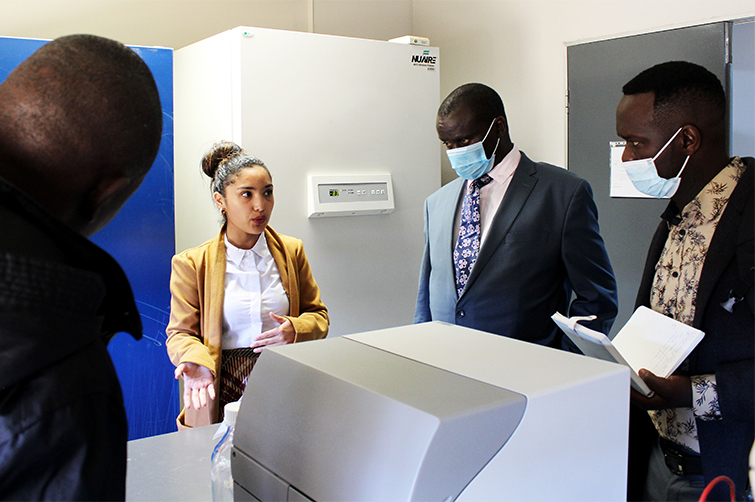
Recardia Schoeman, Scientific Officer in the Department of Pharmacology, gave Prof Paul Waako, Dr Samuel Baker Obakiro, and Dr Richard Oriko Owor from the Busitema University a tour of the department and its laboratories.

Prof Motlalepula Matsabisa, Director of Pharmacology at the University of the Free State (UFS), played host to academics from the Busitema University in Uganda for benchmarking on traditional medicine and to establish collaboration between the two institutions.

Prof Paul Waako, Vice-Chancellor of the Busitema University – who was part of the visiting party – and Prof Francis Petersen, UFS Rector and Vice-Chancellor, signed a collaboration agreement that enables the two institutions to work together and to get involved in the exchange of expertise as part of the collaboration.

Dr Samuel Baker Obakiro, Lecturer of Pharmacology and Therapeutics and Head of the Department of Pharmacology, and Dr Richard  Oriko Owor, a natural products chemist, accompanied Prof Waako on the visit to the UFS from 18 to 21 July, during which they undertook tours of various departments and laboratories, including Pharmacology, Virology, Chemistry, Genetics, Physics, Microbiology, and others. They also visited FARMOVS.


Establishing collaboration

Uganda – through their Ministry of Science, Technology, and Innovation – has a national drive to ensure that science contributes to socio-economic development through their major national agenda, which promotes local production, reduces importation, and increases exportation of goods. Dr Monica Musenero Masanza, Minister of Science, Technology, and Innovation, wants to ensure that the capacity of Ugandan scientists to conduct applied research will promote national development and reduce poverty.

Prof Waako said they came to the UFS to establish collaboration, as universities have an obligation to ensure that science improves the socio-economic situation in Africa. They would like to work with the UFS to ensure that science strengthens science in order to serve the people.

“Currently, one of the biggest challenges is the local manufacturing of pharmaceuticals, and that is why we came to the Department of Pharmacology. We need to come together as African universities and use all the existing capacities to transform the lives of our people.”

“African traditional medicine has a lot to offer, and a lot of research has been done, but we have not been able to take it to the level of final commercialisable products. This is the reason of us coming here, we want to create that link to ensure that the science – which has already been identified and established – is able to move to product production,” says Prof Waako.


At the right place

They decided to visit the UFS after meeting Prof Matsabisa during his visit to their country’s universities as part of the WHO team.

According to Dr Obakiro, when walking down the corridors of the department, they can see that they are in the right place. “We are also looking at mentorship, as our university is still very young. I am happy and privileged to be here. We cannot succeed on our journey if we do not stand on your shoulders.”

Dr Obakiro said they are also looking at how to set up partnerships between academia and industry, as well as collaboration between the different academic departments, such as pharmacology, chemistry, microbiology, and virology, and how these collaborative initiatives can be effective and efficient to drive their agenda.

In welcoming the colleagues from West Africa, Prof Matsabisa said, “Let’s find a way to crawl together and eventually run together. If you want to move into drug discovery and development, no single scientist can do it alone, it is a multidisciplinary approach. It is a team effort with a shared vision. We have some experience that we can share with you, but we are not perfect, and I think we can learn together.”

News Archive

UFS lecturer overcomes barriers to become world-class researcher
2016-09-05

Description: Dr Magteld Smith researcher and deaf awareness activist Tags: Dr Magteld Smith researcher and deaf awareness activist

Dr Magteld Smith researcher and deaf awareness
activist, from the Department of Otorhinolaryngology
at the UFS.
Photo: Nonsindiso Qwabe

Renowned author and disability activist Helen Keller once said the problems that come with being deaf are deeper and more far-reaching than any other physical disability, as it means the loss of the human body’s most vital organ, sound.

Dr Magteld Smith, researcher at the Department of Otorhinolaryngology (Ear, Nose and Throat) at the University of the Free State, said hearing loss of any degree can have psychological and sociological implications which may impair the day-to-day functioning of an individual, as well as preventing the person from reaching full potential. That is why Smith is making it her mission to bring about change in the stigmatisation surrounding deafness.

Beating the odds
Smith was born with bilateral (both ears) severe hearing loss, which escalated to profound deafness. But she has never allowed it to hinder her quality of life. She matriculated from a school for the deaf in 1985. In 2008 she received a cochlear implant   a device that replaces the functioning of the damaged inner ear by providing a sense of sound to the deaf person   which she believes transformed her life. Today, she is the first deaf South African to possess two masters degrees and a PhD.

She is able to communicate using spoken language in combination with her cochlear implant, lip-reading and facial expressions. She is also the first and only deaf person in the world to have beaten the odds to become an expert researcher in various fields of deafness and hearing loss, working in an Otorhinolaryngology department.

Advocating for a greater quality of life
An advocate for persons with deafness, Smith conducted research together with other experts around the world which illustrated that cochlear implantation and deaf education were cost-effective in Sub-Saharan Africa. The cost-effectiveness of paediatric cochlear implantation has been well-established in developed countries; but is unknown in low resource settings.

However, with severe-to-profound hearing loss five times higher in low and middle-income countries, the research emphasises the need for the development of cost-effective management strategies in these settings.

This research is one of a kind in that it states the quality of life and academic achievements people born with deafness have when they use spoken language and sign language as a mode of communication is far greater than those who only use sign language without any lip-reading.

Deafness is not the end

What drives Smith is the knowledge that deaf culture is broad and wide. People with disabilities have their own talents and skills. All they need is the support to steer them in the right direction. She believes that with the technological advancements that have been made in the world, deaf people also have what it takes to be self-sufficient world-changers and make a lasting contribution to humanity.

We use cookies to make interactions with our websites and services easy and meaningful. To better understand how they are used, read more about the UFS cookie policy. By continuing to use this site you are giving us your consent to do this.

Accept