Medical personnel at the Universitas Academic Hospital and the University of the Free State (UFS) in Bloemfontein became the first in Southern Africa to use Interstitial brachytherapy as a method for treating cervical cancer.
A multidisciplinary team, consisting of an anaesthetist, clinical oncologists, application specialists, medical physicists, radiation therapy radiographers and professional nurses, completed the first interstitial cervical cancer brachytherapy in Southern Africa at Universitas Academic Complex in June this year.
Prof Alicia Sherriff, Head of the UFS
Department of Oncology and a clinical oncologist, explained: “Brachytherapy is a method of internal radiation therapy, where a source of radiation is placed inside or near the cancer. This type of radiation travels only a short distance and makes it possible to deliver curative doses to the cancer while staying within the tolerance of the surrounding bladder, rectum, and small bowel.”
She further emphasised that intracavitary brachytherapy has been an essential component of the curative management of cervical cancer since 1938.
According to her, feasibility studies were published for the use of applicators that combine intracavitary and interstitial brachytherapy in 2006. In 2014 prospective clinical trials started reflecting on the clinical value to improve local control for the locally advanced cervical cancers with combining intracavitary and interstitial brachytherapy to get higher doses of radiation where the cancer has grown outside of the cervix. Interstitial brachytherapy where the applicators are placed into the tissue with cancer are also used in prostate and breast cancer.
Second-most common cancer in South African women
As per the
Catalan Institute of Oncology (ICO) and the
International Agency for Research on Cancer (IARC) information Centre on Human Papilloma Virus and cancer publication of March 2023, the current new diagnoses of cervical cancer annually in South Africa are 10,702 with 5,870 patients passing away annually due to cervical cancer. It is the second-most common cancer in women in South Africa and the most common among women between 15 and 44. Due to late/delayed presentation and diagnoses most cervical cancer patients seen have more advanced stages where the cancer has infiltrated outside of the cervix into the surrounding tissue.
“At the Universitas Academic Complex we have been approaching cervical brachytherapy with CT (Computer Tomography)-based image guidance for more than a decade already and the past five years we have been doing Adaptive CT-based image guided brachytherapy.
“This means that with each brachytherapy treatment the cancer and all the surrounding normal organs are delineated based on a new CT image to ensure that we consider how the cancer has shrunk from one brachytherapy to the next and to see how we can limit the dose to the surrounding organs but at the same time achieve the highest possible dose of radiation with each treatment,” says Prof Sherriff.
Planning to expand the use to other cancers
The intracavitary brachytherapy applicators which are used most frequently are placed within the cervix and uterus and deliver high doses there but cannot address the infiltration into the surrounding tissue adequately, she continued. “That is where these additional needles that are placed via the Venezia applicator into the surrounding tissue give the ability to also reach those areas with high-dose radiation while sparing the organs.”
Prof Sherriff explained that the interstitial brachytherapy does add additional time, expertise and logistical planning to the management and would not be utilised for all cervical cancer patients, but for those patients with locally advanced disease whose general health would support a more aggressive approach. The other academic training institutions are aiming to add interstitial brachytherapy to their platforms as well as at the UFS which is also planning to expand the use to other cancers.
Save more lives
The MEC for Health in the Free State province, Mathabo Leeto, has congratulated medical professionals on this groundbreaking medical intervention.
She said this breakthrough is in line with goals set by the United Nations in not only the provision of quality health services, but also and importantly, saving lives.
“This milestone is responsive to our targets for improvement of women’s health and reducing mortality. It is responsive also to Goal 3 of the United Nations’ Sustainable Development Goals which seeks to reduce global maternal mortality ratio, ensure universal access to sexual and reproductive health-care services, including for family planning, information and education, and the integration of reproductive health into national strategies and programmes,” she said.
“Hopefully this breakthrough will help us save many more lives. I wish to congratulate everyone who contributed to this innovative way of cancer treatment and assure you that your province and the people are indebted to you,” concluded Leeto.
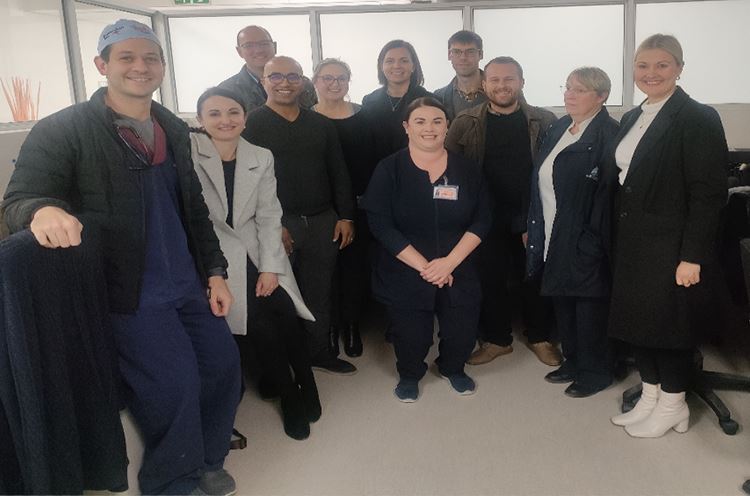
The medical staff who were involved in the first interstitial cervical cancer brachytherapy in Southern Africa were, from left: Dr Marnus Booyens (Anaesthetist); Dr Karin Vorster (Head Clinical unit and Clinical Oncologist); Dr Willie Shaw (Head of Medical Physics for the division of Radiation Oncology); Khalil Ben Fredj (Application Specialist ELEKTA for the TIMEA region and medical physicist); Prof Alicia Sherriff (HOD Oncology and clinical oncologist); Dr Dedri O’Reilly(medical physicist); Chantel Stroebel (Radiation therapy radiographer at brachytherapy); Dr Lourens Strauss (Medical physicist); Karl Sachse (Medical physicist); Sr Angelique Engelbrecht (professional nurse); Marga Claassen (Clinical and Commercial Account Specialist, SA for Elekta and Medical physicist).