Latest News Archive
Please select Category, Year, and then Month to display items
31 August 2026
|
Story Rorisang Rampheteng
|
Photo Kaleidoscope
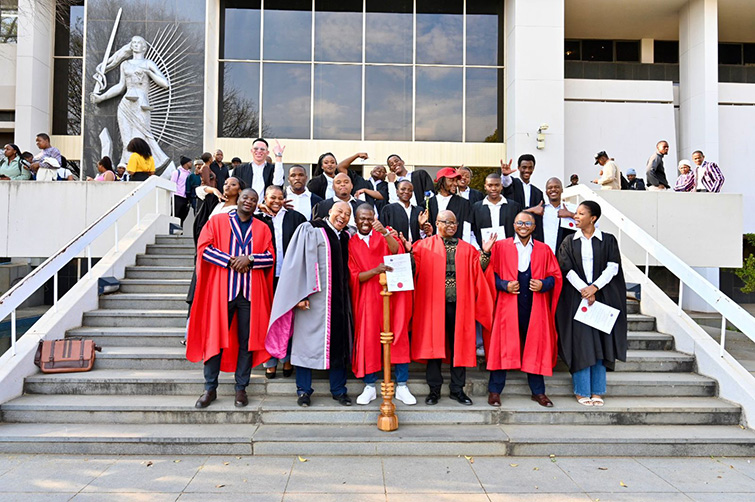 The newly elected 2026/2027 Student Representative Council (SRC) of the University of the Free State, pictured outside the Equitas Building on the Bloemfontein Campus following their official swearing-in ceremony.
The University of the Free State (UFS) this week inaugurated its newly elected Campus Student Representative Council (CSRC) leadership for the 2026/2027 term, following student elections held across the Bloemfontein, South, and Qwaqwa Campuses.
The newly elected student leaders now take up their portfolios with a responsibility to represent their fellow students and engage on matters affecting the student community, including student governance, policy and transformation, commuter student representation, and student media and dialogue.
For the new leadership, the term begins with a clear focus on listening to students, responding to their concerns, and strengthening the role of student representation in university life.
Bloemfontein Campus elects new leadership
On the Bloemfontein Campus, Vukona Baloyi has been elected President, with Kingsley Alagbaoso serving as Deputy President. Busisiwe Nkaletshane will serve as Secretary, while Nyiko Mahlaola has been elected Deputy Secretary.
Gaogakwe Fandie takes up the Treasurer portfolio, while Avumile Gatyeni will serve in Policy and Transformation. Relebohile Sibanyone has been elected to represent Commuter Students.
Baloyi said the new leadership would prioritise challenges affecting students, particularly accommodation and access for missing-middle students. “The main issue is accommodation, especially off-campus – in fact, even on-campus – but mostly off-campus,” said Baloyi.
He identified the standardisation of contracts for private student accommodation as one of the key issues the CSRC intends to address. “We need a mechanism where the institution can hold these private accommodations accountable,” he said.
Baloyi said students continue to face challenges relating to deposits, electricity charges, and additional fees, adding that the CSRC would advocate for measures to protect students from what he described as exploitative accommodation arrangements.
South Campus welcomes new student leaders
On the South Campus, Esona Radebe has been elected President, with Lesenyeho Moeketsi as Deputy President. Reanetse Serai will serve as Secretary, while Neo Mohlomi takes up the Deputy Secretary portfolio.
Tshepiso Mekhoe has been elected Treasurer, with Siphesihle Lusenga serving in Policy and Transformation. Olebogeng Mogotsi will represent Commuter Students, while Nompumelo Mlangeni has been elected to the Student Media and Dialogue portfolio.
Qwaqwa Campus elects new student leadership
On the Qwaqwa Campus, Langa Happy has been elected President, with Sathekge Mokgadi serving as Deputy President. Mabizela Nombulelo will serve as Secretary, while Mokheseng Kutlwano has been elected Deputy Secretary.
Ndumo Mzondeki takes up the Treasurer portfolio, while Mokhampanyane Tlaleng will serve in Policy and Transformation. Khanyeza Sabelo has been elected to represent Commuter Students, with Nkonyane Sinenhlanhla taking up the Student Media and Dialogue portfolio.
Student elections provide a democratic voice
The inauguration follows an election process that Prof Sethulego Matebesi, Chairperson of the Electoral Logistics Committee, described as challenging, but marked by increased student participation.
Comparing this year's elections to previous ones, Prof Matebesi said the process took place against a broader national backdrop of heightened political activity ahead of local government elections. “We have seen some increments and that is what we are looking forward to,” he noted.
He said the election process has moved from paper-based nominations to a digital nomination process, while pre-election briefing sessions were held to educate students about the electoral process. “We have steadily moved from a paper-based nomination to a digital nomination process, and we did pre-election briefing sessions to educate all students and take the students along.”
Prof Matebesi said there has been a significant increase in self-nominations and a slight increase in voter turnout.
He emphasised that the outcome of the elections represented the choice of students. “The outcome of the elections is the will of the students of the University of the Free State and not of management, not of the ELC, and not of anybody else, but it’s the will of the students,” remarked Prof Matebesi. “The students have spoken, and we need to respect that.”
Student representation and governance
Dr Temba Hlasho, Executive Director: Student Affairs, Sport, Arts and Culture, said student elections are important because they provide students with a democratic voice and establish a representative body through which student concerns can be communicated to university management. “Student elections are important in the sense that, under democracy, you need a voice from students,” said Dr Hlasho.
He said an elected SRC provides credibility when management engages with students on issues affecting them. “When management wants to have conversations or negotiations around issues that affect students, they need a credible body. A body that is elected by the students.”
According to Dr Hlasho, the university is also preparing for a review of the ISRC Constitution, with the process expected to address concerns raised during this year's elections. “What needs to be improved is the constitution itself.”
He said executive management has already approved the review process and that a schedule has been submitted for approval. “We are hoping to finish the review by June so that the 2027 elections will be run on the reviewed constitution.”
Dr Hlasho added that students would play an important role in reviewing the constitution. “So, all the concerns that were raised by students this year – the same students must review the constitution and change it, because the university management cannot do it for them.”