Latest News Archive
Please select Category, Year, and then Month to display items
10 November 2026
|
Story Chrystal Francis
|
Photo Supplied
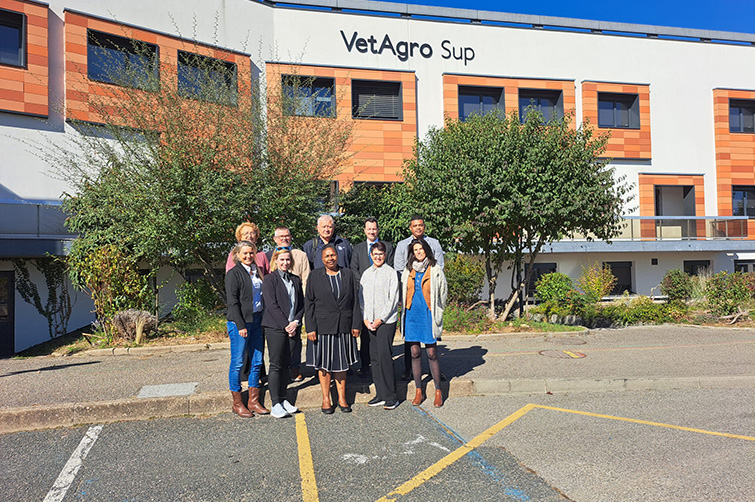 Prof Johan van Niekerk, Nico Janse van Rensburg, Dr Mireille Bossy, Cédric Colmar, Margaux Meysonnet, Dr Claudia Cordel, Elfrieda van den Berg, Prof Bulelwa Nguza-Mduba, Dr Lindie von Maltitz, and Christopher de Jongh.
A delegation from the University of the Free State (UFS), led by Prof Bulelwa Nguza-Mduba, Deputy Vice-Chancellor: People and Operations, recently visited institutions in France to gain practical insights that could help shape the University's planned Veterinary Academic Hospital in Bloemfontein. The visit also opened discussions on potential international research collaboration to strengthen South Africa's response to livestock diseases.
The visit took place at the invitation of Vincent Abt, French Agricultural and Food Counsellor for Southern Africa, and was facilitated by the University's Land, Enterprise and Agricultural Futures (LEAF) initiative. Engagements with VetAgro Sup, a French veterinary institution with roots dating back to 1761, provided an opportunity to learn from established approaches to veterinary education and clinical training.
Prof Hester C. Klopper, Vice-Chancellor and Principal of the UFS, previously emphasised that the establishment of a veterinary science programme reflects the University's commitment to transdisciplinary research and addressing national priorities through innovation in higher education. The programme responds to South Africa's pressing need for more veterinary professionals – a shortage that poses risks to food security, animal welfare, public health, and agricultural productivity.
According to a statement published by the Western Cape Government on 28 February 2023, titled South Africa bleeding veterinarians, South Africa had approximately 60 to 70 veterinarians per million people, compared with an international norm of 200 to 400. These figures underscore the importance of expanding veterinary education and training opportunities.
“The opportunity for the UFS is not simply to produce veterinarians, but to develop graduates and partnerships that contribute to the well-being of communities, the sustainability of agriculture, and the resilience of our national animal health systems,” said Prof Bulelwa Nguza-Mduba, Deputy Vice-Chancellor: People and Operations.
Hospital visit informs clinical training plans
A seven-member UFS delegation visited France from 7 to 13 October 2026 to explore partnerships in veterinary education and research. VetAgro Sup's teaching hospital offered UFS Estates representatives Nico Janse van Rensburg and Christopher de Jongh an opportunity to examine the layout of clinical facilities and the movement of patients through the hospital. Their observations provide a practical reference for planning the UFS Veterinary Academic Hospital on the South Campus.
The proposed hospital would provide supervised clinical training and offer veterinary services to surrounding communities, while students at the nearby Paradys Experimental Farm could also gain experience with livestock production systems, preparing them for practice in South African agricultural conditions.
Discussions at VetAgro Sup also considered postgraduate supervision and academic staff exchanges. Joint research is another possibility, as are student exchanges once the UFS school becomes operational.
Research grounded in the Free State
Foot-and-mouth disease demonstrates the economic consequences of livestock disease outbreaks. Updated modelling by the Bureau for Food and Agricultural Policy, reported in October 2026, estimates that the outbreak crisis could reduce the South African red meat industry's gross production value by R21,1 billion between 2025 and 2035 against a pre-outbreak baseline.
According to the Free State Department of Agriculture, 804 cases had been confirmed by 26 October 2026. Of these, 787 were resolved, while 17 affected properties remained under quarantine.
Prof Johan van Niekerk, Vice-Dean: Agriculture in the Faculty of Natural and Agricultural Sciences, identified disease management as a potential research focus, and joint investigations could examine earlier detection and the spread of infections through livestock populations.
The potential partnership offers opportunities for both the UFS and its French counterparts to draw on their respective research strengths. The UFS could contribute its understanding of Free State livestock production, while French specialists bring complementary veterinary expertise. Beyond joint research into shared animal health challenges, the relationship could create opportunities for student exchanges and closer industry collaboration, benefiting both institutions while supporting South Africa's veterinary training and agricultural research needs.
Industry engagement and next steps
The delegation attended the Sommet de l'Élevage livestock exhibition in Clermont-Ferrand, gaining exposure to developments in livestock production. Meetings with Boehringer Ingelheim and the Montpellier-based veterinary diagnostics company IDVet explored how industry expertise might complement academic research, especially as it relates to disease surveillance and diagnostics.
“LEAF opens doors for international veterinary and agricultural collaboration, and this visit is an example of how we aim to translate international engagement into practical opportunities for collaborative research, education, and innovation,” said Dr Lindie von Maltitz, LEAF Manager and Senior Lecturer in Agricultural Economics.
The planned reciprocal visit by Abt and representatives of VetAgro Sup will provide an opportunity to identify where the institutions' research priorities align. For the UFS, the next step is to establish whether these shared interests can develop into collaborative research and training opportunities that contribute to veterinary education and address the needs of South African livestock producers.