Latest News Archive
Please select Category, Year, and then Month to display items
07 October 2026
|
Story Vuyelwa Mbebe
|
Photo Born2Shoot
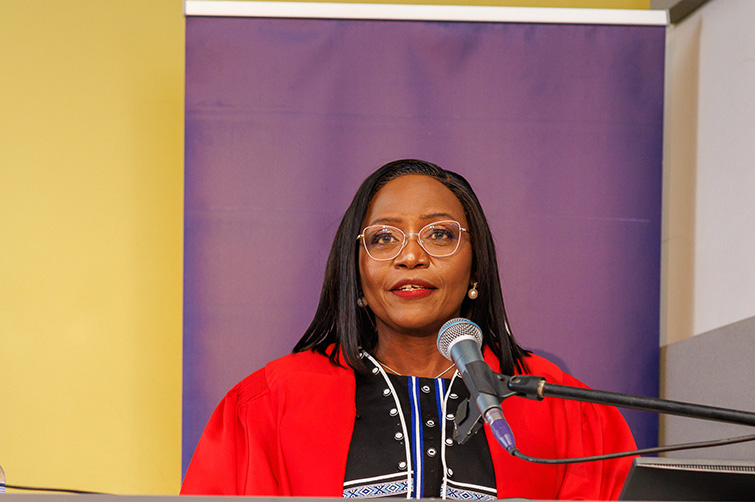 Prof Thuthukile Jita delivered her Inaugural Lecture at the Education Building Auditorium on Thursday 1 October 2026.
South Africa must move beyond simply connecting learners and teachers to technology – by embracing meaningful digital transformation that enables an equitable, resilient, and socially just education system.
This was one of the key messages contained in the Inaugural Lecture by Prof Thuthukile Jita, Head of the Department of Curriculum Studies and Higher Education in the University of the Free State’s (UFS) Faculty of Education, following her promotion to full Professor.
Speaking at the UFS Bloemfontein Campus on 1 October 2026, Prof Jita reflected on her personal and scholarly journey in a lecture titled ‘Beyond the Digital Divide: Reimagining Curriculum and Teacher Education for a Digital South Africa’.
She encouraged her audience to consider the question ‘What does it truly mean to bridge the digital divide in South Africa?’
For Prof Jita, the answer goes far beyond providing devices and connectivity. It is about people, what teachers know, what they believe is possible, and what the education system enables every learner to do.
She also reflected on a research journey shaped by her experiences as a teacher in rural and township schools. Growing up and attending schools in Umlazi and Umzimkhulu in KwaZulu-Natal, she saw first-hand how education could open possibilities, while unequal access to resources could constrain them. Later, as a teacher, she encountered classrooms with fewer textbooks, laboratories, and technological resources.
These experiences prompted questions that would eventually become a sustained research programme focused on the question ‘How can technology contribute to meaningful learning when access to resources remains unequal?’
From access to agency
Prof Jita’s research initially examined whether pre-service teachers had the competence to use information and communication technology (ICT) in teaching. Over time, however, the question evolved.
“Having technology does not necessarily mean knowing what to do with it. Likewise, digital competence does not automatically translate into meaningful classroom practice,” she said.
Her research therefore moved from access to capability, opportunity and, ultimately, agency – asking not only what teachers can do, but what they choose to do and what their educational contexts allow them to do. “The digital divide should not be solved by providing technology; the digital divide should be bridged by expanding possibilities brought by the technology,” she argued.
Her work on infrastructure and inequality similarly highlights that digital exclusion has multiple dimensions, including motivational, material skills, and usage access.
Building digital resilience
The COVID-19 pandemic brought these inequalities into sharp focus. Teachers improvised, shared data, and used platforms such as WhatsApp to keep learning going.
But Prof Jita distinguishes emergency digital learning from digital resilience. She said emergency learning is about surviving disruption, while digital resilience is the ability of educators, institutions, and systems to anticipate disruption, adapt, sustain learning, and recover.
“We cannot build resilience while we are already in the middle of a crisis,” she said.
Designing for inclusion
Prof Jita’s current research increasingly asks how digital education can be designed so that it does not reproduce existing inequalities.
Her work on virtual laboratories, for example, explores whether technology can expand opportunities for learners in schools where physical laboratory resources are limited. The aim is not simply to put existing practices on a screen but to create new possibilities for learning. “Inclusion is not a feature you add at the end; it is the design brief from the start,” she said.
For Prof Jita, the way forward rests on four interconnected priorities: access, equity, resilience, and transformation. “A digitally advanced education system must also be a socially just education system. Advancement without justice is simply a faster way of reproducing the divide.”
Ultimately, her message is clear: connecting people is only the start. The real work lies in creating the conditions for teachers and learners to turn digital access into meaningful educational opportunities.