Latest News Archive
Please select Category, Year, and then Month to display items
02 September 2026
|
Story Lunga Luthuli
|
Photo Lunga Luthuli
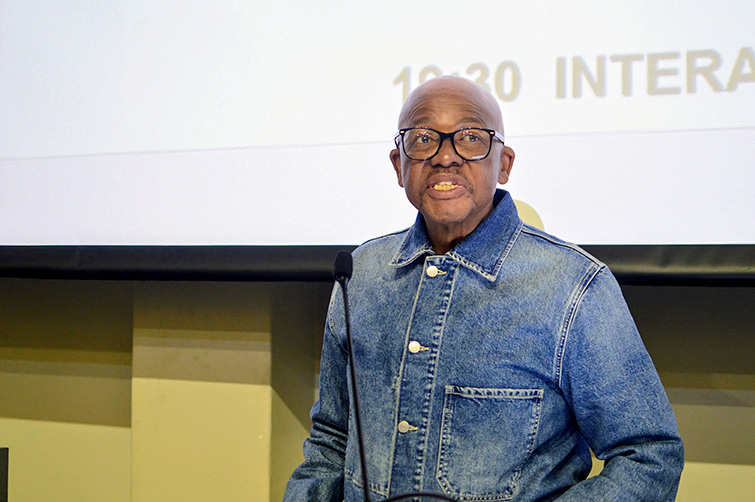 Dr Martin Mandew, former Qwaqwa Campus Principal, speaks at the 2026 UFS Division of Student Affairs, Sports, Arts and Culture Lecture, themed ‘Beyond the Classroom: Reimagining Student Success in an Era of Rapid Change.’
The future of work will demand more from university graduates than academic qualifications alone, and students need to develop the ability to adapt, learn continuously, and remain distinctly human in an increasingly AI-driven world.
This was the central message from Dr Martin Mandew, former University of the Free State (UFS) Qwaqwa Campus Principal, who delivered the Division of Student Affairs, Sports, Arts and Culture Lecture at the Qwaqwa Campus on 27 August 2026. Held annually, the 2026 lecture, titled ‘Beyond the Classroom: Reimagining Student Success in an Era of Rapid Change’, explored what it means for students to succeed beyond obtaining a qualification.
Preparing graduates for a rapidly changing world
Dr Mandew argued that rapid technological change, particularly the rise of artificial intelligence, is fundamentally reshaping workplaces, industries, and the skills graduates need to remain relevant. While some routine jobs are already disappearing or becoming vulnerable to automation, new occupations are emerging in areas such as sustainability, digital culture, renewable energy, and AI ethics.
He challenged students to think of university as more than a place where academic knowledge is acquired.
“Being at university is being immersed in a cauldron of knowledge,” Dr Mandew said, describing universities as both repositories of existing knowledge and places where new knowledge is constructed. He emphasised that this environment should be a space for transformation, where different ideas, cultures, and influences come together.
For Dr Mandew, going beyond the classroom means deliberately using the broader university experience to develop the attributes needed to navigate an uncertain future. This includes participating in clubs and societies, multidisciplinary projects, community engagement, leadership opportunities, and activities that encourage critical and ethical thinking.
Putting people at the centre of technology
He said these experiences are particularly important as the world moves from Industry 4.0 towards Industry 5.0 – an emerging model that places greater emphasis on human-centred collaboration between people and technology.
“Industry 5.0 stresses human and machine,” Dr Mandew said, explaining that the emerging paradigm seeks to place the human at the centre amid the growing predominance of AI. It emphasises human-centricity, sustainability, and the reinsertion of human values into AI-driven workplaces.
In this environment, technical competence remains important but graduates will increasingly need conceptual, technological, and human skills. Dr Mandew highlighted resilience, adaptability, creativity, lifelong learning, and ethical reasoning alongside the ability to navigate complex digital environments, engage in interdisciplinary problem-solving, and respond rapidly to technological change.
He urged students to develop curiosity about major global developments, including artificial intelligence, climate change, sustainability, renewable energy, geopolitical tensions, Agenda 2063, and the African Continental Free Trade Area. “Student success means nurturing a deep sense of curiosity on these and other markers that will emerge in the not-too-distant future,” he said.
Defining student success
Dr Mandew challenged students to see graduation not as the end of learning, but as evidence that they are equipped to continue learning and adapting. “Student success in an era of rapid change also means the ability to teach yourself anything on the fly. It is about the ability to re-invent yourself,” he concluded.
Qwaqwa Campus Principal
Prof Prince Ngobeni said the lecture is a reminder that student success cannot only be measured by marks, throughput, or graduation. “Success must also be about whether we have helped students develop the confidence, resilience, skills, values, and sense of purpose to make a meaningful contribution – wherever life takes them,” he said.
The lecture reinforced the importance of the university experience in preparing graduates not only for their first job, but for a world in which careers, technologies, and societal challenges will continue to evolve.